
Industry Insights
The Curious Case of Gather AI: How Physical AI is Transforming Inventory
“I can't describe why,” says Sankalp Arora. “I was just always super interested in making robots.” It’s a familiar enough sentiment, surely, among our readership. What makes his expression unique, however, is where it ultimately landed him. Back home in India, Arora lacked both the financial and educational means to capitalize on interest. Talent, perseverance, and a well-connected benefactor helped the nascent roboticist transform ambitions into his life’s work.
A few successful projects put him on the radar of Sanjiv Singh, a professor of mechanical engineering at CMU’s Robotics Institute. A loan from Arora’s father paid for a one-way ticket to Pittsburgh, for an unpaid internship at the school. “[Singh] liked my work enough that he offered to fund my master’s and PhD. So that's how I got my education. I’m really, really fortunate. Really thankful for that.”
Among the projects Arora worked on during his CMU days was an autonomous helicopter, on-going research that formed the foundation of Near-Earth Autonomy, a startup cofounded by Singh in 2012 that has done key contract work for the U.S. military. Six years later, Arora founded Gather AI with fellow CMU grads, Daniel Maturana and Geetesh Dubey. In 2023, Kiva systems engineer, Andrew Hoffman, signed on as cofounder and CTO.
Gather AI was founded on the principles behind Arora’s PhD — a bid to make robots “curious,” which he defines as “an attempt to reduce uncertainty of what you think about the world. That's what our robots are doing actively capturing data to reduce uncertainty of the warehouse environment. That's how mathematically curiosity is made.”
Before spinning the work into a standalone startup, the team that would become gather surveyed industries in hopes of finding a profitable fit for the technology. “We knew we had the hammer of curious robots,” says Arora. “We were looking for the nail. We approached it in a very scientific fashion of doing customer studies. And before spinning out, did about 175 customer interviews.”
The team landed on warehouse inventory as a first application for its work in robot curiosity. “We leveraged the concepts we learned [at CMU], but the tech stack emerged completely new,” says Arora. “One of the things that our robot does is it actively looks around to find feature-rich areas to reduce its own uncertainty. The other thing it does is if you tell it to count partial panels, it will figure out the needs to take images from multiple angles to reduce uncertainty in how many boxes are there.”
Certified System Integrator Program
Set Yourself at the Forefront of the Global Vision Market
.jpg) Vision system integrators certified by A3 are acknowledged globally throughout the industry as an elite group of accomplished, highly skilled and trusted professionals. You’ll be able to leverage your certification to enhance your competitiveness and expand your opportunities.
Vision system integrators certified by A3 are acknowledged globally throughout the industry as an elite group of accomplished, highly skilled and trusted professionals. You’ll be able to leverage your certification to enhance your competitiveness and expand your opportunities.
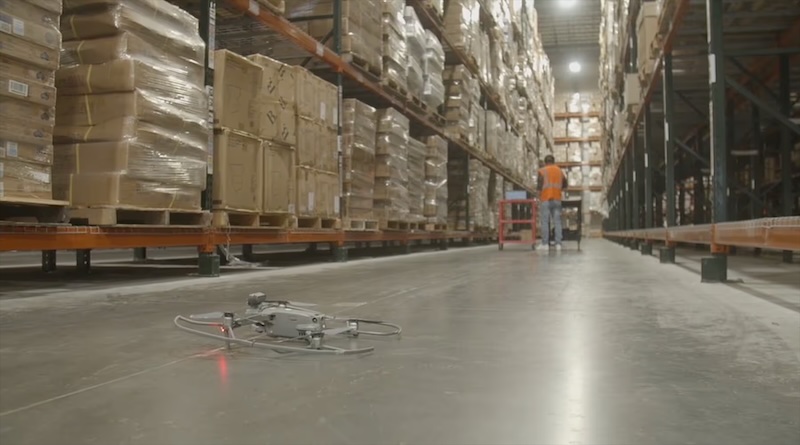
Gather’s offering began with drones. Tracking warehouse inventory using small quadcopters isn’t a wholly new concept, though unlike Verity or Corvus, for example, Gather relies on off-the-shelf hardware to do the job. “You don't need to make robots to have effective data gatherers because commercially available hardware, even consumer-grade hardware is good,” says the CEO.
The company initially relied on DJI systems, though its offerings have expanded as that company has come under government scrutiny outside of China. Here in the States, Gather has also begun to work with Qualcomm spinoff, ModalAI. The design has allowed flexibility not only between brands, but across form factors.
“It took us three years to make the tech stack that can work on a drone that you can buy out of Best Buy or can work on a moving camera on a phone,” says Arora. “Now it has turned out to be our mode because we get so much capital efficiency out of it. And we can focus on the part that the customers care about. They don't care about the drone or the camera on the phone. They care about the data. And we can focus about getting them the most out of that data.”
A vist to Gather’s booth at Modex last week points at how the company has expanded beyond its initial drone focus. A forklift occupied a good portion of its paid floorspace. Leveraging cameras mounted to existing pieces of warehouse equipment affords the company the ability to expand well beyond inventory tracking.
“When you're not looking around for things in the warehouse, the number of orders you're fulfilling also increases,” says Arora. “That's just to start with. That's it just with static inventory. With forklift, we're capturing workflows. How quickly was a truck unloaded? How quickly was put away happening? Which drivers need more training? Which vendors are shipping more damaged products, stopping goods to be mis-shipped on wrong truck? We've suddenly moved from inventory data to work flow data, especially for pallet-in, pallet-out warehouses. They turn into Amazon Go stores because they don't need to scan anymore. That digitizes their full operations and they can really tap the power of data analytics.”
Association for Advancing Automation
Discover how Association for Advancing Automation can support your automation journey with their complete range of solutions and expertise.
Visit Company Website


