
Cervoz Technology Co., Ltd Product

Member Since 2025
Cervoz delivers industrial-grade SSDs, DRAM, and expansion cards with strict BOM control, original ICs, and long-term supply stability. Our solutions meet mission-critical demands in automation, embedded systems, military, and transportation industries.
Product filed under:
Industrial Industrial
Compact embedded systems are becoming smaller, while storage requirements continue to grow. Applications such as embedded computing, medical computers, self-service kiosks, and service robots need reliable local storage for operating systems, data, logs, updates, and system files.
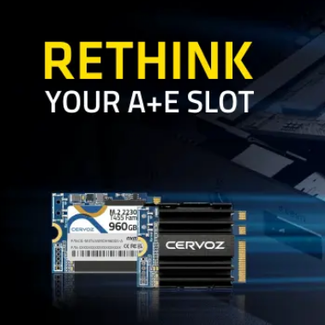
However, when system space is limited, adding storage is often not as simple as installing another SSD. Designers may face limited PCB space, low-profile enclosures, and a lack of available M-Key storage slots.
When Your Space and Interfaces Are Limited
M.2 A+E Key slots are often used for Wi-Fi, Bluetooth or other PCIe-based expansion modules. In some embedded system designs, A+E Key slot may be unused or available for alternative configuration. For applications that require additional storage but cannot accommodate larger SSDs, the M.2 2230 A+E Key form factor provides a practical way to increase storage capacity within a limited footprint. By utilizing an available A+E Key slot, system designers can expand local storage without increasing system size.
M.2 2230 A+E Key: Compact Size, More Storage
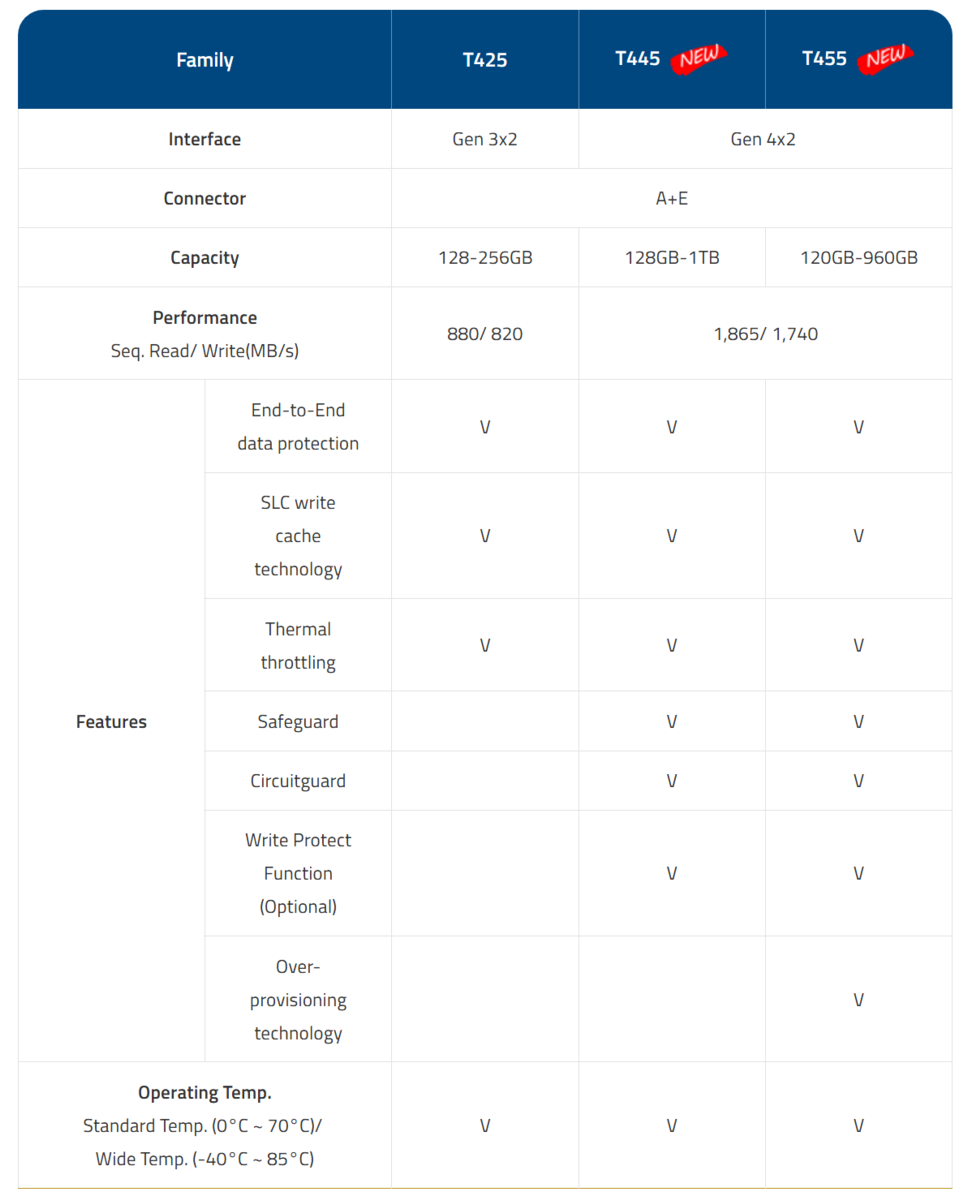
The Cervoz T445 and T455 M.2 2230 A+E Key SSDs are designed to deliver PCIe Gen4x2 NVMe storage in an ultra-compact form factor. The series provides high-speed storage expansion for space-constrained embedded and industrial applications.
%20SSD_3.png)
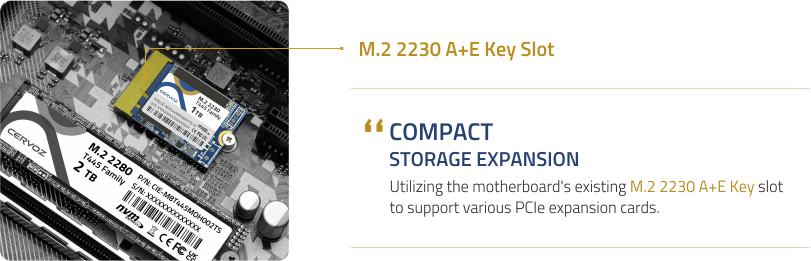
Both the T445 and T455 adopt 3D TLC NAND flash and support the PCIe Gen4x2 interface, delivering sequential read speeds of up to 1,865 MB/s and write speeds of 1,740 MB/s. With the compact M.2 2230 A+E Key design, the series helps system designers make better use of available board interfaces while maintaining a small system layout.
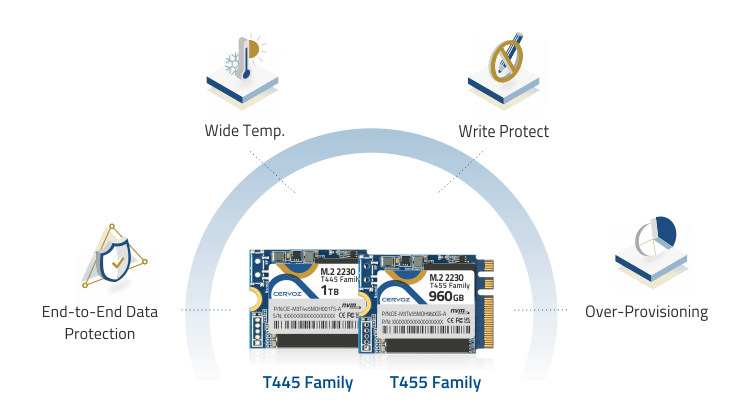
Key advantages of the T445/T455 series include:
-
M.2 2230 A+E Key form factor for compact system layouts
-
PCIe Gen4x2 NVMe performance for faster data access
-
Capacity of T445 up to 1TB and T455 up to 960GB (with Over-provisioning)
-
Standard temperature and wide temperature support
-
End-to-End Data Protection for data integrity
-
Optional Write Protect function for enhanced data security
-
Industrial-grade technologies for long-term embedded deployment
Built for Space-Constrained Applications
The T445 and T455 M.2 2230 A+E Key SSDs are ideal for applications where system size, thermal design, and interface availability are critical considerations.
Embedded Computing
In embedded computing, they can be used in compact IPCs, fanless systems, and low-profile platforms.

Self-Service Kiosks
In self-service kiosks, they provide local storage for operating systems, applications, transaction logs, and media assets.

Service Robots
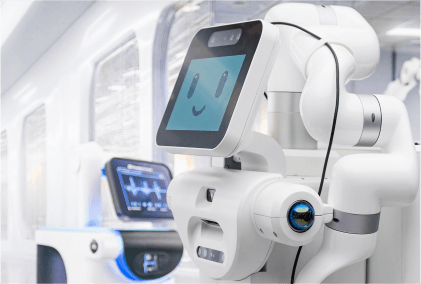
In service robots, they can support system boot, local data logging, AI model storage, and operation records.
Medical Computers
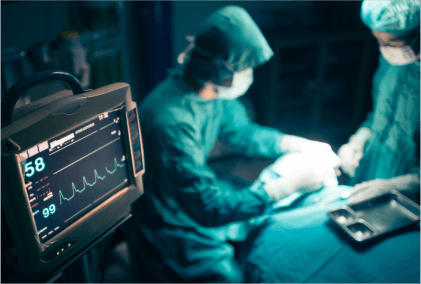
In medical computers, compact size and reliable storage are essential. They support storage needs for bedside terminals, nursing stations, and treatment center systems.
As embedded systems continue to become smaller and more integrated, storage expansion must balance capacity, performance, reliability, and space efficiency. The Cervoz T445 and T455 M.2 2230 A+E Key SSDs provide a compact PCIe Gen4x2 NVMe storage option for applications where every millimeter matters. Contact us now for more details about the products.
Cervoz M.2 2230 A+E Key SSDs
Read More
Other Products from Cervoz Technology Co., Ltd
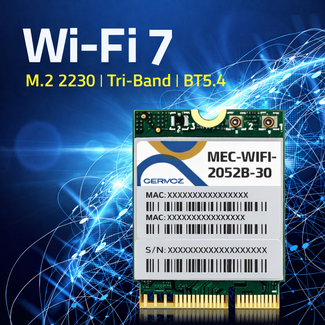
Future-Ready Wi-Fi 7 Module for Industrial Connectivity
In applications such as AGVs, industrial automation involving mobile or hard-to-wire settings, and Edge AI systems deployed across distributed locations
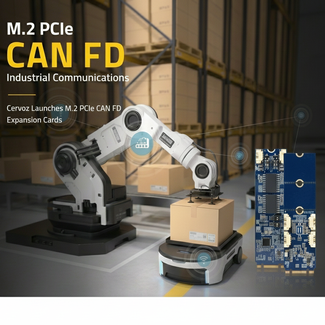
Cervoz Launches M.2 PCIe CAN FD Expansion Cards for Industrial Communications
As AGVs and AMRs evolve with smarter sensors and faster control loops, communication speed and reliability have become mission-critical.