
News
Synchronous Reluctance Motors Combined with High-performance Converters
 Nuremberg
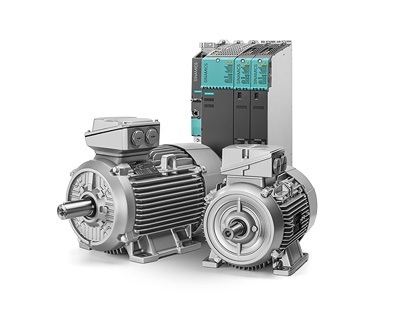
- Firmware V4.8 enables Sinamics S120 converters to operate with Simotics synchronous reluctance motors.
- For applications in general mechanical engineering such as winders, extruders and servo pumps
- Lower system costs and short pay-back time
The new firmware version 4.8 allows Sinamics S120 high-performance low-voltage converters to be combined with Simotics synchronous reluctance motors. This connection is ideally suited for drive solutions in which the dynamic response of induction motors is no longer sufficient but the high performance of permanently excited synchronous motors would be excessive. Typical applications include winders, extruders or servo pumps. Control has also been optimized in terms of efficiency for generator operation, opening up additional scope for other regenerative applications. The modular system comprising Sinamics S120 low-voltage converters and Simotics synchronous reluctance motors enables customized high-performance machine concepts to be implemented with the utmost speed and flexibility in industrial machinery and plant engineering. The synchronous reluctance motors achieve this by offering optimized vector control, generator operation optimized in terms of energy efficiency and dynamic response, as well as safety features and technology functions. Profibus and Profinet interfaces enable integration into the Totally Integrated Automation landscape.
Lower system costs and short pay-back time: Firmware V4.8 enables Sinamics S120 converters to operate with Simotics synchronous reluctance motors.
The system costs for reluctance motors are lower than is the case with permanently excited synchronous or induction motors. In the part-load range, for instance, a drive system with reluctance motor is far more favorable in terms of energy usage than an induction motor. This enables a return on investment for high-performance low-voltage converters and reluctance motors to be achieved in less than twelve months. Reluctance motors offer a substantially higher efficiency level in the part-load range compared to induction motors with the same output. The synchronous principle means that the speed remains constant, and a sensorless vector control ensures optimum operating behavior. Both features enhance the controllability of the drive train. Ramp-up times are short thanks to the motor's low inherent moment of inertia combined with optimized vector control. As regards torque jumps, the behavior is comparable to that of permanently excited synchronous motors, allowing rapid braking also in the event of safety-relevant applications.
Siemens Industry, Inc.
Siemens Industry, Inc. manufactures and markets one of the world's broadest ranges of electrical and electronic products. Its technologies include motion control, totally integrated automation solutions, industrial software, energy management, circuit protection and process control. The company also has expertise in system integration, technical services and turnkey industrial systems.
Discover how Siemens Industry, Inc. can support your automation journey with their complete range of solutions and expertise.
Visit Company Website


Siemens Industry, Inc. manufactures and markets one of the world's broadest ranges of electrical and electronic products. Its technologies include motion control, totally integrated automation solutions, industrial software, energy management, circuit protection and process control. The company also has expertise in system integration, technical services and turnkey industrial systems.
Siemens Launches the First Control System with Integrated Fieldbus Diagnostics
Siemens new Active Field Distributor Simatic AFDiSD which features extended fieldbus diagnostics offers fully integrated and extended fieldbus diagnostics.
Siemens New Package for Advanced Motion Control Applications Integrated in the Engineering Framework
Siemens launched a matched package for motion control applications on the market, comprising the Simatic Advanced Controller and the Sinamics...