
Industry Insights
Modern Automation: Integrating Robotics and Precision Motion
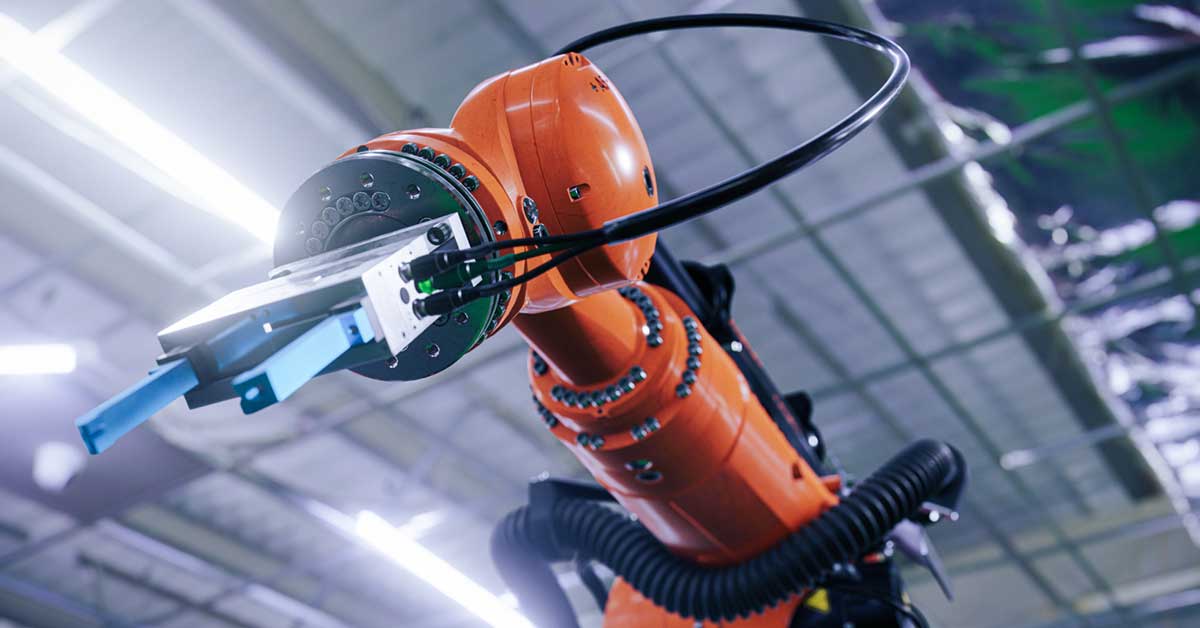
Manufacturers are being pulled in two directions at once. As skilled labor becomes constrained, manufacturers are also facing demands for more agile, high-throughput production. With millions of robots operating worldwide across applications and industries, precision robotic motion control has become a core production strategy.
“The industry is having to adapt by reshaping their processes,” describes Zarren Zafiro, regional sales engineer at LinMot. “Servo motion and robotics are becoming that much more instrumental when it comes to the general production line.” Deploying robotics with integrated servo motion combines their strengths within a single machine architecture. Robots provide flexible manipulation and spatial freedom, while servos provide deterministic, repeatable, high-speed linear or rotary motion.
Industrial robots excel at spatial manipulation tasks, performing complex multi-axis movements in three-dimensional space, like reaching around obstacles, dynamically orienting tools, and adapting to changing part positions. The deterministic motion of servo motors provides extremely repeatable positioning, high-speed indexing, and precise synchronization. The combination provides flexible robotic manipulation with the controlled motion of servo motors, enabling agile production process switching, reducing robot idle time, and optimizing energy use.
Increasingly, the line is blurring. Robots are being treated as coordinated motion subsystems, while servo motors have benefited from advanced path planning and adaptive behavior associated with robotics. More has changed with motion than just robot adoption; increasing automation complexity means motion control is more than a single indexing, positioning, or material-handling task; it has often become a coordinated dance, deconflicting material handling, robotics, AMRs, and human operators. Zarren expands, “Programming and integrating the machines are going to be one of the major reasons customers pick a specific solution. The simplicity of programming will be a necessity in the future.”
With this complexity, safety has become a broader design issue than “fence the robot.” The adoption of robotics at higher levels means more operators are working in and around automation than ever before. In industrial motion, the ability to design for this increasing complexity enables innovative solutions to application challenges.
High Precision Motion is More Accessible Than Ever
Historically, high-precision motion control was a costly niche technology for specific applications that required high precision for the process to function at all. Combining servo motor axes with robotics has enabled machine builders to integrate product transport, positioning, inspection, tooling, and manipulation into a coordinated system rather than a collection of isolated subsystems.
As motion-control technologies have become more standardized across industries, specifications have improved while costs have started to decrease. Zhiping Yu, assistant national sales manager, the Americas for SANMOTION by SANYO DENKI, explains, “Overall, we see motor and amp component pricing remain stable or even decreasing while the performance capabilities of amp and motors have increased. We now provide a servo motor with a 23-bit encoder resolution at lower cost than a similar legacy motor with a far less accurate 2000-line incremental encoder.”
Moving from isolated servo tasks to synchronized motion that works in conjunction with vision systems, robotics, and other components, system architectures have evolved to meet application-specific needs. Some applications benefit from unified architectures where PLC, motion, and robot kinematics expose standardized data and status to higher layers for orchestration, diagnostics, and asset management.
In other applications, a traditional split-controller architecture, separating robotic motion control from PLC and machine control, still makes the most sense. Zhiping expands, “Traditional split-controller architecture is still very relevant if there is a high level of simple I/O coordination. Compared to a PLC, motion controllers such as our S series product still do not have as high a number of available I/O points and expansion ports via EtherCAT. Remote I/O will still have a cost and performance impact. Unified architectures have great advantages in terms of their simplicity and ease of coordination.”
Certified Motion Control Professional Program
Strengthen Your Skills and Enhance Your Career
Become a Certified Motion Control Professional (CMCP) and join the elite group of system integrators, machine builders, manufacturers, end-users and others recognized in the industry for their professional knowledge and expertise.
Limitations may exist in regards to timing, latency and upgradeability, Zhiping shares. He cautions that there must be a holistic mindset when making any upgrades or improvements to account for how these changes may affect the larger process now that everything is more integrated.
Novel applications in combining servo motion and robotics are enabling automation and process agility. For instance, a servo-driven conveyor or gantry can extend a robot’s working envelope. In these systems, the robot handles dexterous movement while servo motion handles deterministic positioning or product presentation. This architecture is widely used in packaging, palletizing, and electronics assembly.
Another common use-case is dynamic product tracking. In these systems, servo-driven conveyors continuously move products while vision systems locate parts in real time and robots pick or process them without stopping the line.
As industrial machine designers incorporate robotics and motion into more solutions, and as component capabilities increase, it will become even easier to apply complex precision motion for automation. The challenges are safety, machine complexity, lifecycle management, and the availability of skill sets.
“High levels of integration come with potential issues in reliability and consistency.” Zhiping describes. “We are all still learning as IoT continues to grow. Not all applications require a supreme level of coordination and precision. At the end of the day, manufacturing is an endurance race. I see my car finishing the race as the first step.”
Latency or synchronization errors that are insignificant in standalone machines can create major quality or collision problems in tightly coordinated systems. This is why deterministic industrial Ethernet protocols such as EtherCAT, CIP Motion, PROFINET IRT, and Sercos have become increasingly important in advanced motion and robotics applications. Mature robotics and advanced motion control solutions have reduced commissioning time and costs, but broad adoption requires substantial in-house knowledge of motion, robotics, safety, networking, and IT and OT software.
To scale automation to meet growing demand, it will be necessary to understand and account for these challenges for long-term success. “Finding the people who can help in all categories of integrating motion and a robotic system will be a significant challenge,” Zarren details. “Workers that become a ‘jack of all trades’ are invaluable to companies, and they’ll rely on their knowledge in multiple platforms.”
The Future of Motion Control in an Automated World
Motion systems are integral to many of the automation technologies that are changing manufacturing, and the pace of new technology deployment has accelerated. Industrial decision-makers are looking to realize the potential of AI, expanded traditional automation, and new robotics technologies like AMRs that put robots on the shop floor interacting with human operators. IoT architectures, hardware, software, and safety standards all need to evolve alongside these new technologies.
As automation becomes essential to compete effectively, streamlined machine learning models operating at the edge have the potential to change how motion systems operate significantly. “Automation itself has become an essential production strategy for all our customers,” Zhiping shares. “Our products are on the EtherCAT industrial motion network. In the past 10 years, we’ve seen motion taking on more network and connectivity functions. From a motion architecture standpoint, I see it continuing to become decentralized while not paying as much penalty in terms of reduction in coordination as in the past.
Automation has moved from a strategic competitive advantage to an essential competitive requirement, and motion technology solutions are no longer judged only by raw speed or isolated precision. They are judged by how well they combine precision motion, adaptable handling, modular integration, safety, and data transparency into systems that can absorb labor pressure while supporting product variation and faster changeovers. From complex humanoid robotic motion control to traditional conveyor systems, precision motion control technologies are increasingly an essential component of modern automation deployments. By integrating deterministic motion with the flexibility of robotics, automation can be more efficient and operate effectively across more applications than ever.
Association for Advancing Automation
Discover how Association for Advancing Automation can support your automation journey with their complete range of solutions and expertise.
Visit Company Website



Weekly Bot Brief Newsletter on Robotics 12/27/2019
Despite the NASDAQ having crossed the 9,000 mark for the first time in history, neither the Bot Index nor the..
Neousys Launches Nuvo-11000 Series: Rugged, Fanless Computers with Intel® Core™ Ultra 200 Series for Enhanced AI Computing
Neousys announced the launch of its latest fanless embedded computers, the Nuvo-11000 series.
Epson to Showcase the Latest Robots for the Packaging Industry at Pack Expo
Epson Robots will be showcasing the latest 6-Axis and SCARA robots as well as its integrated parts feeding solutions