
Industry Insights
Going With the Flow: Tesla Eyes AMRs to Manage Materials
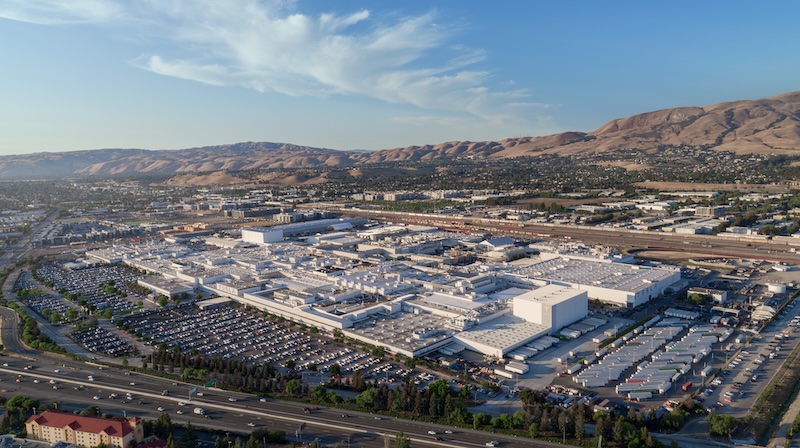
“Tesla has one of the most automated factories in the whole world,” Joshua Joseph told me recently, “and automating material workflow is [one of the final pieces] of the puzzle.”
The Tesla manufacturing engineering is leading the carmaker’s efforts to fill that final piece, transitioning factory floors from the more traditional AGV (autonomous guided vehicle) model to AMRs (autonomous mobile robots).
In a recent piece for Institute of Industrial and Systems Engineers, he positions material workflow as a kind of unseen productivity bottleneck, writing, “Every finished product carries a hidden footprint: the distance its components traveled before reaching assembly. That travel governs cycle time, space use, and safety exposure. Even in highly automated plants, 25% to 40% of production delays trace back to poor material delivery.”
Those numbers, in turn, are pulled from a report about the Toyota Production System (TPS), “a production system based on the philosophy of achieving the complete elimination of waste in pursuit of the most efficient methods.” The Japanese carmaker breaks this into two factors. The first is jidoka, which boils down to automation with humans-in-the-loop to help guard against edge cases and other long tail concerns.
The second factor, just-in-time, deals more directly with material workflow and is, “based on the concept of synchronizing production processes.” More specifically, it’s about ensuring that only the necessary amount of product is produced, and that customers receive orders in as timely a fashion as possible.
“The minimum number of parts needed are stocked in advance on the vehicle assembly line so that a car can be built as soon as the order is received,” Toyota writes of TPS. “The preceding process has a store of finished products from which the next process can pick up the parts that it needs. The preceding process is also stocked in advance with the minimum number of parts needed to re-make parts picked up by the next process before the next pick-up, allowing it to immediately replenish whatever was picked up. Having all processes engaged in this loop achieves wasteless production where we only make what is needed, when it is needed, and in the amount needed to fulfill customer orders and ensure that only sellable items are produced.”
Certified Motion Control Professional Program
Strengthen Your Skills and Enhance Your Career
Become a Certified Motion Control Professional (CMCP) and join the elite group of system integrators, machine builders, manufacturers, end-users and others recognized in the industry for their professional knowledge and expertise.
A fully automated workflow can go a long way toward both, synchronizing elements of the factory floor and collecting metrics to ensure product is being produced at optimal volumes.
AMRs, notably, encompass more than just the familiar Kiva-style warehouse robots in this breakdown. The list also includes automated versions of more traditional PIVs (powered industrial vehicles), including forklifts and tuggers. Leaning on existing form factors like these allows for a more brownfield approach to automation, introducing improvements to workflows with minimal disruption to output.
“Looking at the larger picture, 98.3 % of all American factories are brownfield factories at any point of time,” says Jones, “which means every AMR deployment in this country or throughout the world is going to be in a brownfield environment, which was not designed specifically for AMR.”
He adds that, for all its focus on automation, many of Tesla’s production facilities qualify as brownfield. “Tesla or a small-scale company, it's the same problems,” he adds.
It's just that maybe Tesla has the biggest factories in the world and we're dealing with the same problem like 100x or 500x.”
Jones believes that coordination and communication between the elements of these increasingly automated workflows will be the “next big thing.” Such processes will require a good deal of edge compute, coupled with peer-to-peer communication between robots. “In the next few years,” he adds, “we'll realize that the real winner of the AMR race will be the person who is able to integrate the most complex system in the simplest way.”
Association for Advancing Automation
Discover how Association for Advancing Automation can support your automation journey with their complete range of solutions and expertise.
Visit Company Website


Kelly Sickles to Head Finance at Market Leading Vecna Robotics
Kelly Sickles is the newest addition to the rapidly growing team at Vecna Robotics (Vecna).
Safety Equation Changes with AMRs
Autonomous mobile robots have evolved quickly, and safety guidelines are catching up.