
Industry Insights
Direct Edge, Hybrid Edge, and Cloud AI Boosts Manufacturing Efficiency
With artificial intelligence, including machine learning and deep learning in direct edge, hybrid edge, and the cloud, manufacturing, and automation processes become more productive, efficient, and cost-effective.
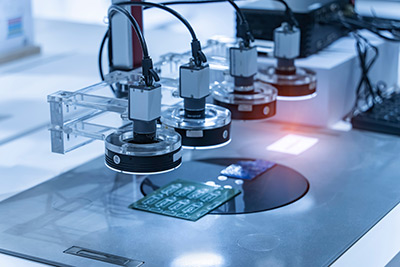 Understanding edge computing, hybrid edge computing, and cloud computing is critical in the rapidly evolving world of technology. While it seems that more companies are using hybrid edge-and-cloud — a combination of these new technologies — managing and processing data in the digital era requires an understanding of all three approaches as well as multi-cloud, hybrid-cloud, and multi-hybrid variants.
What is Edge Computing?
Edge computing is a distributed computing framework that brings enterprise applications closer to data sources such as IoT devices or local edge servers. In simpler terms, edge computing is the practice of capturing, processing, and analyzing data near where it is created. It’s like having an embedded processor or minicomputer at the source of data (like a security camera or a sensor) that can process data right there, instead of sending it all the way to a central server. This can deliver strong business benefits, including faster insights, improved response times, and better bandwidth availability.
What is Hybrid Edge Computing?
Hybrid edge (fog) computing is a combination of edge computing and hybrid cloud computing. This
decentralized computing approach can improve performance, reduce latency, and lessen the load on the cloud by handling some of the resource-intensive tasks locally. This approach can be particularly useful in scenarios where quick data analysis is needed or when only selected data needs to be sent to the cloud. It’s like having a minicomputer (edge computing) at the source of data that can process data right there, and having the flexibility to use both public and private clouds (hybrid cloud) based on specific needs.
What is Cloud Computing?
Cloud computing is the on-demand availability of computing resources (such as storage and infrastructure) as services over the internet. It’s like renting a super-powerful computer that’s located somewhere else and using the internet to access and use that computer. You only pay for what you use. This eliminates the need for individuals and businesses to manage physical resources themselves.
What is Multi-Cloud Computing?
As the word implies, multi-cloud computing involves the integration of multiple public cloud services from different vendors within the same architecture. For example, a business might use AWS for data storage, Google Cloud Platform for development and testing, and Microsoft Azure for disaster recovery.
What is Hybrid Cloud Computing?
Combining a public cloud with a private cloud is called hybrid cloud computing. In hybrid cloud scenarios, public cloud services are used in conjunction with private cloud services and on-premises infrastructure. While hybrid cloud deployments and architectures are not one-size-fits-all, a hybrid cloud combines a public cloud with a private cloud that is run on-premises or at the edge.
What is Multi-Hybrid Cloud?
The term multi-hybrid cloud describes a hybrid cloud that combines more than one public cloud service with a private cloud. Multi-hybrid cloud is emerging as a new trend which integrates edge, cloud, and hybrid cloud approaches across multiple cloud providers ensuring the best AI edge deployment for the use case and environment. The tradeoff for this flexibility is a strong reliance on containers and orchestration tools to address the need for portability and a consistent environment for encapsulation of AI workloads.
AI Vision Systems
The evolution of AI vision systems and multi-hybrid cloud computing are intertwined, each propelling the other towards new frontiers. AI vision systems, with their ability to conduct inspections and guide robotics, are akin to the edge computing aspect of a multi-hybrid cloud. Cloud computing, with its on-demand resources, parallels the scalability of AI vision systems. As cloud resources can be scaled up or down based on demand, AI vision systems can also adjust their capabilities based on the complexity of the task at hand.
However, due to heterogeneous and distributed AI environments, the necessity for addressing compatibility and interoperability will become even more important so that devices, platforms, and standards can work together, especially for devices offering out-of-the-box solutions. Unlike the cloud where systems are more homogeneous and centralized, this can pose challenges across environments in which AI applications need to be integrated and communicate with other systems such as smart homes, smart factories, and smart grids.
Evolution of AI in Direct Edge, Hybrid Edge, and Cloud
Even with the rapid growth in direct edge, hybrid edge, and cloud computing technology, manufacturers seem hesitant to rely on the cloud for critical manufacturing processes. This is primarily due to cybersecurity concerns arising from geopolitical events and fears of cyberwarfare. The consensus expectation is that direct edge and hybrid edge computing will see significant expansion while cloud computing will likely serve as a source for AI training, noncritical components, and backup and restore, as well as data analytics for business intelligence and process analysis in manufacturing.
The main difference between edge and hybrid edge computing is that edge computing has one-to-one mapping between the cell and the computing instance. In contrast, hybrid edge computing has a dynamic load distribution between a cluster of PCs. “In edge computing, this means that each robot cell or inspection element has its own dedicated computing instance,” says Sina Afrooze, cofounder and CEO of Apera AI. “In hybrid edge computing, the cameras are connected to a cluster of PCs. The cluster dynamically distributes the load between the PCs, so that if one PC goes down, the others can pick up the slack. This means that hybrid edge computing is more resilient to hardware failures than edge computing.”
Afrooze also notes the “trend of increasingly powerful edge hardware, with substantial investments in startups working on advanced system-on-chip solutions for edge inference. These developments are anticipated to greatly enhance the capabilities of edge AI, aligning with industry preferences.”
Regarding hardware evolution, the industry will most likely see a new generation of processors optimized for AI. New chip architectures will help to accelerate AI’s expansion beyond the cloud by doing more with less compute power and memory, while using orchestration for the coordination of separate processors in each environment.
Apera uses standard machine vision imaging cameras, rather than smart cameras, and processes data on networked PCs. This enables the creation of a computer cluster at the factory level, providing resilience to hardware failures and allowing for hybrid edge computing at the plant level. The cloud is utilized for non-mission-critical tasks like training, due to its powerful computing capabilities, and for backup and restore.
“For training, the cloud provides access to very powerful compute instances, which allows training to happen very efficiently,” Afrooze says. “For backup and restore, the cloud provides a secure portal where all changes made to the system are automatically backed up. In case of a hardware failure, the customer can download everything, including all the calibration data of the system, from the cloud to the new hardware, minimizing downtime on the manufacturing facility.”
Which Compute Model Will Prevail?
In the industry, where robots and work cells are increasingly working together in concert (e.g., fleets), cloud-based capabilities are able to inform the coordination and orchestration tasks among robots using computation, analytics, and integrated connectivity. However, manufacturers will continue to do inference at the edge as the compute bandwidth required (data needed for inference per second) outstrips network bandwidth (data that can be reliably transferred per second).
Edge inference is necessary to hit inference speeds and cycle times, especially in high-speed, high-volume, high-resolution inspection applications. For example, a typical deployment may generate 30 5 MP color images per second on the edge. Each image is 15 MB. To send these images through a network requires 15 MB x 30 images, or 450 MB/s. A common gigabit Ethernet is 125 MB/s.
“Imagine having hundreds of these cameras in a factory,” says Keven Wang, CEO at UnitX. “The network infrastructure to support this would be a major undertaking for most factories. Inference speeds collocated on the edge do not need additional networking infrastructure associated with hybrid edge and cloud deployments. This keeps costs down and makes it easy to start deployment one station at a time.”
AI training will be on the cloud for most tasks – to utilize the centralized and rapidly evolving computing hardware. Data analytics will also most likely be on the cloud for easy access to employees 24/7/365. “Data insight does not stop at the walls of factories,” says Wang. “However, many manufacturers today are resistant to adopting cloud-based training as this requires additional considerations for security, compliance, and ensuring they have the right expertise in-house. Adoption to cloud deployments may be slow as a result, but it’s already happening.”
With deployment of AI at the edge, serverless computing will probably become more prevalent as the modules will only execute when needed without spinning up a full VM or container.
Edge AI Deployed at Scale
Neurala leverages its expertise in edge AI — namely, performing all functions that can be done on the cloud (from AI learning and setup to AI inference and deployment) at the compute edge. Customers utilize their AI functionality either from the cloud before deploying at the edge, or on-prem (cloud not required) to execute edge devises, says a Neurala rep. This allows users to implement AI in their production line with relatively low computing power.
With work that began in 2006 and with some seminal patents, Neurala’s team has delivered solutions that are sold and distributed by organizations throughout the entire camera supply chain. Neurala’s technology has been deployed in millions of cameras, solving problems in manufacturing and logistics. For example, Neurala works with Japan’s IHI Logistics and Machinery Corporation to optimize efficiency and productivity in shipping finished products.
With Neurala’s technology, food in cardboard shipping cases can be automatically read by a system that Neurala developed in collaboration with IHI. Through Neurala’s deep learning–based character recognition technology, this new inspection setup enhances traditional optical character recognition (OCR) by automatically identifying an expiration date, including where the date appears on the packaging.
Moreover, if a series of dates is present on a box, the system checks whether the text indicates the expiration date rather than the SKU or production date. This reduces the need for manual intervention in cases of errors or misreads and ensures the ERP system gets only accurate data. This has resulted in a 10% increase in read rates compared to another third-party OCR technology, increasing throughput and improving employee satisfaction.
Real World Applications of AI Inspection Systems
In the competitive world of manufacturing, quality control is paramount. To ensure the highest standards, manufacturers are increasingly turning to AI for inspection and bin-picking tasks. AI-powered inspection systems can detect defects and anomalies that would otherwise go undetected by human inspectors, leading to improved product quality and reduced costs.
Neurala and Qualcomm: Powering Edge AI for Manufacturing Agility
Neurala’s software enables Qualcomm’s IoT platforms to perform complex AI tasks at the edge without the need for cloud connectivity. For example, Qualcomm QCS8550 and QCM8550 processors are designed for performance-intense IoT applications, such as autonomous mobile robots and industrial drones. Neurala’s software enables these processors to perform object recognition and classification at the edge for manufacturing use cases, making it possible to develop and deploy AI-powered IoT devices that are more efficient and responsive. The partnership is helping accelerate the development and deployment of AI-powered IoT solutions.
 Vision-Guided Robots Improve Quality, Efficiency, and Cost
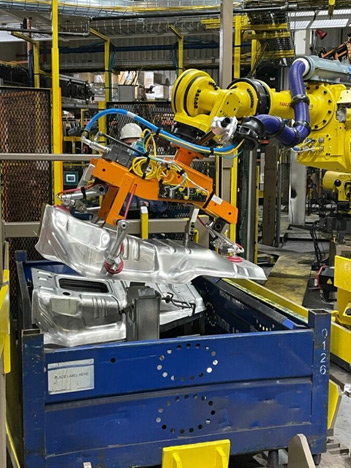
Apera’s technology has effectively automated a material handling operation at the truck plant of a major automaker. The task involved moving large stamped-metal automotive parts from dunnage onto a stack. The company automated the process using a FANUC America Corp. industrial robot and Apera AI’s 4D Vision technology, which resulted in improved quality, efficiency, and cost. According to a toolmaker involved in the project, the Apera AI vision system was easy to integrate and use and resulted in a significant improvement in accuracy. Likewise, an electrical engineer said, “The Apera AI vision system is accurate and simple to use. I have no reservations about using it in future projects.” The Apera AI vision system was the fastest and simplest vision-guided robotic system the controls engineer had ever seen.
Linamar Shifts into Gear with Automated Random Bin-Picking
Hastech Manufacturing, a division of Linamar Corporation, a tier 1 automotive supplier in Canada, was manually loading unmachined transmission disks for processing. Due to labor shortages and wanting higher productivity, the company automated the process using ABB Robotics’ industrial robots and Apera AI’s Vue robotic vision software. Random bin picking of the unmachined disks was challenging due to the deep bin lined with plastic, irregular lighting, shadows, and grease covering the parts. However, Apera AI’s technology was able to overcome these challenges, guiding the robot into the corners and avoiding collisions with the sides as it moves parts out of the bin.
The automation project was a success, with all three cells now successfully picking, allowing Hastech’s operators to focus on quality and productivity. ABB’s robots seamlessly perform the job using a custom end-of-arm tool that picks through the center of the disk. Overall, the automation project has improved efficiency and productivity at Hastech Manufacturing. Linamar is working with both ABB Robotics and Apera AI to implement the same solution elsewhere in its operating companies.
Tab Inspection: Precision Detection of Ultrasonic Weld Defects
UnitX is helping a global battery manufacturer inspect 100% of battery cell tabs for ultrasonic weld defects, such as tears, shifts, and foreign object debris. The system inspects a single cell tab within 1.6 seconds across three imaging angles for six different defect types. The system accurately inspected 99.5% of tabs in a recent accuracy audit. The system achieved a 0.00% a false acceptance (FA) rate, 0 escapes, a false reject (FR) rate of 0.5%, and 0.5% overkill. In addition to reducing labor costs and improving overall quality control, the system achieved significant quality improvements compared to human inspection for defects during the cell tab ultrasonic weld process.
Cell Inspection: Unparalleled Accuracy and Efficiency
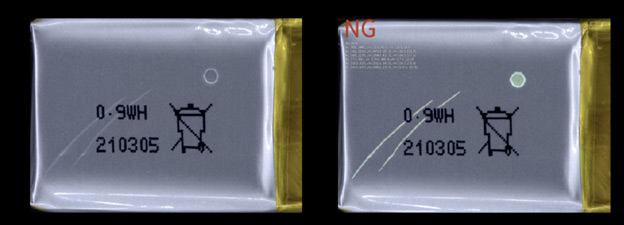
In another application, UnitX is helping a global battery manufacturer inspect battery cells for electrolyte leakage, a manufacturing defect which can cause safety concerns and impact battery performance and longevity. The UnitX system inspects five cells per second and is deployed across more than 10 lines in the United States. The system achieved significant quality improvements compared to human inspection for electrolyte leakage during the formation process. The system also reduced labor costs by eliminating three shifts of inspectors. Quality control was also improved: in a recent accuracy audit, 99.78% cells were accurately inspected, with a 0.04% FA rate and a 0.18% FR rate. Uptime was almost 99% over roughly a million cells inspected.
Harnessing AI and ML for Enhanced QA
“The most promising applications solve narrowly-defined problems that have a definitive problem statement and an addressable data requirement,” explains Chris Kennedy, director of partnerships and marketing at Prolucid Technologies. “You don’t necessarily need an enormous dataset on day one to be successful, but the generation of proper training and validation datasets need to be factored into the timing and budgeting process for a project that includes an artificial intelligence or machine learning component.”
It’s important to remember that most AI deployments are mainly involved with non-destructive examinations and computer vision applications. In those areas AI/ML is being used to drive up the efficiency and productivity of analysts and QA professionals. In many cases, properly trained models can become more accurate than human input quite quickly, and when the AI/ML application is effectively used as a tool by QA or inspection professionals, their level of productivity can increase dramatically.
Association for Advancing Automation
Discover how Association for Advancing Automation can support your automation journey with their complete range of solutions and expertise.
Visit Company Website


Bin picking, kitting and sorting of bolts with an Epson industrial robot—multiple object finishes
This application uses an @epsonrobots industrial robot for bin picking and placement of various bolts, including shiny objects.
How to Find Manufacturing Prospects: A Practical Guide for 2025 and Beyond
Learn how to find manufacturing prospects using trade shows, LinkedIn, and AI-powered intent data to build a consistent sales pipeline.
Introducing the Dobot X-Trainer, a groundbreaking dual-armed, teleoperated AI training platform
Experience the future of robotics with the Dobot X-Trainer, a groundbreaking dual-armed, teleoperated AI training platform now available for pre-order.