
Industry Insights
Dexory is Building Big Robots for the World's Warehouses
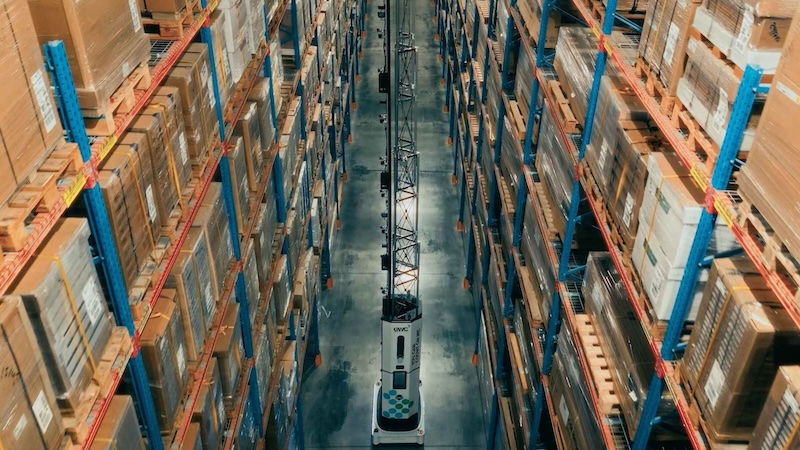
By way of reintroduction, Dexory CEO Andrei Danescu refers to the startup’s primary hardware offering as “the world's tallest autonomous robot.” With a telescoping peak of roughly 14 meters (45 feet), I’m not aware of too many systems that come within swiping distance of that claim. Locus’ recently announced self-replenishing Array system, for instance, taps out at 10 feet.
It’s a good conversation starter, to be sure. It stopped me dead in my tracks when I saw it on the floor at Modex a couple of years back. There’s just something programmed into our simple little lizard brains that make us stop and say, “Hey, that’s a really big robot.” It’s the “ceiling” part of floor to ceiling that makes warehouse inventory and scanning so complex.
Warehouse/distribution center ceilings tend to be in the neighborhood of 30-40 feet to help maximize real estate. This is precisely why specialized forklifts exist. We’ve seen some creative solutions as investment has flooded into the category. A handful of companies have invested in drone scanners, and I’ll always have a bit of a soft spot for what BionicHive was trying to do with those shelf-climbing squid ‘bots (quoting Marge).
Building a 40-foot robot always struck me as a kind of brute force approach to the problem – which, respect. Dexory wanted to get a robot that could reliably scan up to 40-foot shelves into the market as quickly as possible, so it went ahead and built a 40-foot robot. Maybe one day, years from now, the team will laughingly reflect on the much simpler solution they overlooked in favor of building an AMR covered in scaffolding, but for the now, the startup has a robot out in the field, doing that work.
“We looked at other ways of acquiring the data,” says Danescu. “It’s about how to find a way to scan incredibly fast. Speed is one of the big things for automation. How quickly do people actually see an impact from the money they invest and from the from the systems that they deploy? A big driver for us is how quickly you can actually collect the information and transform it into insight.”
While the big robot is, naturally, the thing that gets potential customers to stop and say, “Hey, that’s a really big robot,” it’s the data that keeps them around. Dexory’s system is, in essence, a 45-foot rolling data collecting machine, creating an ever-updating warehouse digital twin that includes floor to ceiling inventory. Danescu believes the detail rich 3D scan will be key not only for inventory purposes, but also for maximizing space, and incorporating future automation into the environment.
“The digital twin is where it gets really interesting,” says Danescu. “From the way I look at it, is it's digital infrastructure. When you look into the future, logistics is by far one of the biggest and most important industries. However we want to look at the future, we'll be moving goods around. So that was one of the big drivers and when you look at other technologies, other automation, because we have a very accurate digital twin, and it's very easy to add additional technology to that.”
Following an initial EU rollout, the UK-based company has quickly expanded operations into North America (specifically the United States and Canada) and has some presence in Australia. Dexory recently opened a second headquarters in Nashville and has announced revealed some of its larger U.S. partners, including automotive manufacturer, Stellantis. Danescu says the company has deployed “hundreds” of robots (with only a single system required for each instance) and now has partners in 14 U.S. states.
“We opened up the U.S. market more than a year ago, but we just didn't have a very strong presence,” Danescu adds. “We wanted to do things differently to a lot of companies scaling from Europe. A lot of people get scared about scaling in the U.S. It's a different way of doing business. I said, ‘look, if the product's good, the market's gonna love it. If the market's gonna love it, they're gonna buy from us regardless, because we are the only ones with the value proposition.’ And it was exactly that. It's very different indeed doing business in the U.S., but people really love the products for what it does for them. The adoption was very, very quick.”
Association for Advancing Automation
Discover how Association for Advancing Automation can support your automation journey with their complete range of solutions and expertise.
Visit Company Website


