
Industry Insights
Chef Robotics CEO on Real World Automation
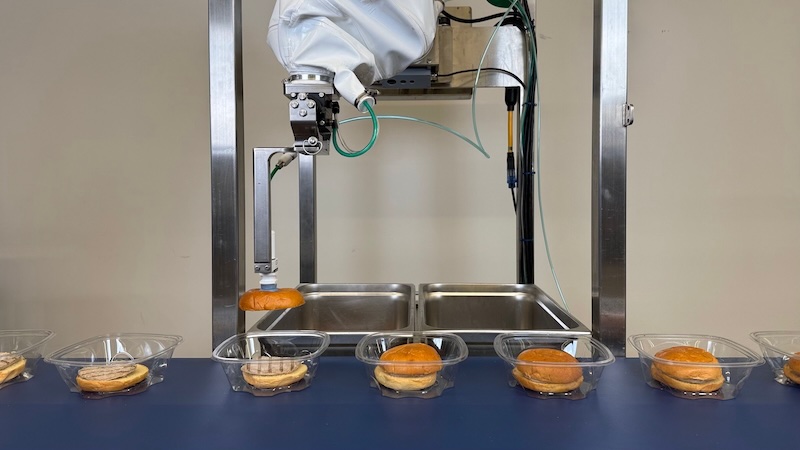
The dearth of successful food robot startups is not for lack of imagination. I’ve seen dozens come and go in my decade or so of robotics coverage. They’ve made me salads, pizzas, coffee, vegetarian burgers. They’ve arrived in all shapes and sizes, from small arms to fully automated food trucks, with an equally wide spectrum of on-board intelligence solutions to match.
Conversations I’ve had with these startup founders have largely centered on the foodstuffs being served up. The above examples, for instance, are each deliberate. Someone, somewhere decided that they’d stumbled upon the foodstuffs form factor most ripe for automation. Pizza, for instance, presents a fairly uniform shape. Salads and bowls, meanwhile, are a relatively easy lift when it comes to things like end effectors. Both can be customized with toppings scooped out of individually labeled bins.
There is, however, another important lens with which to view the commercial food industry: scale. It’s a key piece of any conversation about automation, so why should food prep be any different? The above examples fall on the small end of the scale, when we’re talking about automating say, the work a barista does to create the latte art that reminds you you’re alive for a fleeting second before snapping back into the soul-sucking reality of your morning commute.
When the time came to put its own spin on food automation, on the other hand, Chef Robotics started big. The Bay Area-based startup followed a more standardized automation trajectory by identifying what is essentially the cooking equivalent of manufacturing. After all, many of the processes on a massive scale are already automated — and have been for a long time. Heck, Herman Lay was using machines to automate potato chip packing before the onset of the Second World War.
Laying out a hypothetical roadmap for Chef CEO Rajat Bhageria tells me that autonomy levels are inversely proportional to the number of people served by a food sector. If America contributed nothing else to the advancement of humankind in the 20th century, it at least made us very efficient at automating potato chip packing. Chef’s current sweet spot is the execution of food prep with some complexity that can still be accomplished at scale with assembly lines.
As with manufacturing, higher throughput presents more potential ROI, helping to justify the price of automation. It’s significantly more difficult to hit those goals if your robot is designed to, say, make a salad at a fast casual restaurant. For one thing, not nearly enough people are coming through the door each day. For another, a single worker tasked with making salads all day has a more complex, less repetitive job than the person on the factory assembly line scooping the same single ingredient into bowls all day. Questions of diversity and complexity of tasks are why the CEO of a company like Chef finds themselves having conversations about generalized models, imitation learning, data gaps, and general-purpose robots.
“My thinking is: don't bet the company on this like AI stuff coming to fruition,” Bhageria says. “Bet the company on getting revenue. Ship robots. Do whatever it takes to ship robots.”
It’s not a skepticism around whether generalized physical AI is ever coming, so much as a business strategy. It’s the pragmatism of a CEO with shipped robots, active clients, and – in a very real sense — mouths to feed.
Physical AI startups working toward a single generalized model are banking on long timelines afforded by deep pockets. That output is tied to researchmilestones, rather than real world ROI. It’s a process with its own risk-reward ratio, and one of the key factors of running a deep tech startup. Investors spend more and wait longer in hopes that a longshot will deliver a handsome return down the line.
Of course, quantum leaps aren’t a regular occurrence in technology. Even if the aforementioned longshots pan out, it will be due in part to the groundwork laid by the companies automating the different steps along the way. Conversely, plenty of moonshots that haven’t met their end goal have still yielded useful breakthroughs for the industry at large.
Bhageria sees Chef’s work as a mixture of both approaches. Current deployments are collecting real world data to improve current models, while funding the research that helps the company develop future versions.
“[Chef will continue doing] research on the end-to-end, learning from demonstration stuff, but don't bet the entire company on it like Physical Intelligence and Skild and all the others,” says Bhageria. “They're betting their company on it. My thing is — get revenue and build a good business, because these customer relationships are hard to build, regardless of the tech.”
Association for Advancing Automation
Discover how Association for Advancing Automation can support your automation journey with their complete range of solutions and expertise.
Visit Company Website


