
Industry Insights
ANSI, A3 Publish Revised R15.06 Industrial Robot Safety Standard
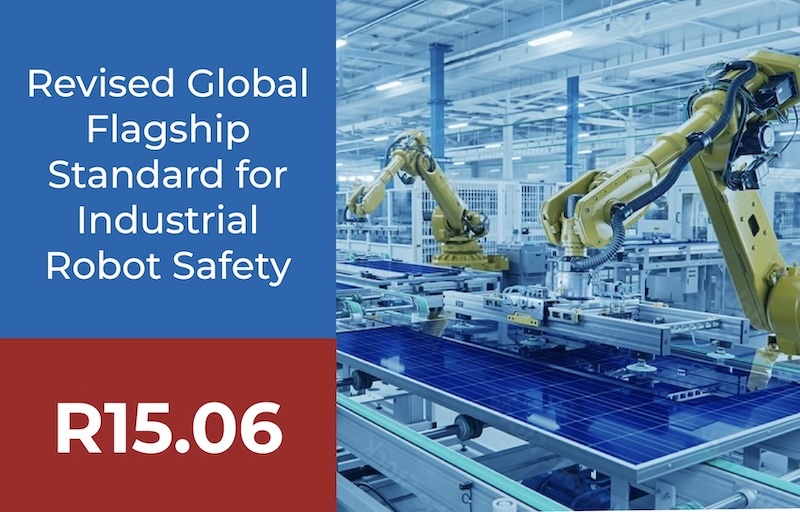
The Association for Advancing Automation (A3) and The American National Standard for Industrial Robots and Robot Systems (ANSI) Wednesday announced the publication of the R15.06-2025 standard. The updated national industrial robot standard was adapted from ISO 10218-1:2025 and ISO 10218-2:2025, which were jointly published in January 2025.
This follows the now-customary practice of first approving standards via an international committee (ISO), prior to passing them at the national level. Similarly, the Canadian Standards Association will publish both parts as Z434.
ISO 10218-1, which serves as the foundation for ANSI/A3 R15.06, was first published in 2006. The standard is a foundational text for the safety of industrial robotic systems. It focuses specifically on manufacturer requirements prior to system implementation designed to reduce worker risk.
ISO 10218-2 arrived five years later, in 2011. The section details how the above systems are integrated into workplaces. This specifically covers safety requirements around robot cells and applications, along with frequent concerns such as operation, upkeep, installation, and the decommissioning of industrial robotic systems. ANSI and A3 combined the two in the form of R15.06-2012, which – as the number system suggests – was published the following year.
The 2025 publications mark the first major revisions to the above standards in over a decade. 101218-1 was expanded from 50 to 95 pages, with 10218-2 growing from 72 to 223 pages. Such updates are considered necessary for keeping pace with changes to the industry and the technologies that help them to function. They are, however, lengthy and involved processes that require -- among other steps -- input from a 30-person international committee. Once adopted, they are considered the industry flagship for industrial robotic safety standards.
The People Behind the Standard
ISO Technical Committee 299 Working Group 3 operated in tandem with the European Committee for Standardization (CEN) Technical Committee CEN/TC 310 to update the standards that were published as ISOs 1218-1 and 1218-2 earlier this year.
The subsequent U.S. standard, meanwhile, was assembled by the R15.06 Drafting Subcommittee on Safety Requirements for Industrial Robots and Robot Systems. Honda Safety Consultant, Todd Dickey, serves as the subcommittee’s chair, with Yasakawa Motoman Senior Manager, Collaborative Robotics, Bill Edwards, serving as vice chair.
The remainder of the subcommittee is comprised of robotics safety experts with a broad range of expertise, including integrators, suppliers, researchers, users, and producers. Several A3 member companies and A3 employees are actively involved in the group, as well.
Want to hear from the creators of the updated standards discuss the new changes? Watch our recent interview with them during this year's Automate LIVE.
Word Matters
The revised standard includes some key language updates designed both to adapt to changing technologies and to rethink manufacturer and user relationships with these technologies. The first is “Collaborative Robot” or “Cobot.”
The term has been in wide use since the late-20th/early-21st century, emerging as industrial robotics manufacturers sought ways to increase human-robot interaction (HRI). Early examples of these systems were lighter weight than their industrial predecessors and relied on human coworkers as sources of power, decreasing the possibility of injury through accidental collision.
The new standard eschews the term’s use, “because human-robot collaboration relates to the application and not to the robot alone.” Instead, the document opts for the similar – but markedly distinct – “collaborative application.”
“The ‘collaborative robot’ term has mistakenly become synonymous with robots utilizing power and force limiting technology,” Dickey tells A3. “In actuality there is no such thing as a ‘cobot,’ rather there are robots that utilize collaborative technologies. The recognized collaborative technologies are hand-guiding controls, speed and separation monitoring, and power and force limiting.”
ROI Calculator

Discover the potential cost savings of robotic automation over a 20-year system life
This calculator compares your current manual labor costs against the total cost of owning and operating a robotic system over its 20-year lifespan.
Edwards adds that the change was also adopted, in part, because human-robot collaboration refers to more than simply the hardware, noting, “It is the entire Collaborative application that must be safe.”
Similarly, “Safety rated-monitored stop,” which refers to a mechanism that halts a robot’s movement when a human enters a workspace, is now the more technically accurate “monitored standstill.” The new terminology can be applied to both collaborative and non-collaborative robot applications.
Meanwhile, “safeguarded space” has been expanded to include protections beyond the standard obstructive fences/cages. The more “dynamic” take on the term now includes additional sensors like speed and separation monitoring and area scanners. The term applies to both collaborative and non-collaborative robotic application, can include physical barriers, as well spaces that dynamically change, so long as workers are protected.
Further Changes
Beyond changes to the way we talk about industrial robots, both parts one and two bring key changes to how technologies are implemented. Part 1 introduces cybersecurity requirements pertaining to robot safety. The number of safety functions covered has dramatically increased, from low single digits to three-dozen. The standards also expand design requirements for increased safety.
In keeping with the updates to language, Part 2 is more concerned with robot applications, rather than the robot systems. As with Part 1, listed safety functions have increased here from single digits to more than three-dozen, and cybersecurity requirements have been added, where applicable. Collaborative application content pulled from ISO/TS 15066 has also been folded into this section.
New for 2025
The Drafting Subcommittee is presently working on a third part for R15.06. Unlike parts one and two, however, this will be a wholly original product of the national group, rather than the adoption of an existing ISO. The strategy is different here, due to the piece’s focus. Rather than the manufacturer or integrator, for which the first and second parts are respectively written, part three it aimed at the user.
This is due, in large part, to where governing bodies place the onus of implementing safety protocol. Here, the focus is the customer, i.e. the company implementing the technology in their factory or warehouse. The forthcoming standard will focus on safety requirements for industrial robot cells.
“There were two technical reports that provided guidance to users of robotic equipment; TR R15.506-2014 gave guidance on how to handle change to existing robot cells and TR R15.706-2019 gave guidance on user responsibilities,” says Dickey. “The vital information from those technical reports have been incorporated into the newly developed R15.06-3 standard which elevates the information from guidance to requirements.”
The first two parts of R15.06-2025 can be download via A3’s site. Part three is expected to arrive before the end of the year.
“Historically, technology always outpaces standards,” Dickey adds. “Safety standards deal with ‘state-of-the-art’ technologies i.e. what's on the market at this given time. Artificial intelligence is one such technology that will need to be dealt with in future safety standards development.”
 Register for IRSC 2025
Join us in person at the International Robot Safety Conference to connect with the creators of these safety standards and learn more about the latest work on mobile robot safety, and the importance of industrial cybersecurity. Register now to join us in Houston, Texas from November 3-5, 2025.
Association for Advancing Automation
Discover how Association for Advancing Automation can support your automation journey with their complete range of solutions and expertise.
Visit Company Website


Video: How Wireless Machine Safety Works
This Ask the Expert video explains how wireless machine safety is not only possible, it can deliver the same level of reliability as wired solutions. From FORT Robotics.
Wireless E-Stop Applications
Who can use a wireless e-stop system? This video explains how wireless e-stops can increase safety and productivity for a variety of application