
Industry Insights
An Open-Source Robot Project Aims to Avoid Tariff Hikes Ahead of Release
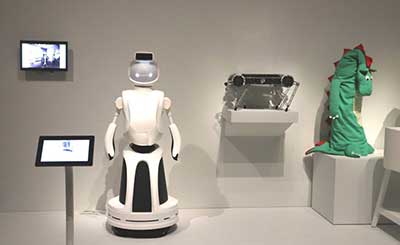 Over six months in 2020, more than 183,000 Philadelphia Museum of Art visitors were greeted by a curious, friendly robot named Quori.
It was a low impact gig — no heavy lifting or back flips required. Still, it had its purpose.
Quori was launched in 2013 as a standardized robot researchers could use to study human-robot interactions. While the Philadelphia Museum of Art was its highest profile job, the robot also saw use at 11 universities and 35 research groups across the United States.
Now, the project is opening a more ambitious chapter. Quori v2 is designed as an "open-everything" robot. Everything, from PCB schematics of on-board hardware to the 3D files required to print the exterior shell, will be free to view, download, and modify.
"Quori is intended to be the national and someday global standard for research into human-robot interaction,” Ross Mead, founder and executive director of contributing nonprofit organization, Semio AI, told A3. “It will let us share a piece of hardware, to share software, and to be able to focus on building the applications and running the experiments that we want to run."
Silicon Valley Inspiration
Mead became part of the Quori project at its inception in 2013. Then a PhD student at the University of Southern California, he was among the few to have first-hand experience with the Personal Robot 2 (PR2), a refrigerator-sized robot from robotics company Willow Garage.
Willow Garage loaned PR2 robots to universities, where they impressed researchers —including Mead — with their dexterity. The PR2 was among the first robots precise enough to manipulate a Rubik’s Cube and bag groceries.
While ahead of its time, PR2’s $400,000 price tag made it prohibitively expensive. Willow Garage tried offering discounts to universities that had the robot on-loan, but the company ultimately shut down in 2014. The original team behind Quori v1, a collaboration between researchers at the University of Pennsylvania and the University of Southern California, wanted to avoid that mistake by keeping the price to build the robot around $10,000.
This price target wasn’t easy to achieve. Quori’s design accomplished it by cutting elements normally considered important, like strong and dexterous limbs. “Usually, the hands are as expensive as an entire arm, and an entire arm is as expensive as the rest of the robot,” explained Mead. Quori v1 didn’t have hands at all and used paddle-like arms that, while cute, were only articulated at the shoulder. The robot also moved on a wheeled base instead of complicated, costly legs.
Yet Quori did have something most robots lack: the ability to express emotions. It did this with a projected face that gives the robot’s head a range of motion. This let the robot make small, subtle gestures most can’t. For Quori — a robot built to interact with humans instead of moving objects or across terrain — this proved a cost-effective design.
From Open Software to Open Hardware
While PR2 didn’t achieve mass adoption, it left a lasting mark. Its framework, ROS (Robot Operating System).
Quori is betting that the same principle can extend to hardware. This includes schematics, circuit board designs, and 3D printable components. The files and code behind Quori, as well as documentation that can help newcomers start using it, are published on GitHub.
While making the robot open source is, in part, meant to make it easy for newcomers to access, there’s a deeper goal driving Quori’s open-source approach: scientific reproducibility. If every lab builds its own robot, there's no way to know whether a finding from study of human-robot interaction reflects a broadly applicable dynamic or a quirk. "You don't know whether it’s a property of the robot you're using, or whether the scientific phenomenon just wasn't replicable,” says Mead.
The approach led to several improvements. Researchers at Carnegie Mellon redesigned the internal projection system in Quori's head, which is used to project facial expression and to increase brightness and image quality. Other universities and research groups adopted that modification. At Saint Louis University, researchers swapped out the original paddle-like arms for more dexterous limbs capable of haptic interactions and repurposed the robot for telepresence research.
Building a Better Quori
Quori v2, which is still in development, takes the community’s ideas and runs with them.
The original’s projected face gave the robot facial expressions without inflating the robot’s cost but, as the researchers at Carnegie Mellon discovered, it was often too dim. Quori v2 has an LCD touchscreen display that can present a brighter, sharper, more colorful face. Doug Dooley, a former Pixar animator, was hired to make the most of the new display’s capabilities.
Mead is particularly excited about the new articulated neck, which lets the robot present subtle expressions that are unusual for a robot. For example, Quori v2 can lower its head to express deference or passivity. “I will die on this hill. This is the most important range of motion that no one has,” said Mead.
Quori v2 also responds to the ways researchers modified the original to add or change hardware. Though the original was built with openness in mind, major modifications required a lot of tinkering. The new Quori is designed to be modular from the start.
NEW ONLINE TRAINING COURSE
Designing Industrial AI Agents
Gain the skills to orchestrate advanced AI agents that learn, adapt, and collaborate like experts in real-world automation environments
A fully tricked-out Quori v2 robot has an improved wheelbase, which enables smoother movement than the original, and the earlier model’s paddle-like arms are replaced with articulated arms that allow the robot to communicate and express itself with gestures. Importantly, though, these features are fully independent. A Quori v2 robot could have the wheeled base, but no arms, or vice-versa. Components are attached with a common connector that transfers power and data.
These improvements are paired with a big change to how the robot is produced.
The first Quori robots were built in an attic by Andrew Specian, a PhD student at the University of Pennsylvania. That kept costs low but limited adoption. Quori didn’t have a production line or an order form. The new model will solve that. It was prototyped in collaboration with a hardware design partner, OLogic, which will assist in building and selling finished Quori v2 robots.
"When I say open everything, my dream for this is it's not just software, it's not just hardware, it's the manufacturing process,” said Mead. “We can say that we’ve already got the relationships, and our partners have the molds. So you want a certain number of Quori v2 robots, they can do it. It's done."
But this won’t stop anyone from building the robot themselves. While OLogic helped to prototype Quori v2, and will source its manufacturing, it doesn’t control distribution of the robot’s design. Mead said the full specifications will be published once the Quori v2 design is finalized.
Quori Tries to Dodge Tariffs and Shortages
The cost of the Quori v1 robot fluctuated over time, but generally hovered around $10,000 — at least before U.S. tariffs hit.
Bill Smart, associate director of the CORIS robots lab at Oregon State University, remarked in September of 2025 that the potential cost of building Quori v1 shot up from roughly $8,000 before the tariffs to nearly $50,000 after. Smart’s figure was an estimate of what the robot would cost if it were reproduced at that time; no Quori robot was built at that cost.
Still, Mead says the ever-shifting tariffs landscape has a real and painful impact on Quori v2’s development. “In Q1 of last year, we were experiencing about 150% in tariffs,” said Mead. That lowered to 57% in the summer of 2025, then 21% around the end of the year, before shooting back up to 100% in the first quarter of 2026. “At this point, it’s just not predictable.” The latest estimate, made as of February, 2026, placed the cost of complete Quori v2 robot at $28,330 in production batches of 10 units.
Ibrahim Abdeally, a mechanical engineer at OLogic, said tariffs have also changed how parts are sourced. “There’s been a push from my side to incorporate as much sheet metal as possible, as opposed to CNC’d aluminum,” Abdeally said. “I know I can get sheet metal in the USA with a quick turnaround time.” He noted the tariff on imported aluminum was 100%.
While tariffs are a headwind, the rapid surge in the price of memory, storage, and GPU hardware hasn’t been a problem for Quori v2 yet. The robot does use NVIDIA compute hardware; an NVIDIA Jetson AGX Orin is in the mobile base, and an Orin Nano is found in the head. However, these components have so far avoided a price increase, both at MSRP and actual retail.
What’s Next
Quori v2 has traction at robotics conferences; it won the Innovation Solution Award at the 2024 International Conference on Social Robotics, and the first physical prototype was demoed at the 2025 HRI conference in Melbourne, Australia. The design is now on its second full revision, which is on track to be complete by mid-2026.
In light of tariff-related costs, the Quori team plans to start with a limited release to a select group of researchers later this year. The researchers will be flown to the Bay Area and attend an event where they’ll build their own Quori v2 robots. These will form an initial production run of 10 units. The finished robots will be deployed for six months to stress-test the hardware. If all goes well, hardware partner OLogic will be ready to ship a finalized Quori v2 to customers by early 2027.
“I love the idea that people who are excited about the platform can just get up to speed with it, and make it their own,” said Mead. He hopes to continue this approach up to and through the robot’s release in 2027 by opening up a Quori shop that will sell community-developed attachments and modifications. “It gives us this pipeline for the community to continue to evolve the robot over time.”
Association for Advancing Automation
Discover how Association for Advancing Automation can support your automation journey with their complete range of solutions and expertise.
Visit Company Website


Hugging Face's Open Source ‘Desktop’ Pollen Robot Starts at $299
Pollen's Reachy Mini offers a more accessible price point for open source robotics fans.