
Industry Insights
Amazon’s Blue Jay Robot Combines Multiple Arms into a Single, Multi-Function System
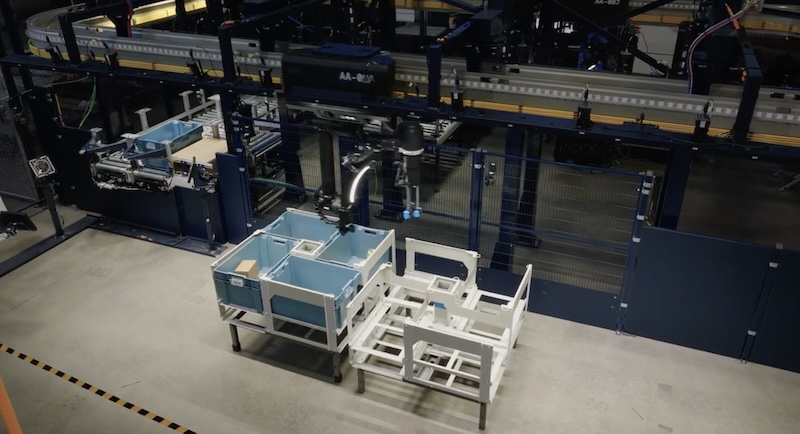
Following Cardinal, Sparrow, and Robin is Amazon Robotics’ latest big bird venture, Blue Jay. Like the three previous systems, the latest robot is a robot arm (or, rather, three robot arms) at heart, but the design is decidedly more radical. The track-based system combines a trio of arms that pick, sort, and consolidate items into a single workstation.
The announcement comes a day after The New York Times reported on internal documents stating that Amazon’s robotics team hopes to automate up to 75% of operations. The company called the documents cited by the paper “incomplete” and noted plans to hire an addition 250,000 people for the coming holiday season.
While Amazon’s fulfillment centers are massive, the retailer is always looking for methods of streamlining and consolidating workflows where possible. Here, the system is concerned specifically with “Sub-Same Day” delivery — that is, those ultra-expediated shipments scheduled to arrive even faster than the company’s standard Same Day offering.
Blue Jay is presently being tested at an Amazon facility in South Carolina, where the company says it will help expand its Sub-Same Day coverage in the region for those times when you can’t wait a full 12 hours for a new pair of socks. The company says Blue works with around 75% of the shippable items it stores at these fulfillment centers.
In a post describing Blue Jay’s development, Amazon notes that the system “moved from concept to production in just over a year,” compared to the three-plus year cycle of its avian predecessors.
The company attributes much of this iteration to simulation, noting, “Our engineers were able to iterate on dozens of prototypes for Blue Jay with the use of digital twins. These are advanced forms of simulation that now allow us to experiment virtually, using real physics to accelerate what we build."
Given the “just over a year” timeframe, I have to wonder if Amazon’s hiring of most of the Covariant staff in August 2024 played a role in Blue Jay’s development. We’ve seen some of the fruits of that acquisition in the form of humanoid research from Amazon FAR, but much of Covariant’s pre-Amazon work centered around physical AI training for pick and place systems, which seems to comport quite well with what we’re seeing from Blue Jay.
Over the holidays, the company will also pilot Project Eluna, a new agentic AI system that uses real-time data to allocate human and automated resources. The system, which will be operational in a Tennessee fulfillment center, responds to natural language queries like “Where should we shift people to avoid a bottleneck?”
Association for Advancing Automation
Discover how Association for Advancing Automation can support your automation journey with their complete range of solutions and expertise.
Visit Company Website


Daniel Theobald Speaks with Kara Miller on Innovation Hub by WGBH
Innovation Hub’s Kara Miller sat down with Vecna Robotics co-founder and CIO, Daniel Theobald.
Flexibility & Production Speed with Robotic Vision
A leading manufacturer of picture frames needed more flexible manufacturing capability than their current high-volume systems could provide.
Fan Blade Defect Inspection & Repair – R&D Project
We are proud to present the integrality of our R&D project carried out in partnership with Université Laval, NRC