
What is a Six-Axis Robot?
A six-axis robot is an industrial robotic arm with six rotary joints (also called axes) that provide complete freedom of movement in three-dimensional space. Each axis represents a degree of freedom, allowing the robot to position its end effector (the tool or gripper at the end of the arm) at any point within its working envelope while orienting it at virtually any angle.
These robots are the workhorses of modern manufacturing, found everywhere from automotive assembly lines to electronics manufacturing, pharmaceutical packaging, and precision machining operations. Their versatility stems from their ability to replicate the range of motion of a human arm, but with greater precision, consistency, and tireless repeatability.
The six axes work together in a kinematic chain, where each joint's movement affects the position and orientation of all subsequent joints. This configuration enables six-axis robots to perform complex tasks like arc welding around curved surfaces, intricate pick-and-place operations requiring precise part orientation, and assembly tasks that demand approaching workpieces from challenging angles.
A3 maintains the standards and specifications that govern how these robots integrate with vision systems, safety protocols, and industrial networks, ensuring interoperability across manufacturers and applications.
Six Independent Rotary Joints
Each axis in a six-axis robot serves a distinct purpose:
- Axis 1 (Base): Rotates the entire robot left and right, providing the primary horizontal sweep
- Axis 2 (Shoulder): Extends the arm forward and backward, controlling the primary reach
- Axis 3 (Elbow): Raises and lowers the forearm, adding vertical positioning capability
- Axis 4 (Wrist Roll): Rotates the wrist assembly, enabling tool rotation around the arm's centerline
- Axis 5 (Wrist Pitch): Tilts the end-effector up and down, providing approach angle control
- Axis 6 (Wrist Yaw): Rotates the mounting flange, allowing the tool to spin independently
How Do Six-Axis Robots Work?
Six-axis robots achieve their remarkable flexibility through coordinated motion of all six joints, controlled by sophisticated algorithms that translate desired end-effector positions into precise angular movements at each axis. This process, called inverse kinematics, happens in real-time as the robot executes programmed tasks.
Coordinated Motion Control:
The robot controller continuously calculates the exact position of each joint needed to place the end-effector at the specified location with the correct orientation. When you program a six-axis robot to move from point A to point B, you define the path and speed for the tool.
±0.02mm Positioning Repeatability
Each axis incorporates high-resolution encoders that provide real-time position feedback to the controller. This closed-loop system ensures the robot achieves positioning repeatability typically within ±0.02 to ±0.1 millimeters, meaning the robot can return to the exact same position thousands of times with minimal deviation.
Teach Pendant and Offline Programming
Modern six-axis robots support multiple programming methods. Teach pendant programming allows operators to manually guide the robot through desired positions, recording each point for playback. Offline programming using simulation software enables engineers to develop and test complex programs without tying up production equipment. Vision-guided programming adds adaptive capability, allowing robots to adjust their paths based on real-time image analysis of part locations and orientations.
What Are the Advantages of Six Degrees of Freedom?
Six degrees of freedom provide unrestricted positioning and orientation capability within the robot's work envelope, enabling complex tasks that simpler robot configurations cannot accomplish.
Complete Spatial Access and Multi-Angle Approach
Unlike robots with fewer axes, a six-axis robot can reach the same point from multiple approach angles. This capability is crucial when working around obstacles, accessing confined spaces, or performing operations that require specific tool orientations. In automotive manufacturing, a welding robot must access both the interior and exterior of a vehicle body, approaching weld joints from angles that avoid interference with the workpiece geometry.
Task Versatility and Quick Production Changeover
Six-axis robots excel in facilities that produce varied products or frequently change production runs. The same robot can perform welding in the morning, material handling in the afternoon, and assembly operations the next day, requiring only end-effector changes and program selection. This flexibility reduces capital equipment costs compared to deploying specialized automation for each task.
Collision Avoidance in Compact Workspaces
The six-axis configuration allows robots to "fold" themselves into compact postures when moving between work zones. This capability enables multiple robots to work in close proximity without interference, maximizing the number of operations that can be performed within a given factory floor space.
How Does a Six-Axis Robot Compare to SCARA and Delta Robots?
Six-axis robots offer greater flexibility and orientation control than SCARA or delta robots, but these alternative configurations provide advantages in specific applications where their specialized designs deliver superior speed, precision, or cost-effectiveness.
Six-Axis vs SCARA Robots
SCARA (Selective Compliance Assembly Robot Arm) robots feature four axes optimized for high-speed pick-and-place operations in a horizontal plane. The fundamental difference lies in their mechanical compliance and motion characteristics.
Six-Axis vs SCARA: Feature Comparison
| Feature | Six-Axis Robot | SCARA Robot |
|---|---|---|
| Work Envelope | Spherical, full 3D access | Cylindrical, primarily horizontal |
| Wrist Orientation | Three wrist axes, unlimited tool orientation | Single vertical rotation, no tilting |
| Pick-and-Place Speed | 0.5-1.0 second cycle time | 0.3-0.5 second cycle time |
| Payload Capacity | 3 kg to 2,300+ kg | Typically 1 kg to 20 kg |
| Typical Applications | Welding, painting, machine tending, complex assembly | Electronics assembly, precision insertion, high-speed packaging |
| Cost | Higher, more complex mechanics | Lower, simpler four-axis design |
When to Choose Six-Axis vs SCARA
Choose six-axis robots when your application requires approaching parts from multiple angles, working with complex geometries, or performing operations that need the tool to tilt or rotate freely. Automotive subassembly, appliance manufacturing, and metal fabrication typically demand six-axis flexibility.
Choose SCARA robots for high-speed, repetitive operations in a horizontal work plane where part orientation doesn't vary significantly. Electronics assembly lines, pharmaceutical packaging, and precision component insertion operations often achieve better throughput and lower cost with SCARA configurations.
Six-Axis vs Delta Robots
Delta robots use three parallel arms connected to a common base, creating an inverted pyramid structure that excels at extremely high-speed picking and positioning operations. Their design philosophy contrasts sharply with six-axis articulated robots.
Six-Axis vs Delta Robot: Feature Comparison
| Feature | Six-Axis Robot | Delta Robot |
|---|---|---|
| Maximum Speed | Moderate | Exceptional, accelerations up to 15 G |
| Work Envelope | Spherical around base | Inverted dome below mounting structure |
| Orientation Control | Complete, six degrees of freedom | Limited, X, Y, Z positioning plus one rotation |
| Payload Capacity | 3 kg to 2,300+ kg | Typically 0.5 kg to 15 kg |
| Installation | Floor or wall mounting | Overhead mounting required |
| Cycle Time | 0.5-1.0 seconds | 0.1-0.3 seconds (300+ picks per minute) |
| Best Applications | Complex manipulation, orientation-critical tasks | High-speed sorting, packaging, pick-and-place |
Six-Axis vs Delta: Application Suitability
Delta robots dominate applications where sheer speed matters most and part orientation requirements are minimal, food packaging, pharmaceutical sorting, and electronics component placement.
Six-axis robots prevail when the task involves more than simple repositioning. If you need to grasp a part, rotate it to inspect multiple sides, then place it with precise angular orientation, the delta robot's limited orientation capability becomes a bottleneck. Many modern production lines deploy both configurations, leveraging each robot type's strengths in different process stages.
What Applications Are Best Suited for Six-Axis Robots?
Six-axis robots excel in applications requiring complex motion paths, precise orientation control, or versatile tool manipulation, making them indispensable across automotive manufacturing, metal fabrication, material handling, assembly operations, and finishing processes.
Arc Welding and Metal Joining
Automotive and heavy equipment manufacturers deploy thousands of six-axis robots for arc welding, where maintaining precise torch angle and consistent travel speed along complex seams is critical. Resistance spot welding similarly benefits from six-axis flexibility, allowing robots to position welding guns perpendicular to metal surfaces at hundreds of precisely located points across a vehicle body.
Material Handling and Machine Tending
Six-axis robots handle parts of virtually any geometry, loading and unloading CNC machines, injection molding presses, stamping equipment, and heat treatment furnaces. Their ability to grasp parts with custom end-effectors, reorient them during transport, and place them with precise alignment makes them ideal for machine tending applications.
Precision Assembly
Electronics, medical device, and automotive component assembly operations rely on six-axis robots to position parts with sub-millimeter accuracy while maintaining correct angular orientation. Collaborative six-axis robots, designed to work safely alongside human operators, excel in assembly applications where product variety makes full automation impractical.
Spray Painting and Surface Coating
Automotive paint shops deploy hundreds of six-axis robots, programming them to follow body panel curves while keeping spray guns perpendicular to surfaces and maintaining optimal standoff distance, achieving coating uniformity impossible for human painters to match consistently.
Vision-Guided Inspection
Vision-equipped six-axis robots perform dimensional inspection, defect detection, and quality verification tasks by positioning cameras or sensors at multiple angles around parts. Some inspection applications combine six-axis robots with coordinate measuring machine (CMM) functionality, using touch probes or laser scanners to verify part dimensions.
What Are Typical Payload and Reach Ranges for Six-Axis Robots?
Six-axis robots span an enormous range of payload capacities and reach dimensions, from compact models handling 3 kg loads with 500 mm reach for electronics assembly, to massive robots managing 2,300 kg payloads with 4,700 mm reach for heavy material handling.
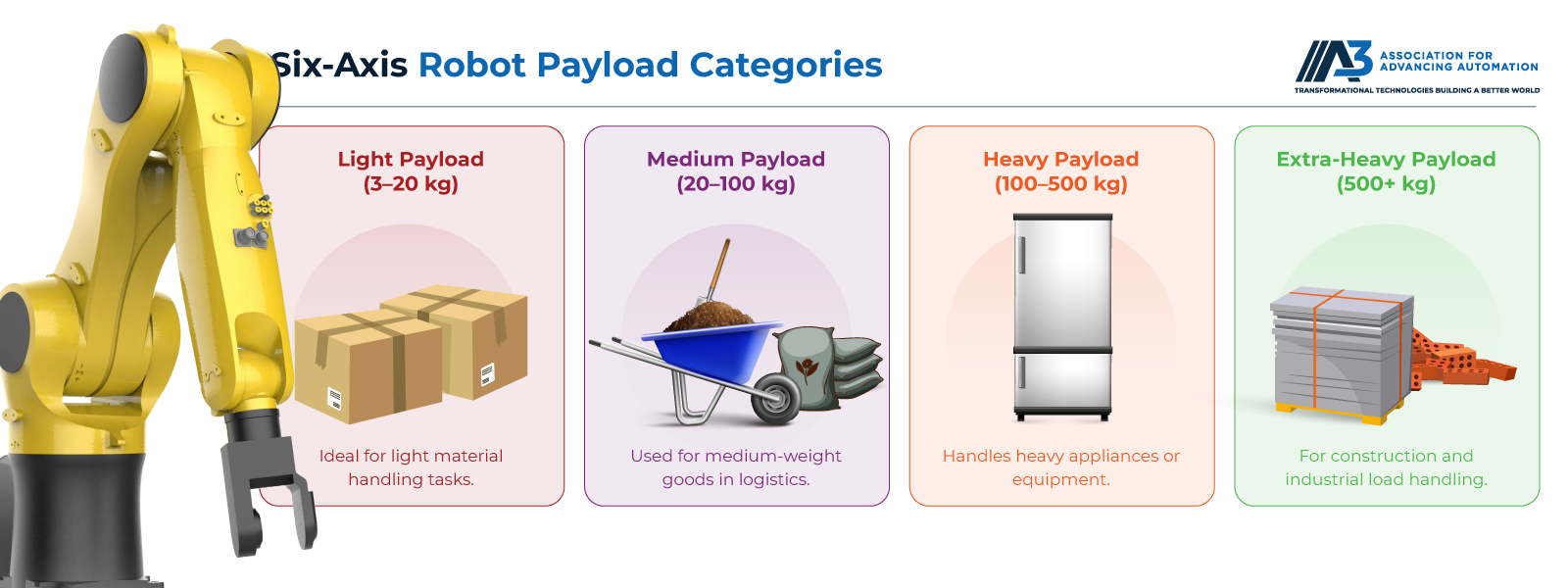
Payload Categories
Light Payload: 3-20 kg Compact robots with 500-900 mm reach, ideal for electronics assembly, small parts handling, and precision dispensing. Positioning repeatability within ±0.02 mm.
Medium Payload: 20-100 kg Typical reach of 1,400-2,400 mm. Handles the majority of general industrial applications, from machine tending to welding. Most commonly deployed configuration across diverse manufacturing sectors.
Heavy Payload: 100-500 kg Reaches of 2,500-3,100 mm for automotive body welding, large part handling, and heavy material transfer. Reinforced structures maintain accuracy while manipulating substantial loads at extended reach.
Extra-Heavy Payload: 500+ kg Models with 4,000+ mm reach handle extreme loads in foundries, heavy equipment manufacturing, and aerospace production. Can manipulate automotive engine blocks, large castings, and structural assemblies.
Payload vs Reach Considerations
A robot's maximum payload capacity applies at full reach extension, moving closer to the base allows handling heavier loads due to reduced moment arm. When selecting a robot, consider the end-effector weight in addition to the workpiece. If your part weighs 15 kg and your gripper weighs 5 kg, you need at least a 20 kg payload robot.
Lighter payload robots achieve higher axis speeds and acceleration rates, translating to shorter cycle times. A 10 kg payload robot might complete a pick-and-place cycle in 0.5 seconds, while a 500 kg payload robot requires 2-3 seconds for comparable motion.
Conclusion
Six-axis robots deliver unmatched versatility and spatial access capability, positioning them as the dominant industrial robot configuration across manufacturing sectors worldwide. Their six degrees of freedom enable complex tasks that simpler robot types cannot accomplish, from following intricate welding paths with precise torch orientation to assembling components that require multi-angle approach and manipulation.
While SCARA and delta robots offer advantages in specialized applications, six-axis robots remain the go-to solution when application requirements include varied part geometries, orientation-critical operations, or flexible production systems. As manufacturing becomes increasingly automated and product variety continues expanding, the six-axis robot's flexibility and reprogrammability make it an essential asset for competitive production operations.
Recommended Resources
Explore more robotics insights and industry developments
Meet the World’s Most Precise six-axis Robot
The Meca500 is one of only a few industrial robots with an integrated controller in its base, and the only industrial robot arm that fits in the palm of your hand. The Meca500 is also designed to maximize space-efficiency and minimize deployment time in labs and factories.
ABB extends no-code Wizard Easy Programming to industrial robots
ABB Robotics has extended the scope of its free Wizard Easy Programming software to include its six-axis industrial robots powered by an OmniCoreTM controller in addition to its collaborative robots.
Expanding robot network fulfills demand for industrial machines
To fulfill growing demand for high speed, high payload robots, Uchimura Robotics has joined the TM Robotics distributor network. TM Robotics is the authorized partner of Shibaura Machine, supplying the company’s six-axis, Cartesian and SCARA robots.