
What is GigE Vision?
GigE Vision is a global camera interface standard that revolutionized industrial imaging by enabling high-speed video transmission over standard Ethernet networks. Since its introduction in 2006, it has become one of the most widely adopted interfaces in machine vision.
GigE Vision (Gigabit Ethernet Vision) is an interface standard that defines how industrial cameras and imaging devices communicate with host computers over Gigabit Ethernet networks. Think of it as a universal language that allows cameras from different manufacturers to work seamlessly with various software applications - all using the same inexpensive cables you might already have in your facility.
The standard was developed by the Association for Advancing Automation (A3) and is maintained by a committee of leading machine vision companies. What makes GigE Vision particularly powerful is that it leverages existing Ethernet infrastructure, meaning you don't need specialized hardware or expensive proprietary cables.

The Core Components
GigE Vision consists of three essential elements that work together:
- GigE Vision Control Protocol (GVCP): Manages camera configuration and control
- GigE Vision Stream Protocol (GVSP): Handles the actual image data transmission
- GenICam XML Description: Provides a standardized way to describe camera features
Key Benefits
Long Cable Runs Extending Over 500 Kilometers
Standard cables work up to 100 meters without signal degradation. With fiber optics, you can extend this to over 500 kilometers.
Cost Effective Cables and Components
Uses inexpensive CAT5e or CAT6 cables and standard network components. No frame grabber required for most applications.
Multi-Camera Networking
Connect multiple cameras to a single network using standard switches. Scale from single to multi-camera systems effortlessly.
125 MB/s to 1,250 MB/s Bandwidth
Delivers bandwidth of 125 MB/s for standard GigE, with 10 GigE options providing 10x that throughput.
Real-World Applications
GigE Vision cameras are everywhere in modern manufacturing - from inspecting pharmaceutical packaging at high speeds, to guiding robotic arms in automotive assembly, to ensuring quality control in food processing plants. The technology excels in any environment where you need reliable image capture over distance, or when coordinating multiple cameras across a large installation.
The standard has evolved significantly since 2006. Version 2.0 introduced 10 Gigabit Ethernet support and enhanced multi-camera synchronization through IEEE 1588 Precision Time Protocol (PTP). Version 2.2 added GenDC streaming support, enabling efficient transmission of diverse data types including 3D imaging data - a game-changer for inspection applications that need both 2D images and depth information.
When Does GigE Vision 3.0 Launch?
A3 (the Association for Advancing Automation) expects to release GigE Vision 3.0 sometime during 2025. The exact release date hasn't been announced, but the standard is currently in active development by the GigE Vision Technical Committee.
What's changing?
GigE Vision 3.0 introduces a revolutionary new streaming protocol based on RoCEv2 (RDMA over Converged Ethernet version 2). This isn't a replacement for the existing standard - it's designed as a supplement to version 2.2, meaning your current GigE Vision systems will continue to work while giving you the option to leverage breakthrough performance improvements.
Why RoCEv2 Changes Everything
RoCEv2 was originally developed for hyperscale data centers and high-performance computing environments. It allows data to transfer directly from camera memory to computer memory without involving the CPU or operating system - a technique called "zero copy" transfer.
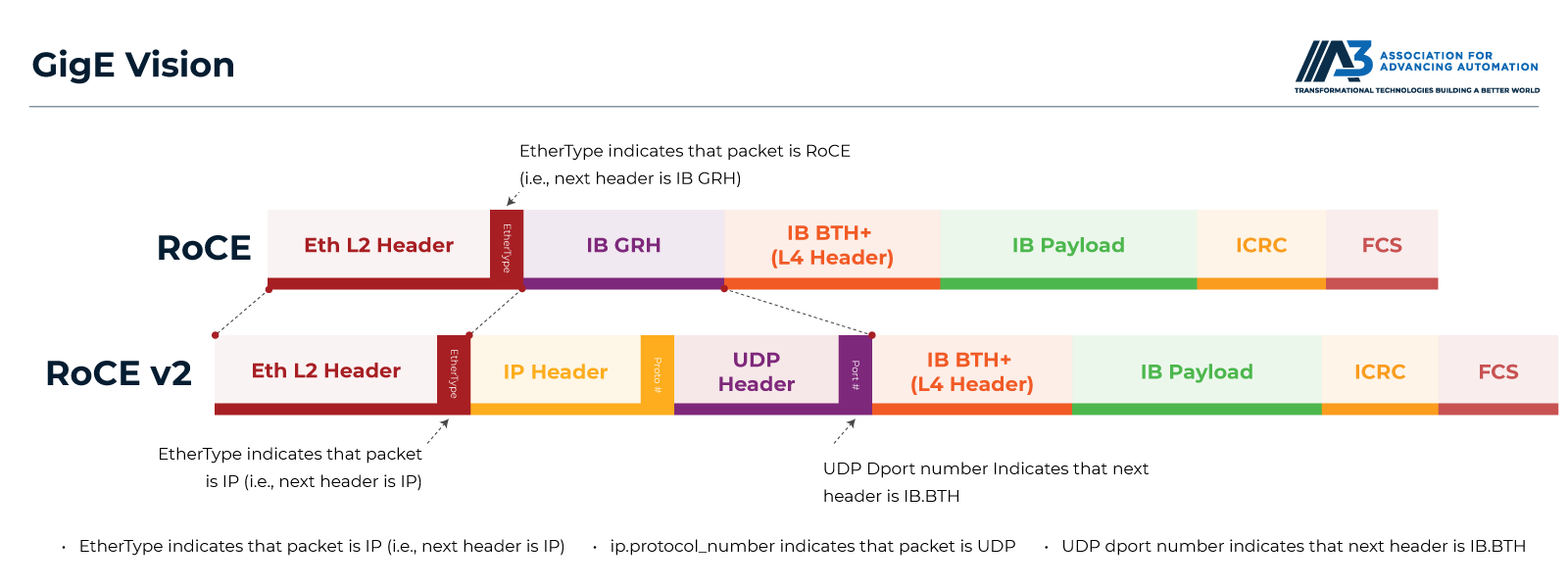
For machine vision, this translates to three massive improvements simultaneously:
- Dramatically Lower Latency: Critical for real-time robotic control and automation
- Minimal CPU Usage: Frees up processing power for image analysis and AI algorithms
- Higher Throughput: Supports cameras running at 10 GigE, 25 GigE, and beyond - even up to 400 Gbps
What This Means for Different Users
10+ GigE Bandwidth Applications
Designed for high-speed applications requiring over 10 GigE bandwidth - think semiconductor inspection, high-resolution 3D scanning, and multi-camera synchronization at extreme frame rates.
GigE Vision 2.x Compatibility
Your existing GigE Vision 2.x devices will continue to work. The new RoCEv2 streaming protocol coexists with traditional GVSP, allowing gradual upgrades.
RoCEv2-Capable Network Interface Cards Required
To take advantage of RoCEv2, you'll need network interface cards (NICs) that support the protocol. These are already available from major NIC manufacturers for 10 GigE and higher speeds.
Hardware-Based Error Detection
RoCEv2 handles error detection and recovery in dedicated hardware rather than software, resulting in more stable connections and fewer dropped frames.
Do you need GigE Vision 3.0 now?
For most users, no immediate action is required. The GigE Vision Technical Committee has designed version 3.0 to be a smooth evolution rather than a disruptive change. If you're currently planning new systems for deployment in late 2025 or beyond, you might want to specify RoCEv2-capable NICs to future-proof your investment. However, standard GigE Vision will remain fully supported and appropriate for the vast majority of applications.
Who should be most excited for GigE Vision 3.0?
Engineers working with multiple high-resolution cameras, applications requiring sub-millisecond response times, or systems processing enormous data volumes will see the most dramatic improvements. Industries like semiconductor manufacturing, advanced packaging inspection, and high-speed scientific imaging stand to benefit significantly from the upgrade.
GigE Vision vs USB3 Vision: Which to Choose?
Both GigE Vision and USB3 Vision are excellent standards that solve different problems. The right choice depends entirely on your specific application requirements - there's no universal "better" option.
Let's cut through the marketing noise and focus on what actually matters when you're designing a machine vision system. Both standards are mature, well-supported, and used extensively across industry. The decision usually comes down to three critical factors: distance, bandwidth requirements, and system architecture.
The Key Differences at a Glance
Feature Comparison Table
| Feature | GigE Vision | USB3 Vision |
|---|---|---|
| Bandwidth | ~110 MB/s (1 GigE), ~1,250 MB/s (10 GigE) | ~400 MB/s sustained (USB 3.0/3.1 Gen 1) |
| Cable Length | Up to 100m (copper), 500+ km (fiber) | 5m standard, ~25m with active extenders |
| CPU Usage | ~6% at 85 MB/s | ~1% at 85 MB/s |
| Multi-Camera Support | Excellent | Good for 1-3 cameras |
| Power over Cable | Yes (PoE) | Limited (USB power) |
| EMI Immunity | Excellent | Good |
| Setup Complexity | Moderate | Very easy |
| Cost per Camera | Lower (multi-camera) | Lower (single-camera) |
Decision Framework: Which Interface Should You Choose?
Choose GigE Vision if:
- Your camera needs to be more than 5 meters from the computer
- You're using 4+ cameras in the same system
- You need to distribute cameras across a large installation
- Your environment has significant electrical noise
- You want to leverage existing Ethernet infrastructure
- Power over Ethernet (PoE) would simplify your installation
Choose USB3 Vision if:
- The camera will be within 5 meters of your computer
- You need maximum bandwidth for 1-3 high-resolution cameras
- Plug-and-play simplicity is a priority
- Your application requires the lowest CPU overhead
- You're building a compact inspection system
- Budget is extremely tight for single-camera setups
GigE Vision Real-World Scenarios
Large Factory Floor Winner: GigE Vision
When you need 12 cameras monitoring an automotive assembly line spread across 80 meters, GigE Vision is the obvious choice.
Laboratory Microscopy Winner: USB3 Vision
For a microscope camera sitting 2 meters from a lab computer, USB3 Vision offers plug-and-play convenience and plenty of bandwidth for high-resolution imaging. Setup takes minutes, not hours.
Packaging Inspection Consider Both
A compact inspection system with 2-3 cameras within arm's reach? USB3 is simpler. But if you need cameras on opposite ends of a conveyor belt, or plan to expand to 6+ cameras, GigE Vision scales better.
Mobile Robot Winner: GigE Vision
For cameras on a mobile platform that need to connect back to a control system, GigE Vision's flexibility with network topology and wireless capability gives you more architectural options.
The Bandwidth Reality Check in GigE Vision
With standard GigE (110 MB/s), you can run a 5-megapixel camera at 25 frames per second, or a 2-megapixel camera at 60 fps. This is plenty for most industrial inspection applications.
With USB3 Vision (400 MB/s)
You can push that same 5-megapixel camera to 80+ fps, or comfortably handle a 12-megapixel camera at standard frame rates. The question is: do you actually need that extra speed? For many applications, the answer is no, and GigE's other advantages become more important.
With 10 GigE Vision (1,250 MB/s)
You match or exceed USB3 speeds while keeping all of GigE's architectural advantages. This is increasingly common in high-end applications.
Important Consideration: The Distance Trap
One of the most common mistakes in system design is choosing USB3 Vision for its speed advantage, then discovering mid-project that the camera needs to be 15 meters from the computer. USB extenders exist, but they add cost, complexity, and potential points of failure. Always measure your cable runs before committing to an interface.
Conclusion
Don't choose an interface based on specifications alone. Consider your complete system architecture, installation environment, growth plans, and support requirements. Many experienced integrators keep both types of cameras in their toolkit, selecting the right tool for each specific job rather than trying to force one standard to handle everything.
Recommended Resources
Explore additional materials to deepen your understanding of GigE Vision and related machine vision technologies
An Early Look at GigE Vision 3.0
GigE Vision 3.0, currently in development by A3 and its GigE Vision Technical Committee, will offer unparalleled advances for machine vision applications by leveraging cutting-edge RDMA over Converged Ethernet (RoCE) technology.
GigE Vision Meets Important Data Path Needs
GigE Vision™ is a new camera interface standard developed using the Gigabit Ethernet communication protocol. It represented over 2 years of work by individuals from 12 companies...
Image acquisition with GigE Vision® cameras in real-time
Camera Module is a functional module of the »RealTime Vision« and supports industrial cameras with GigE Vision® interfaces and signals the incoming image in the PC as soon...