
What Is the Difference Between Edge AI and Cloud AI?
Edge AI processes data locally on devices at the point of data collection (robots, cameras, sensors), while cloud AI sends data to remote servers for processing and returns results over the network. Edge AI prioritizes low latency and operates independently of network connectivity, whereas cloud AI leverages centralized computing power and scales processing capacity across many devices.
The distinction centers on where computation happens. Edge AI deploys machine learning models directly to industrial hardware, enabling real-time decision-making without network delays. Cloud AI centralizes processing in data centers, providing access to more powerful computing resources and simplifying model updates across distributed systems.
Modern automation systems increasingly use both approaches in hybrid architectures. Time-critical decisions (robot collision avoidance, defect detection on high-speed lines) happen at the edge for immediate response, while complex analytics, model training, and long-term optimization leverage cloud computing power. Understanding when to use edge, cloud, or hybrid approaches enables building automation systems that balance performance, cost, and maintainability.
What Latency Considerations Matter?
Edge AI provides deterministic response times of 10-100 milliseconds independent of network conditions, while cloud AI introduces variable latency of 50-500+ milliseconds depending on network quality, making edge essential for real-time control and cloud suitable for non-time-critical analytics.
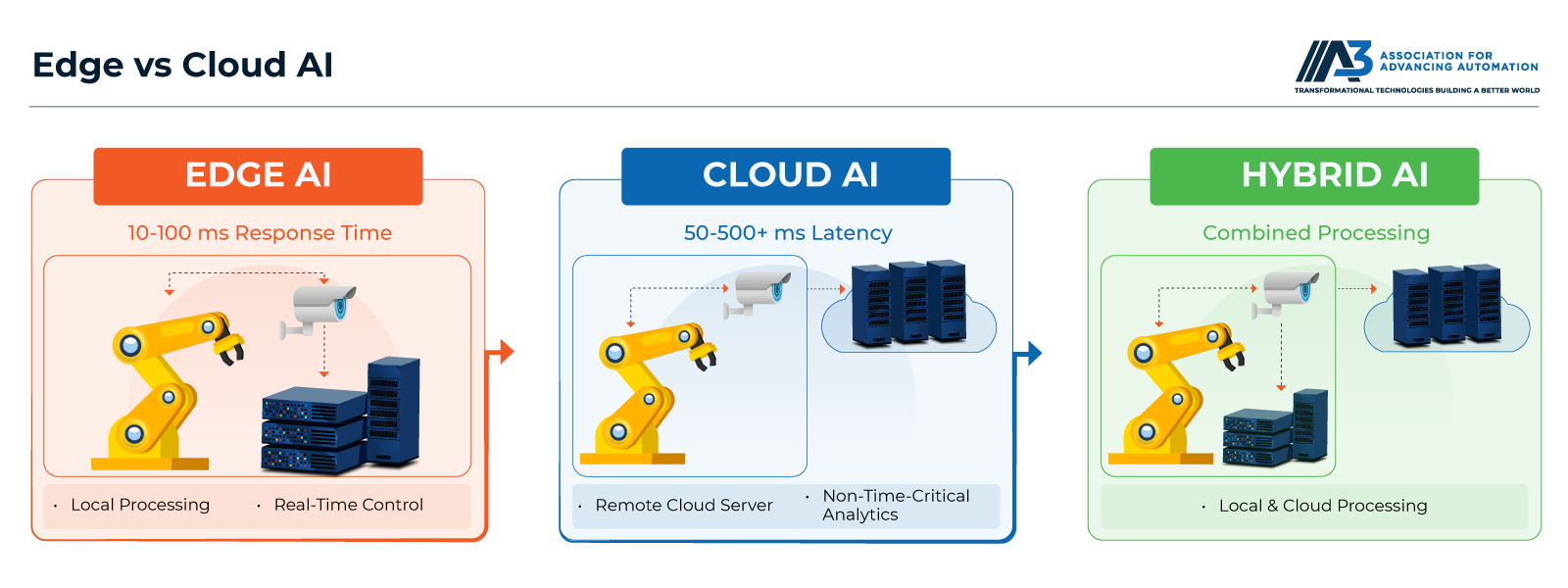
Edge AI Latency Performance
Edge AI systems process data locally with predictable, low latency. A vision system running inference on an edge AI accelerator achieves:
- 10-50 milliseconds for classification tasks
- 30-100 milliseconds for object detection
- 50-150 milliseconds for complex segmentation
This latency remains constant regardless of network conditions, internet outages, or how many other systems are operating simultaneously. The deterministic timing enables edge AI for applications requiring guaranteed response times.
Cloud AI Latency Components
Network transmission: Sending image or sensor data to the cloud and receiving results adds 20-200 milliseconds depending on connection quality, distance to servers, and network congestion. A 5-megapixel image (15 MB uncompressed, 2-5 MB compressed) takes 40-100 milliseconds to upload on a 100 Mbps connection.
Processing time: Cloud inference itself might be faster than edge (10-30 milliseconds on powerful GPUs), but the network overhead dominates total latency.
Variable latency: Network conditions fluctuate. A system averaging 100-millisecond round-trip might spike to 300-500 milliseconds during network congestion or drop to unusable levels during connectivity issues.
Real-Time Application Requirements
High-speed manufacturing requires predictable, low latency:
- Robotic pick-and-place: 50-100 milliseconds total cycle time from image capture to robot command
- Defect detection at 200 parts/minute: 300-millisecond maximum decision time
- Collaborative robot safety: 20-50 milliseconds to detect human approach and initiate protective stop
These applications demand edge AI. Even average cloud latency of 100 milliseconds becomes problematic when worst-case latency reaches 300-500 milliseconds, potentially causing production delays or safety issues.
Network Dependency
Edge AI operates during network outages. A factory vision inspection system continues functioning regardless of internet connectivity. Cloud AI systems become inoperable when network fails, creating production downtime risk.
For critical production equipment, this independence from network reliability is often decisive. Edge AI eliminates network infrastructure as a single point of failure.
How Do Operational Costs Compare?
Edge AI requires higher upfront hardware investment ($500-$5000 per device for AI accelerators) but minimal ongoing costs, while cloud AI has lower initial costs but accumulates data transmission and compute charges that can reach $100-$1000+ monthly per device depending on usage patterns.
Edge AI Cost Structure
Initial hardware investment:
- Entry-level edge AI accelerator (Google Coral, Intel Neural Compute Stick): $50-$200
- Industrial edge AI modules (NVIDIA Jetson series): $500-$1500
- High-performance edge servers: $2000-$5000+
Ongoing operational costs:
- Power consumption: $5-$20 monthly per device
- No data transmission costs
- Minimal bandwidth requirements (only for model updates, telemetry)
- Local maintenance and updates
A typical industrial vision system with edge AI might cost $1500 upfront and $10 monthly ongoing, front-loading investment but minimizing recurring expenses.
Cloud AI Cost Structure
Initial hardware investment:
- Minimal (standard industrial PC with network connectivity): $500-$1500
- Higher bandwidth network infrastructure may be required
- Reliable internet connectivity with service-level agreements
Ongoing operational costs:
- Cloud compute: $50-$500 monthly per device depending on inference volume
- Data transmission: $20-$200 monthly for image/sensor data upload
- Cloud storage: $10-$100 monthly for data retention
- Bandwidth costs for high-volume operations
A cloud-based vision system processing 1000 images daily might cost $1000 upfront and $150-$300 monthly ongoing, with costs scaling linearly as device count or inference volume increases.
Cost Crossover Analysis
For a single deployment, cloud AI's lower initial investment appears attractive. However, total cost of ownership crossover occurs typically within 12-24 months depending on usage patterns. After this point, edge AI's minimal ongoing costs make it less expensive than accumulating cloud charges.
Break-even calculation example:
- Edge AI: $1500 initial + ($10 × months)
- Cloud AI: $1000 initial + ($200 × months)
- Break-even: approximately 2.6 months
The calculation heavily depends on inference volume, data size, and cloud pricing. Low-volume applications might favor cloud economics, while high-volume production systems strongly favor edge deployment.
Scaling Considerations
Edge AI scaling: Each device requires its own hardware investment. Deploying 100 vision systems requires 100 edge AI accelerators. However, ongoing costs remain minimal regardless of scale.
Cloud AI scaling: Initial costs scale modestly (network infrastructure upgrades), but monthly operational costs scale linearly with device count. 100 devices processing 1000 inferences daily might generate $15,000-$30,000 monthly in cloud costs.
For high-volume manufacturing with many inspection points, edge AI's economics become increasingly favorable despite higher upfront investment.
When Is Hybrid (Edge + Cloud) Architecture Best?
Hybrid architectures excel when combining time-critical edge processing with cloud-based analytics, enabling real-time operational decisions locally while leveraging cloud resources for model training, performance monitoring, and long-term optimization across distributed systems.
Edge vs Cloud: Feature Comparison
| Feature | Edge AI | Cloud AI | Hybrid (Edge + Cloud) |
|---|---|---|---|
| Latency | 10-100ms, deterministic | 50-500+ms, variable | 10-100ms for critical tasks, flexible for analytics |
| Network Dependency | Independent, works offline | Requires connectivity | Critical functions offline-capable |
| Initial Cost | Higher ($500-$5000 per device) | Lower ($500-$1500 per device) | Moderate ($800-$3000 per device) |
| Ongoing Cost | Minimal ($5-$20/month) | Higher ($100-$1000+/month) | Moderate ($30-$150/month) |
| Computing Power | Limited to device capabilities | Virtually unlimited scaling | Best of both approaches |
| Model Updates | Requires device-by-device deployment | Instant across all devices | Edge models updated from cloud |
| Data Privacy | Complete, data stays local | Data transmitted to cloud | Sensitive processing local, analytics in cloud |
| Scalability | Hardware per device | Centralized scaling | Flexible resource allocation |
| Best For | Real-time control, offline operation | Non-critical analytics, centralized management | Production systems requiring both speed and intelligence |
Real-Time Production with Cloud Analytics
Manufacturing systems use edge AI for immediate quality decisions (pass/fail inspection, dimensional measurement, defect detection) while sending detailed data to the cloud for:
- Trend analysis: Identifying gradual quality degradation over hours or days
- Process optimization: Correlating production parameters with outcomes across shifts
- Predictive maintenance: Analyzing vibration, temperature, and performance data to predict failures
- Model improvement: Using production data to retrain and improve edge models
The edge handles "what happened just now" while the cloud analyzes "what's happening over time" and "what might happen next."
Distributed Learning
Hybrid architectures enable distributed learning where edge devices collect data during production, periodically upload anonymized or aggregated data to the cloud, where improved models are trained and tested, then deployed back to edge devices.
This approach provides:
- Continuous model improvement without disrupting production
- Learning from all deployed systems simultaneously
- Centralized expertise improving distributed operations
- Privacy protection by keeping raw sensitive data local
Network Resilience
Hybrid systems maintain critical functionality during network outages while maximizing intelligence when connectivity is available. An automated warehouse might:
- Edge: Robot navigation, obstacle avoidance, immediate path planning
- Cloud: Fleet optimization, predictive task allocation, long-term route learning
- Resilience: Robots continue operating if cloud connection fails, reverting to locally-stored optimization strategies
Application Patterns
Use edge AI when:
- Latency under 100 milliseconds is required
- Network reliability cannot be guaranteed
- Data privacy regulations restrict cloud transmission
- High inference volume makes cloud costs prohibitive
Use cloud AI when:
- Processing complexity exceeds edge hardware capabilities
- Centralized model management across many devices is priority
- Inference volume is low enough for favorable cloud economics
- Network connectivity is reliable and sufficient bandwidth available
Use hybrid architecture when:
- Time-critical and analytical workloads coexist
- Fleet learning and continuous improvement are important
- Network reliability varies but critical functions must continue
- Balancing performance and total cost of ownership is key
Conclusion
The choice between edge and cloud AI fundamentally affects system performance, cost, and operational characteristics. Edge AI provides deterministic low latency and network independence at the cost of higher upfront hardware investment and limited per-device computing power. Cloud AI offers centralized management and scalable computing resources but introduces variable latency and ongoing operational costs that accumulate over time.
Hybrid architectures increasingly dominate industrial automation by combining edge AI's real-time responsiveness for critical decisions with cloud AI's analytical power for optimization and learning. This approach delivers both immediate operational performance and continuous long-term improvement while maintaining resilience to network disruptions.
Understanding latency requirements, cost structures, and operational patterns enables selecting appropriate architectures for specific automation applications. Time-critical manufacturing control demands edge processing, non-critical analytics benefit from cloud scalability, while most complex production systems achieve optimal results through thoughtful hybrid designs that leverage both approaches strategically.
Recommended Resources
Explore more AI insights
Conversations on Edge AI: Seven Takeaways from A3's Intelligent Edge Webinar Series With Intel Corporation
Most of today's industrial manufacturing relies on technology designed around 50-year-old standards. Such fragmented, proprietary, and highly inflexible architectures fail to meet modern...
Deploying AI at the Edge: From Operation to Automation
As companies increase the use of automation technologies in their factories, warehouses and other locations, they recognize the need for artificial intelligence technologies (such as machine vision to inspect for defects) that can guide decisions in real time.
Managing Industrial Data To, From and Between the Cloud and the Edge
Modern production operations rely more on integrated data and computing power from the cloud. Yet, most legacy industrial solutions are built on siloed, proprietary, and generally inflexible systems that make retrieving data to send to the...