
News
AI Agents in Manufacturing Quality Control: What They Are, What They Do, and Why It Matters Now
Key Takeaways:
- AI agents reason across systems, not just within them. Unlike traditional inspection tools, they maintain operational context and correlate information across multiple data sources to surface why a problem occurred, not just that it did.
- The problem isn’t a lack of data — it’s disconnection. Sensor readings, inspection outputs, maintenance logs, and operator knowledge live in silos with no shared reasoning layer, making root-cause analysis slow and labor-intensive.
- A real-world weld inspection case shows this in action. Mindtrace’s agent stack identified a recurring link between missing heat traces and intermittent power instability by correlating inspection findings, equipment data, and historical incidents automatically.
- Expert knowledge that lives in people’s heads can now be captured and shared. The system builds a searchable operational memory — giving newer employees the same process-specific context that would otherwise exist only in a senior engineer’s mind.
Manufacturing environments have never struggled to generate data. Machines produce sensor streams, inspection systems capture thousands of images every hour, MES platforms log production activity, and operators contribute observations that often reveal issues before dashboards do.
Yet, understanding why quality issues occur can still take hours or even days.
The problem is not the absence of data, it is the separation of it. Sensor readings, inspection outputs, maintenance history, and operator knowledge live in disconnected systems with no shared reasoning layer between them. Most manufacturing AI improves detection within one domain, but very few can reason across all of them together – Mindtrace can.
Agents are “thinking” systems designed to observe events, retrieve relevant context, reason across multiple sources of information, and assist with decisions over time.
Traditional AI inspection systems are typically stateless; an image enters the system, a prediction is produced, and the interaction ends. Agents have changed that drastically!
Agents are Already Helping
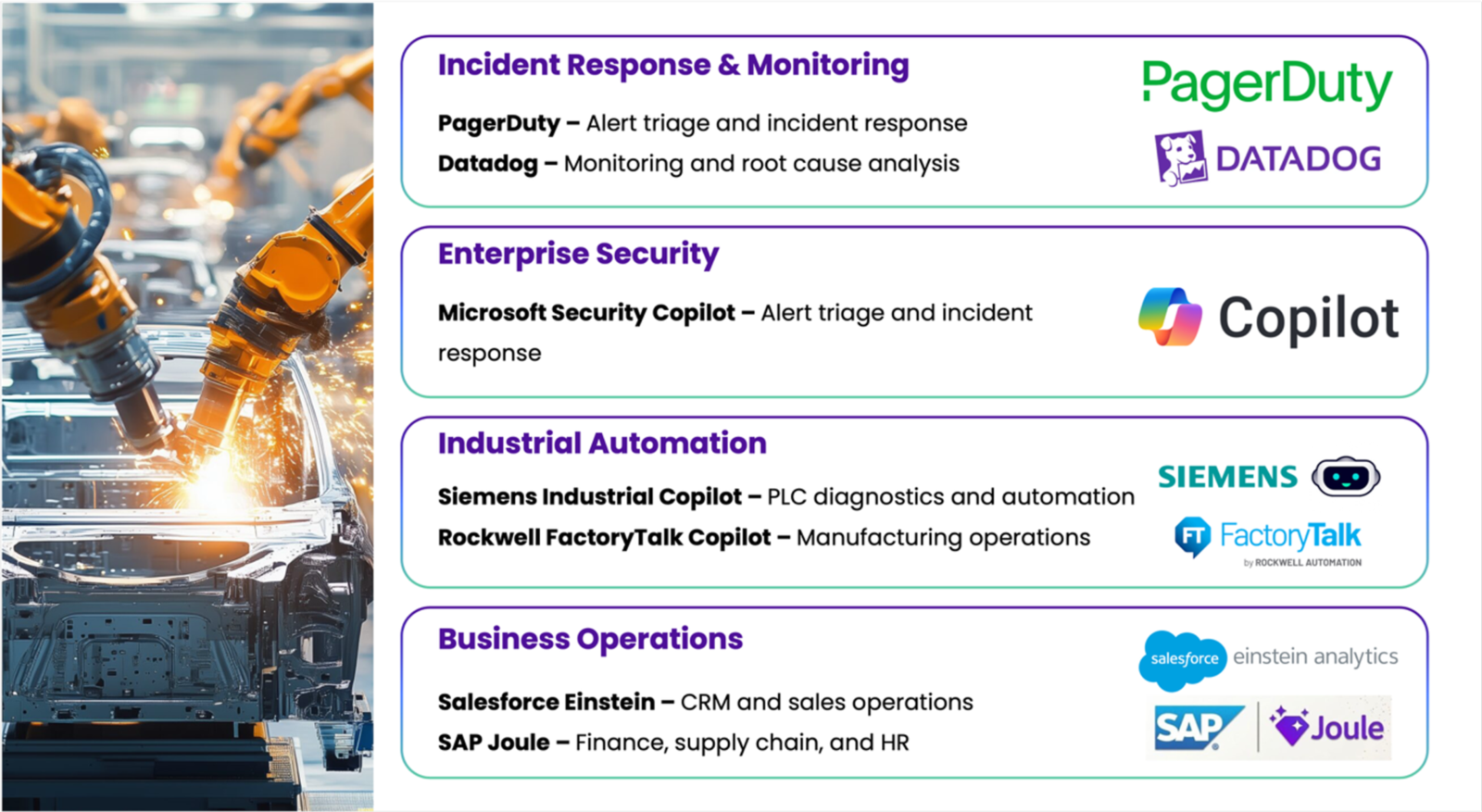
AI agents are no longer experimental technology. Across many business functions, organizations are already using tools like Salesforce Einstein for sales operations, Microsoft Security Copilot for cybersecurity investigations, SAP Joule for enterprise workflows, and Siemens Industrial Copilot for industrial operations. These systems help users analyze data, surface insights, automate routine work, and make faster decisions. While their applications vary, they all demonstrate the same underlying idea: software that can understand context, reason through information, and assist people in achieving a goal. Understanding these familiar examples makes it easier to see how similar agent-based approaches can be applied to manufacturing quality control.
What are Mindtrace AI Agents?
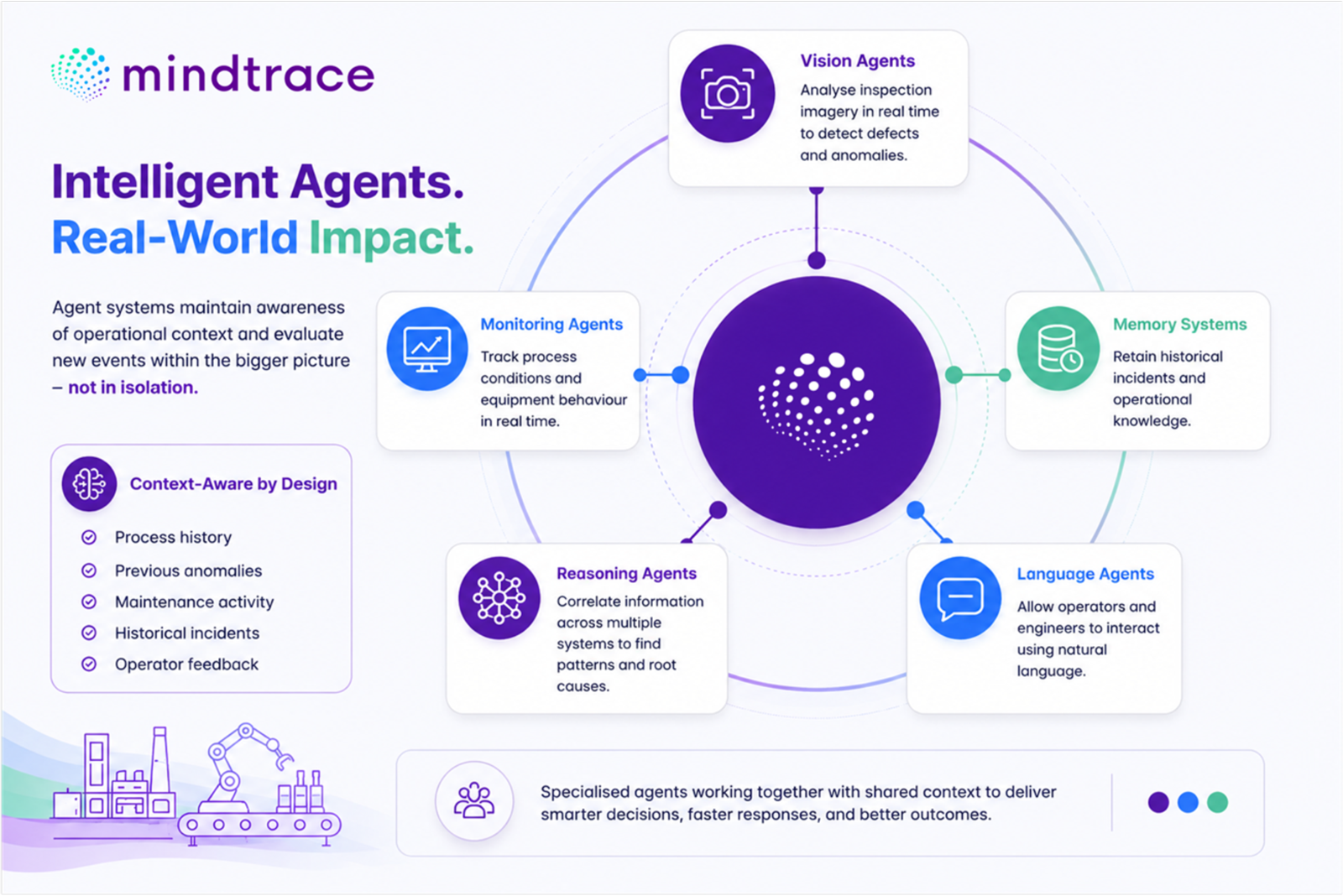
Mindtrace agent systems operate differently – they maintain awareness of operational context, including process history, previous anomalies, maintenance activity, historical incidents, and operator feedback. New events are evaluated within that broader context rather than in isolation.
In manufacturing environments, this typically becomes a coordinated system of specialised agents working together. Examples include:
- Vision agents that analyse inspection imagery in real time.
- Monitoring agents that track process conditions and equipment behaviour.
- Memory agents that retain historical incidents and operational knowledge.
- Reasoning agents that correlate information across multiple systems.
- Language agents that allow operators and engineers to interact with the system using natural language.
Together, these capabilities move manufacturing quality control from isolated defect detection toward contextual operational reasoning.
How Mindtrace is deploying Agents?
One area where Mindtrace is currently applying agent-based reasoning is laser weld inspection.
In many laser welding processes, heat trace inspection provides an important indicator of weld quality. An incomplete or missing heat trace can indicate process instability that may ultimately affect weld integrity. The challenge is that identifying a missing heat trace is often the easiest part of the investigation. Determining why it occurred is considerably more difficult.
A missing heat trace may be associated with power delivery issues, equipment drift, material variation, process parameter changes, fixture alignment problems, or other operational factors. The relevant evidence typically exists across multiple systems and requires engineers to manually piece together the timeline. This is precisely the type of problem that motivated the architecture shown below.
Here is a 3-step flow on how multiple Mindtrace agents orchestrated together to solve a complex production issue.
.png)
Step 1: Connecting Knowledge that has Never Spoken to Each Other
In this workflow, a Mindtrace vision agent continuously analyses weld inspection images, identifying incomplete or missing heat traces. In parallel, monitoring agent observe operational signals — voltage behaviour, current stability, equipment conditions.
Rather than treating these as independent events, the system consolidates inspection findings, power supply behaviour, historical incidents, and operator observations into a shared reasoning framework. This produces a contextual picture of the production environment, not a collection of disconnected alerts.
Step 2: Recognising Trends Before They Become Failures
Flagging a defect is the starting point. A Mindtrace reasoning agent correlates inspection findings with operational events, weighs competing hypotheses, and compares current behaviour against historical incidents stored in operational memory.
In the example shown above, the system identifies a repeated temporal relationship between incomplete heat traces and intermittent low-power events within the same production window. Historical incidents show similar patterns linked to unstable power delivery, and evidence for alternative explanations — fixture movement, camera instability — is absent. As evidence accumulates, candidate explanations are progressively strengthened or eliminated until the most probable root cause emerges.
From there, the agent determines the appropriate response: preparing a prioritised brief for the shift supervisor and attaching diagnostic context. The operator’s role shifts from monitoring dashboards to acting on clear, explained recommendations.
Step 3: Making Expert Knowledge Available to Everyone
The final stage introduces the Mindtrace AI agent orchestrator.
Rather than navigating multiple dashboards and inspection logs, engineers and operators receive a concise summary of findings, supporting evidence, and recommended actions through a conversational interface.
In this weld heat trace example, the orchestrator identifies the link between missing heat traces and power instability, references similar historical incidents, and presents a root-cause assessment.
This helps in accelerating investigation and distributing knowledge across the organisation. As operators contribute observations and engineers resolve issues, the system builds a searchable operational memory grounded in actual production history, giving a newer employee the same process-specific context that would otherwise exist only in a senior engineer’s head.
Why Now?
Two things have shifted recently that make agents deployable in ways that were not amenable before.
The data infrastructure is finally there. Connected machines, real-time sensor feeds, and integrated MES systems mean the evidence agents need to reason across is now accessible in a unified form on most modern production floors.
The interface problem is solved. Any operator can ask, “Why did first-shift yield drop on Thursday?” and receive a reasoned answer drawn from actual production data. The people closest to the process can now query it directly, in plain language.
Mindtrace is developing specialised AI agent infrastructure for industrial quality intelligence — built for the factory floor, designed to run on your infrastructure, and shaped around the processes of the people using it that stays inside your facility. The goal is expert-level reasoning that runs on your hardware, learns from your process, and remains under your control, without proprietary data leaving the facility.

Mindtrace Inc
Achieve Zero Defect Manufacturing with Mindtrace. Our Brain-Sense™ AI delivers rapid, scalable computer vision for automated visual inspection, ensuring 100% quality assurance and reduced waste in high-stakes automotive, aerospace, and defense production lines
Discover how Mindtrace Inc can support your automation journey with their complete range of solutions and expertise.
Visit Company Website


Achieve Zero Defect Manufacturing with Mindtrace. Our Brain-Sense™ AI delivers rapid, scalable computer vision for automated visual inspection, ensuring 100% quality assurance and reduced waste in high-stakes automotive, aerospace, and defense production lines
When Perfection Matters: Using Photometry-based Imaging Systems for Cosmetic Surface Inspection
Advanced Vision—a new class of automated visual inspection technology—combines the automation benefits of traditional machine vision with the sensitivity of true human vision to detect even the most subtle cosmetic defects and ensure a flawless product.
Automated car inspection with MotionCam-3D
A car rental company uses the Photoneo 3D camera MotionCam-3D to inspect and identify defects on rental cars.
Next-Gen Robot-Based 3D Inspection for Inline Quality Control
A state-of-the-art robot-assisted 3D inspection and metrology system is designed for real-time quality control in manufacturing by senswork Inc.