
Industry Insights
Taking Stock of Physical AI: Simbe's CEO on the Power of Data
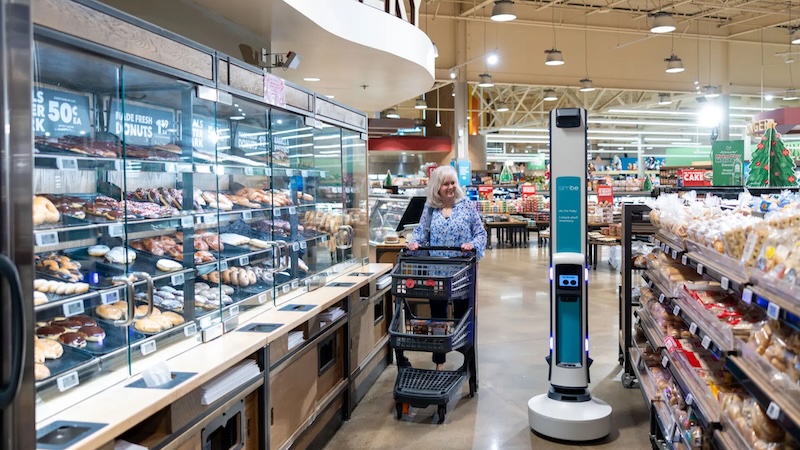
“We've seen more data in physical retail stores than probably anyone on the planet,” Brad Bogolea says. It’s tough to argue from the standpoint of sheer numbers. While Simbe’s CEO won’t reveal the precise number of Tally robots currently cruising up and down grocery store aisles, he suggests I extrapolate from the following datapoints:
- More than 1,000 cities across 10 countries
- A Cities can contain multiple locations with Tally systems
- Partnerships with 55 retailers (BJ's, Kroger, Giant Eagle, Albertson's, Aldi, etc.)
While prominent hardware startups have grappled with the question of amassing a large enough tranche of data to sufficiently train physical AI, Simbe’s robots have been counting whistling while they work, counting bananas, and spotting missing soup cans. I’m racking my brain to identify a robot I personally interact with more often in the real world, audibly greeting Tally during my weekly trip to one of two Poughkeepsie ShopRites.
Last November marked a decade since the Bay Area company announced the first version of the robot via press release. The pitch lays things out in simple terms: misplaced, out of stock items, and missing shelves contribute to an estimated annual loss of $450 billion for retailers globally. Inventory/story walks are a necessary but tedious and resource-consuming solution. How about a robot that can autonomously cruise up and down the aisles, constantly updating a map of store shelves?
Seems like a straightforward proposition from the vantage of a robotics newsletter in 2026. Jump back a decade, before terms like “digital twin” and “embodied AI” started losing all meaning, and you’ll remember that there are no sure bets in this business. Bogolea notes that robotics funding was significantly more difficult to come by as Simbe looked to launch its first product
“You and I know the old days, and if we back up 10 years, very few venture capitalists were putting dollars into areas like robotics,” he says. “We were fortunate to have research institutions like Willow Garage and other things way back.”
As Simbe marks Tally 4.0’s arrival this week, the company’s network of inventory robots have enjoyed an enviable headstart in the great rush to collect real world data for large model training. Tally’s scale and the consumer-facing nature of these deployments have no doubt played their own role in the establishment of a robotics ecosystem that has since seen funding round sizes that would have seemed impossible a few years back.
NEW ONLINE TRAINING COURSE
Designing Industrial AI Agents
Gain the skills to orchestrate advanced AI agents that learn, adapt, and collaborate like experts in real-world automation environments
Bogolea contends that massive rounds have fed back into the ecosystem, benefiting other robotics startups, in turn. “I'd say certainly any of the hype cycles or interest or what's happened at a foundationary model level is generally good for these spaces,” he explains.
In recent years, massive generative AI investments opened the door to huge humanoid robot rounds. The prevalence of such systems at events like last week’s CES have, no doubt, led some Simbe backers to wonder whether Tally 5.0 will sport a pair of arms in order to retrieve and restock the aforementioned missing soup can.
Ultimately, however, Bogolea says the company hasn’t faced too much pressure in the wake of the current hypercycle. After all, there’s plenty of space to expand in the space Simbe currently dominates. Also, it’s commonly understood that it’s going to take time to get humanoids right — particularly the hands, especially at scale.
Tally’s shelf scanning job may be relatively easy compared to the complexities of dexterous manipulation in a 3D environment, but the robot is out in the world doing that work, right now. And, perhaps more importantly to Simbe and its shareholders, the company’s customers are getting returns on their investments.
“They have perpetual eyes in their stores that allow them to have fewer out of stocks which boost sales,” Bogolea says. “They have fewer promotional errors. They have up-to-date product location information, which helps new employees understand where products are. It helps online grocery players pick orders faster in these physical stores.”
He adds that the company “hasn’t even scratched the surface” when it comes to the data Tally machines have been collecting for the past decade plus.
“It’s not just about what's happening on physical store shelves,” Bogolea says. “It's also navigational data. It's a full store digital twin. The place we’re going is […] how do you ask more abstract questions about these stores on cleanliness, orderliness, layering on more conversational AI versus, you know, exception level insights around store operations performance. It’s a really exciting opportunity.”
Association for Advancing Automation
Discover how Association for Advancing Automation can support your automation journey with their complete range of solutions and expertise.
Visit Company Website


