
Industry Insights
Robot I/O Aims to Speed Up Robot Deployment
Robot intelligence has advanced significantly in the last few years, but its support infrastructure has lagged behind. Most research groups working on robotic systems have had to build their own custom software to support individual robots. This has made it difficult to share tools, data, and AI models across platforms as the code needs to be rewritten for each robot.
Researchers from Carnegie Mellon University, Delft University, and Bosch Manufacturing have developed an open-source python-based framework called Robot I/O (RIO) that aims to tackle this bottleneck. The framework eliminates the majority of the setup required, making it easier to deploy AI systems across different robotic systems, without needing to rebuild software from scratch or rewrite code for each robotic deployment. A lot of robotics software was developed before general-purpose intelligence systems became commonplace, and new infrastructure is therefore needed to manage smarter software.
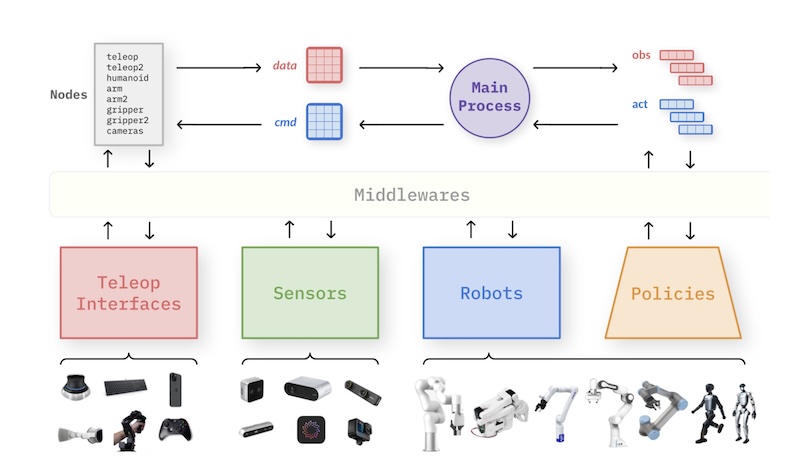
The RIO framework is a unified interface that combines robotic control, data collection, teleoperation, sensor configuration, policy deployment, and AI deployment across a wide range of hardware platforms. The framework allows researchers to move easily between robotic arms, grippers, humanoids, and other platforms, and has been designed to circumvent the extensive engineering work required before research can begin.
RIO is a modular system that allows software components to be reused in different robots. Users can freely choose between robots, sensors, teleoperation interfaces, cameras, middleware, data formats, and policies at every layer of the stack, as well as switch between them with minimal configuration. This approach enables researchers to combine existing components and customize the system to fit their needs whenever they switch hardware, instead of having to rebuild the same infrastructure for each system.
RIO is built on a node-middleware architecture, where nodes for teleoperation interfaces, sensors, robots, and policies are implemented from the same template. Because the nodes are middleware-agnostic, they can be paired with different backends depending on deployment requirements.
NEW ONLINE TRAINING COURSE
Designing Industrial AI Agents
Gain the skills to orchestrate advanced AI agents that learn, adapt, and collaborate like experts in real-world automation environments
RIO has been designed to be flexible and use agnostic components with no locked-in choices. It has also been designed to be reusable, where building blocks can be combined and modified, as well as being accessible for both robotic experts and non-experts through a single configuration file that is quick to install. Because the building blocks have been designed to swappable, the same pipeline can be used for all the robots that a researcher works with and special code is not needed to collect data or train policies for different platforms―even when there’s additional robot arms or cameras in one robotic system compared to another.
This shared foundation across for robot control, data collection and AI deployment could help robotics researchers to accelerate their research efforts, while at the same time, it could help make robotics more accessible for newcomers. This includes students who might normally take a semester setting up their robotic systems before research can begin. This was showcased during testing of the framework, as an undergraduate intern who possessed machine learning experience, but no robotics background was able to unpack a robotic arm and configure it for teleoperation using RIO. They were also able to fully control the robot within two hours of opening the box.
If deployed in industrial robotic settings―where there are often multiple robots, all with different sensors and working environments―it could help to get multiple robots online much quicker and make it easier and quicker to install new robots in existing robotic lines. In general industry R&D, the time from research prototype to real world deployment could also be shortened as the prototype could be tested and adapted in real world conditions.
RIO is still an active research project and some of the research team are still improving the technology alongside a startup called Lavoro AI. The researchers have said that future work on the framework will include expanding hardware support and lowering the barrier to bringing new robots online. The researchers also have a longer-term vision of building robotics foundation models that will allow different robotic platforms to autonomously adapt to new tasks and environments.
Association for Advancing Automation
Discover how Association for Advancing Automation can support your automation journey with their complete range of solutions and expertise.
Visit Company Website


