
Industry Insights
Dexterity's CEO on Real World Robot Data
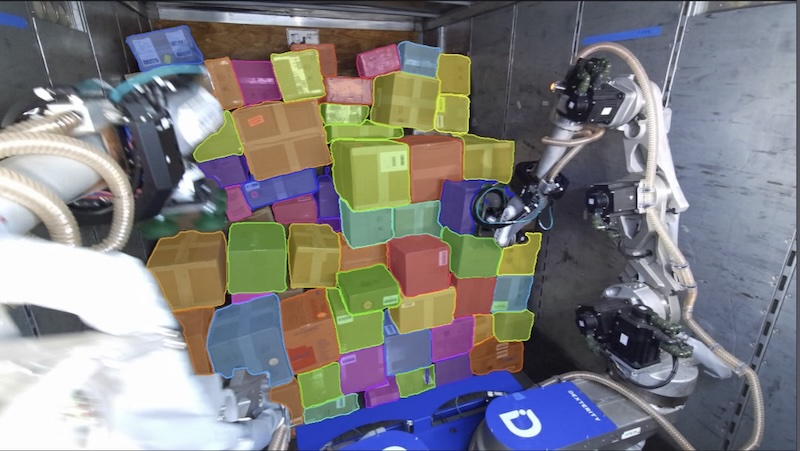
Halfway through our call, Samir Menon asks me to do a “little experiment.” I hesitate slightly. These sorts of interviews rarely call for interaction, besides the bit where we talk back and forth for 30 or so minutes. Dexterity’s CEO instructs me to close my eyes, put my hands down by my side, and then reach for an object on my desk. I lift my AirPods case.
“The first thing that happens is when you close your eyes, you have this model of your body,” Menon explains. “We call it a ‘body model.’ You know what the capabilities of your body are. You've got a model of your AirPods, and then you have a model of the physics of the world and how to reason about the spatial trajectories. All of this for us gets combined inside what we would call a ‘world model.’ The world model doesn't actually do the task, but it helps you reason about the world and it's foundational.”
Earlier this month, Dexterity introduced Foresight — or, rather, it “publicly nam[ed] something [it has] been building for years.” It’s what the Bay Area-based firm has taken to calling the world model it’s been constructing in labs and warehouse floors for the last seven or so years. While many of its newer and more theoretical brethren have been raising billions to take those first steps, Dexterity has been helping robots get very good at packing and unpacking boxes from pallets, loading and unloading trucks, air baggage handling, and parcel singulation.
That Foresight’s introduction didn’t light the startup press on fire probably has much to do with the fact that the company’s announcement wasn’t focused on humanoids, and never actually got around to uttering the words “general purpose.” For better or worse, nowhere in the demo does a robot execute a flawless backflip. If, however, you’re in the market for a browser-based game that allows you to stack boxes in the back of a simulated truck cab, friend, you’ve come to the right place.
Menon says the company is prioritizing safety, while focusing on smaller models.
“Our thinking has evolved quite a bit over the past few years, and it's really crystallized in the past four or five months,” he explains. “Their physical interactions with the world, which we would mediate with what we would call skill models. Skill models need to first and foremost be safe. In order for them to be safe, whatever limited data you have, you need to guarantee that they're going to have an interpretable output and somewhat bounded behavior. So we found it's a pragmatic choice to keep the skill model small. The same way when you look at some of the digital AI providers, they have these big mega models that are doing the complex thinking, and then you have smaller models that you can send off to do more pragmatic tasks.”

The past year has seen a massive spike in funding for physical AI companies, many of whom are working to build massive, generalized world models for robot deployment. Menon — a Stanford PhD, who founded Dexterity in 2017 — believes the attention being paid to startups like Physical Intelligence, Field AI, and the like, will be a net benefit for the industry at large.
“I would say I feel very grateful to be living in a section of our history where physical AI is so hot,” he says. “It's been my dream since I was a kid to work on AI robots. And we genuinely feel more warm and grateful for the attention to the entire sector. I think it adds a lot of momentum. There's a lot of creativity. We're doing great at certain parts of it. We're doing great at the world models. We're doing pretty well at the scale models. I think there are other people who are also doing very great in other parts of it. Like, we're very focused on enterprise. We're focused on enterprise applications, in particular applications that are stressful. Other people are focused on fine manipulation with fingertips. And so I think that the entire field will progress in collaboration and we're very open to collaborating with all these other companies.”
The Dexterity system performed its first autonomous pick in 2021, and was deployed at a Fortune 500 company’s facility the following year. In 2023, it hit 10 million autonomous in-production actions in unstructured environments, according to the company. As of 2025, it’s reporting more than 100 million. Customer deployment has given the company massive troves of data for training robots to perform these enterprise logistics tasks. The next step, according, to Menon, is seeking out edge cases to further bolster the system’s skills.
“We're getting to a point where now we want to proliferate. We want to go across many different sites, different countries, different geographies, different temperatures, different operating conditions and start getting expert tokens in those,” he says. “The goal is ultimately safety first, and the expert tokens allow you to respond at the very least in a safe way when you have unpredictable unforeseen environments.”

Association for Advancing Automation
Discover how Association for Advancing Automation can support your automation journey with their complete range of solutions and expertise.
Visit Company Website


