
Industry Insights
A Golden Compass: OSU Dean Ayanna Howard on Recentering Robotics' Human Focus
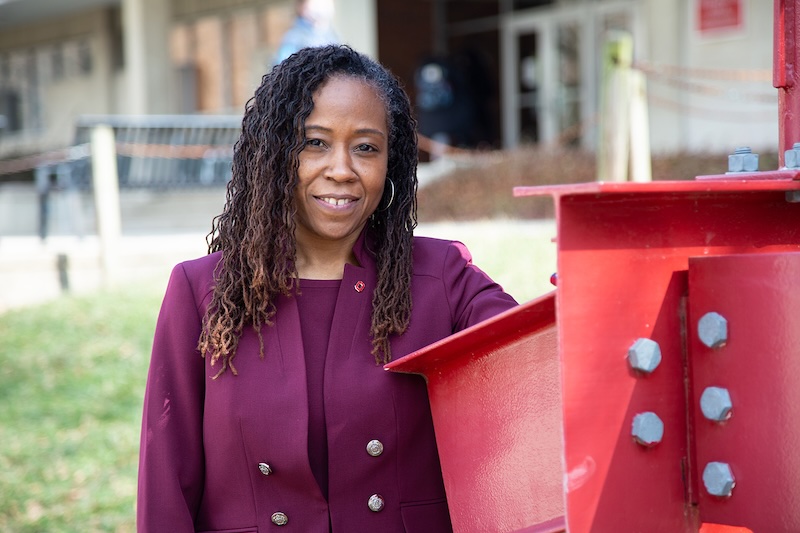
If you’ve ever considered writing a book about technology, you’ve grappled with the fact that the publishing industry doesn’t keep pace with the tech world. It’s taken as read that certain aspects will no longer be wholly accurate by the time its release date rolls around. Of course, good technologists accurately interpret the writing on the wall long before those changes occur.
Dr. Ayanna Howard accepts these truths as we discuss some of the bigger ideas in Rebooting the Machines, six months before the book’s release.
“I talk about things like military AI and the fact that AI at some point — maybe even by the time November comes — will be able to actually pull the trigger,” Howard notes. “What does that mean if you then still have inaccuracies in facial recognition or inaccuracies in identifying social economics? It means that when AI pulls a trigger, you might have a lot more impact depending on who you are. Those are world problems.”
Per its publisher synopsis, the book — which hits shelves November 10 — grapples with the notion that, “AI, including robotics, is not built with a moral center. That means that if we want it to serve all humanity, we must provide the compass.”
Howard, who currently serves as the dean of The Ohio State University’s College of Engineering, has been engaged with such questions for the entirety of her robotics career. Her PhD thesis, “Recursive Learning for Deformable Object Manipulation” focused on the use of robot grippers to safely manage needles amid a horrifying global pandemic.
“Back in the day, we had really big issues with HIV,” Howard says. “It was on the rise, and in hospitals, the way they did waste management is that they would have waste linen, for example, would be in one bag and you'd have just waste papers and all in another and you would have the needles in another bag. We didn't have those safe containers that are in the hospital rooms. And people would have to basically sort them out. The idea was we get robots to do this automated management of sorting out the bags so that things that were hazardous to people, you put it in one bin and things that had to go to wash, you put it another bin. That was the holy grail of what I was trying to do with my thesis.”
Howard’s relationship with NASA began when she was an 18-year-old undergrad, leading to more than a decade of employment at the legendary Jet Propulsion Laboratory. In 2008, she would collaborate with the space agency on SnoMotes, an autonomous snowmobile-shaped robot designed to gather data on melting ice shelves.
“The reason that I was so fascinated with SnoMotes was it was helping Earth,” says Howard. “Even though it was NASA-funded, it was really thinking about how to ensure that we survive the climate apocalypse here on Earth. Working on SnowMotes was my start into thinking about Earth as a planet. And of course, who's on Earth? Earthlings? Humans?”
Considering how robotics and AI could directly affect change in people brought Howard’s thinking back around to healthcare. In 2013, she entered the startup world with Zyrobotics, an educational company developing robotic toys aimed at children with disabilities and special needs. At the time, Howard was an associate professor at Georgia Tech, where she would serve a number of roles, ultimately being appointed chairperson of its School of Interactive Computing. She began her current role at OSU in 2021.
Perhaps unsurprisingly, Howard argues that both universities and commercial entities like startups have an important role to play in advancing the sorts of human-serving technologies around which she’s built much of her career.
“I still get references with my PhD thesis and that was in 1999,” Howard says. “If that didn't exist, we couldn't have a lot of these other technologies. That has to be done in terms of a university because no one else is gonna pay for it. There's not an investor that's like, ‘yeah, if you do something and 20 years from now I get a return on my investment, I'm good with that.’ ”
Association for Advancing Automation
Discover how Association for Advancing Automation can support your automation journey with their complete range of solutions and expertise.
Visit Company Website


