The team at Boston Dynamics pulled out the old hockey stick to showcase recent progress from its Toyota Research Institute (TRI) collaboration. The sports equipment has been something of a chaos agent in the robotics stalwart’s labs over the years, doing its best to disrupt high tech systems as they go about their work.
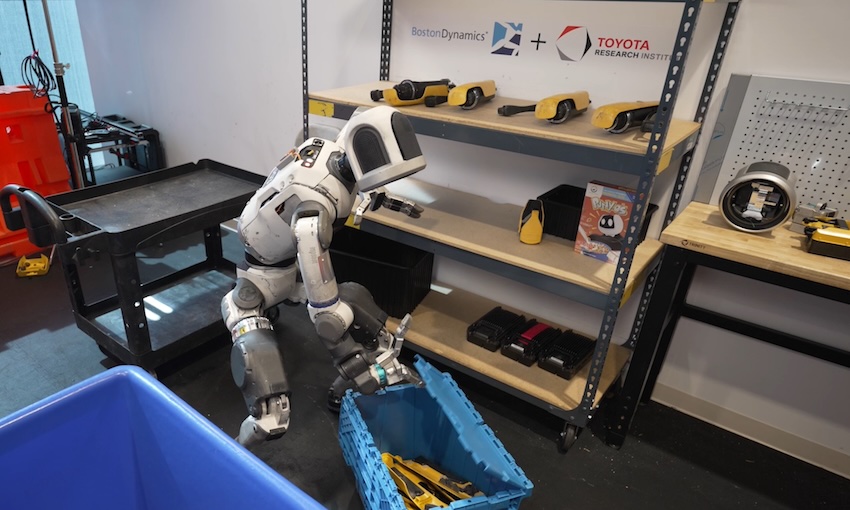
Here the lumber is directed at the electric humanoid, Atlas, the subject of the joint TRI research. Positioned just out of frame is an employee using the stick to be, in a word, “annoying,” making the humanoid robot’s job slightly more difficult, one swing at a time.
In the video, Atlas is tasked with picking Spot components off the ground, before placing them in a bin. The hockey stick intervenes multiple times, first closing the top of the bin after Atlas opens it and then pulling the bin out of the robot’s reach. Undeterred, the system adjusts and completes the job.
Atlas waits in front of an empty cart ahead of a second job, before someone drops Spot pieces down on top. Here the robot lifts up a dismembered Spot leg and appears to briefly examine it before folding it in half and placing it on a nearby industrial shelf.
What’s notable in both of these examples is the robot’s ability to execute a complex string of full-body tasks, while adjusting for real world challenges. According to the teams, both jobs were executed using large behavioral models (LBMs), rather than coding.
“One of the main value propositions of humanoids is that they can achieve a huge variety of tasks directly in existing environments, but the previous approaches to programming these tasks simply could not scale to meet this challenge,” TRI’s Russ Tedrake notes. “Large Behavior Models address this opportunity in a fundamentally new way – skills are added quickly via demonstrations from humans, and as the LBMs get stronger, they require less and less demonstrations to achieve more and more robust behaviors.”
The work is the result of a Boston Dynamics/TRI collaboration announced in October.