Baby Groot’s head is glowing in the late afternoon light. It’s ethereal, angelic even, and quite frankly, it’s hard to pay attention to anything else in the frame —human, robot, or otherwise. But the little tree-bodied galactic guardian had its moment in the proverbial spotlight back in spring 2021, when it was revealed to be the subject of Project Kiwi, an extraordinarily sophisticated bit of Disney Imagineering.
Groot was, in part, the baby of the man sitting to his immediate right on this Teams call. Scott LaValley’s got one of those resumes that makes teenage me want to ask adult me where I went wrong. I mean, look, I have a pretty cool job, but come on.
The guy spent a combined seven years as a contestant on BattleBots and the similarly formatted Robot Wars, during which time he and killer robot, DooAll, also appeared on Jay Leno’s Tonight Show. He worked on Boston Dynamics’ early biped, Petman, for roughly seven years, until the company was swallowed up by Google. He stayed on at Alphabet for another two years as a senior mechanical design engineer for the original Atlas, in conjunction with the DARPA challenge.
From there, he returned to Disney, where he had already done a brief stint in the mid-90s. This time he was made principal imagineer, Advanced R&D. LaValley stayed on for five years this time, during which Baby Groot was born. In November, the Year of our Groot, 2021, he did what any of us would and moved the high desert to found a humanoid robotics company. Cartwheel Robotics was founded in Fallon, Nevada, a city of 9,300, roughly an hour outside of Reno.
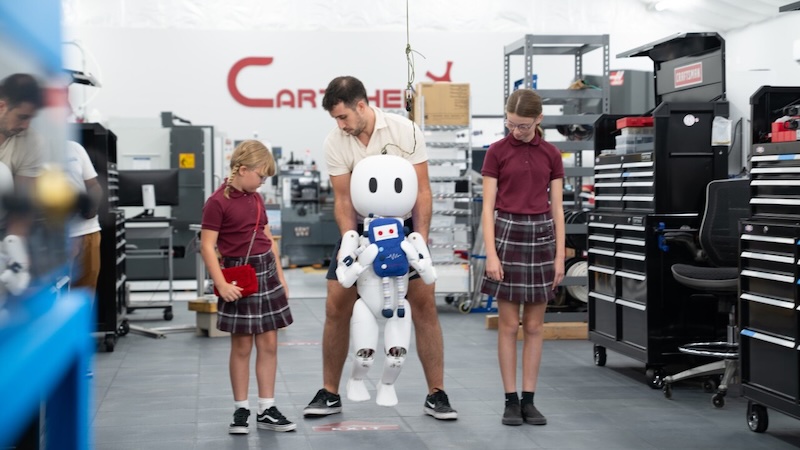
It's from those offices LaValley has connected with me, who just finished scrambling to find stable internet in an empty conference center hours after the close of A3’s Focus event. Backdropping the gloriously glowing Groot gourd at the end of the long conference table are a pair of bipedal robots that represent Cartwheel’s past, present, and future. To the right is Speedy. On the left is Yogi.
LaValley laughs as I reference “the storm trooper on the right.” The all-white exoskeleton, coupled with the helmet-like head immediately conjures images of one of the most iconic villains of now Disney-owned bit of multi-billion-dollar IP.

“Well, that’s why we pivoted,” says LaValley. “Because that’s the strong reaction we were getting. It was like, ‘shoot, that’s not what we were going for. I wanted people to think this was a friendly little guy thing, and I was hoping people wouldn't look at it and go, ‘oh, that’s a cute little robot.’”
LaValley says Yogi and Speedy were developed in parallel and jointly presented to investors. They, too, connected with Yogi’s Charlie Brown-sized noggin. A compromise was struck, with Yogi’s head and torso being attach to the bottom half of Speedy, which had made more progress between the two robots. The MVP (minimal viable product) version of of Yogi is about six inches taller than what Cartwheel is aiming for in production. When it comes to market, the robot is expected to stand a little over three feet tall. As for what the home robot will actually do out of the box, LaValley hopes a system as complex and fluid as Yogi can alter consumer expectations around robotics.
“We want to recalibrate people's expectations for out-of-the-box technology, like a humanoid, to be more aligned with what you would expect from your puppy when you bring it home,” he says. “The puppy’s not going to shake my hand. It's probably not going to roll over when I say ‘roll over.’ And it's probably going to pee on my carpet, right? But we all spend time with our puppies, to raise them and get to that point.”
In a world where a near riot breaks out any time Facebook adjusts the placement of a button, retraining consumer expectations is a big ask. A Roomba this isn’t. There is, however, a clear appeal in a robot that learns and grows along with the home it inhabits. The notion also offers a kind of organic parallel to the manner of learning we now associate with robotics. Videos recently posted to LaValley’s LinkedIn showcase what the company refers to as “Motion Language Models,” which help generate Yogi’s fluid movements.
“We’re moving toward Cartwheel being a foundational model company that has its own hardware platform to deploy that capability on,” LaValley tells me. “So, we’ve started to go in that direction, but we’re going to expand on that under our seed [round]. So right now, it’s a motion language model, which is focused on generative motion through speech or text prompts.”
Cartwheel is similarly exploring various approaches to consumer pricing.
LaValley again, “One model doesn’t fit all. A corporate customer is probably going to pick a RaaS (robotics as a service) type model and pay a flat fee of $2,000-$3,000 a month and be perfectly happy with that. Whereas, if Yogi is going to go into the home, it's probably a little too much. For the home we're looking at more of a robot lease model in a target price of probably $10,000.”