“When we got back from CES, we had a bunch of working [Atlas systems] and our team did a, just a big exhale, letting out all that stress and pressure,” Zachary Jackowski explains “And then we decided, hey, let's go do some really fun stuff, with these robots for a couple of weeks.”
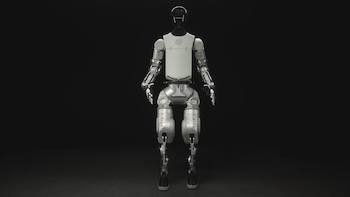
The result of that collective release valve is “Atlas Airborne,” which — as of this writing — has racked up just shy of two million views on YouTube in two weeks. The video is homage of R1, the version of electric Atlas that made its global debut in 2024. Surrounded by a sea of cameras, the humanoid launches into air for a double back flip, before landing on its legs with precision and poise.
The triumphant moment is immediately followed by a full minute of the robot eating s*** in various ways. It’s this — the glorious montage of slips and spills — that signals confidence among a team of engineers. It is, as they say in math, “showing your work.” On social media, Boston Dynamics positioned the video as “one last run in the sun” for the robot — final victory flip and fumble before putting the battle-scarred ’ bot out to pasture.
“We were ready to let the R1 robots go,” says Jackowski, who heads up the Atlas team. “We're making static display models. We've got one up in our museum now. And yeah, we're putting them away. They're on a code branch. There's a couple people still using one. But that branch is getting increasingly divergent from the trunk.”
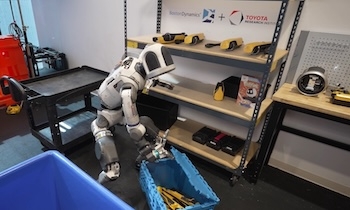
This version of the robot wasn’t destined to work alongside humans. Despite Atlas managing to stick the landing for the camera at least once, the robot was big and bulky. Human onlookers are conspicuously far away from the humanoid as it performs feats with varying degrees of success. To hear Jackowski describe it, the R1’s most important achievement was teaching Boston Dynamics how to build a humanoid in the first place.
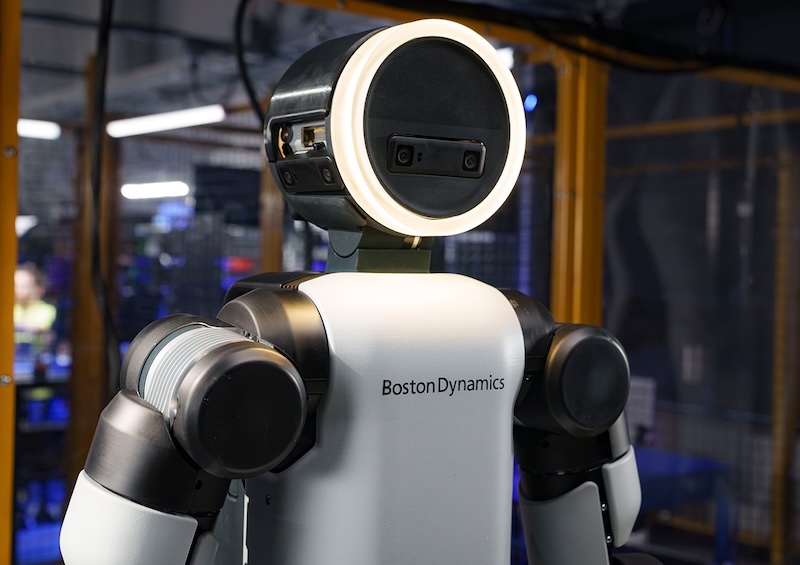
In a number of ways, the production version of Atlas, which was unveiled at last month’s CES, represents a dramatic paring down of the robot. Mass production means building a robot that is significantly less expensive to produce, is easier to repair, and is generally safer around humans. That, in turn, means lighter, and with far fewer parts. Jackowski is particularly proud of the fact that the team managed to streamline the system down to two different kinds of actuators (three with the hands), while maintaining the strength and flexibility showcased in earlier R1 videos.
“If you launched from day one and just said, we want to build the whole humanoid robot product enchilada, there are so many decisions and technical threads to pull on that and information you fundamentally do not have yet about what makes the robot work well, that you just get bound up,” says Jackowski. “When we built [R1], we didn't yet understand how all the pieces fit together precisely. You can spend a lot of money and buy really nice materials and kind of push the limits of performance in a lot of ways. But in a lot of ways, when you build a first-generation robot like that, it's an unbalanced machine. The fact that you went to the extremes on some parts doesn't necessarily, they don't all play together perfectly well.”
He pushes back on my suggestion that moving from an expensive research version to a (relatively) more accessible commercial model necessary introduces major sacrifices into the hardware production.
“The R1 robot has three computers in it, two X86 computers and a Jetson in the head. The new robot has a single Thor in it. That’s an enormous simplification, and an enormous jump in compute power. We get that in a lot of places in the robot. Not just the compute, but the actuator designs. We know how to build super performant low-cost actuators, because we figured some things out that let us have our cake and eat it too. When you design a product, it's not always just make it worse to make it cost less. There are plenty of places where you can legitimately be smarter or use information that you didn't have the first time to make it fundamentally better in every access.”
Atlas’s first stop will be in parent company, Hyundai’s, manufacturing facilities. Jackowski believes the environment represents a good first step toward generalization that will eventually take Atlas beyond industrial applications.
“Hyundai is so beautifully good at designing car plants,” he says. “If you go to a Hyundai car plant, there is a very good reason why every task in that plant that isn't automated is not automated. Like they know this stuff backwards and forward so well. And the reason is that there is such a diversity of behaviors around all these things that aren't automated yet in the car plant. You need that generalization to do that stuff, and there's plenty of diversity to engage with just in that context. The thing you do get with that context is you get some regularity. There's a huge diversity, but you get to engage with that diversity in a repeated form. And you get to work around trained people, trained adults who understand how to work around a piece of equipment.”
Now R1 has been retired, however, it’s likely we’ll see the production version of Atlas collecting research in more domestic settings.
“I'm sure we'll spend some time in home environments too, making beds and folding laundry and cleaning countertops and all that stuff too,” says Jackowski. “It's amazingly capable — probably a little bit too capable for a home environment. That's a great thing if you're going and doing research.”
The A3 Humanoid Robot Forum is Happening at Automate 2026!
As humanoid robots transition from experimental labs to the factory floor, the Humanoid Robot Forum provides the blueprint for what comes next. This intensive two-day event, taking place from June 23-24 at Automate in Chicago, explores the cutting-edge insights into the performance constraints and measurable outcomes of today's most advanced bionic systems. Learn more and join us there!