Boston Dynamics tagged along with parent company Hyundai to Las Vegas for this year’s CES. While the robotics firm has previously made cameos along with the Korean automotive giant, 2026 is seeing it take centerstage, as robotics takes an increased focus at the one-time consumer electronics show.
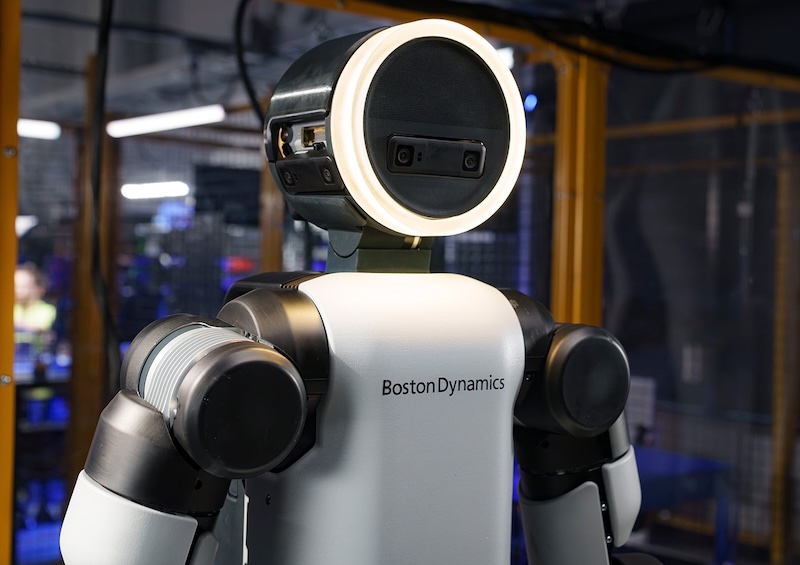
The event saw a handful of big announcements, including an embodied AI partnership with Google’s DeepMind division, as well as the debut of the production version of the company’s electric humanoid, Atlas. Up to now, Boston Dynamics videos have featured a technically impressive – but considerably less scalable – version of the bipedal robot, owing in part to expensive production costs.
This version, while not cheap, is going going into production this year, with the first models landing roles in Hyundai’s own Robotics Metaplant Application Center (RMAC), as well as Google’s DeepMind offices. Hyundai had previously stated its intent to deploy "10,000s of thousands" of Boston Dynamics robotics in its facilities in coming years – a list that also includes the company's Stretch and Spot systems.
Hyundai has also claimed that a recent $26 billion investment in U.S. manufacturing put its high-profile robotics division on track to produce around 30,000 systems per year from a single factory.
Additional customers beyond Hyundai and Google will begin receiving the robot at some point in early 2027, per the company.
“For more than 30 years, Boston Dynamics has been building some of the world’s most advanced robots,” CEO Robert Playter said in a release tied to the news. “This is the best robot we have ever built. Atlas is going to revolutionize the way industry works, and it marks the first step toward a long-term goal we have dreamed about since we were children – useful robots that can walk into our homes and help make our lives safer, more productive, and more fulfilling.”
The new robot is 6.2 feet tall and sports a 7.5-foot reach. It's able to lift payloads of up to 66 pounds and operate in temperatures ranging from -4° to 104°F. The last bit is important for warehouses that rely on truck deliveries, which can get extremely hot and cold when exposed to the elements.
Another interesting tidbit I didn't expect to see in the press material is an IP67 – meaning the humanoid sports strong water- and dust-proofing, so you can actually hose it off, as needed. The new Atlas operates with a stated battery life of four hours, prolonged indefinitely by the robot's ability to hot swap its own on-board batteries in around three minutes.
As for this claim, "Atlas will add value from day one, and much like Spot and Stretch, most customers will see ROI within the first two years of adoption" – we'll obviously have to just wait and see on that one. Return on investment remains a massive question mark as far as deploying these systems in the field, and use cases are likely to be fairly limited in the earliest stages.
Boston Dynamics is a bit less clear on what the initial tasks will be, noting that it is, "starting to work with select customers to evaluate, train, and perfect feature-rich, autonomous material handling solutions." Material handling has been the key focus for Agility, whose Digit robot has made the most real-world progress among U.S.-based humanoids.
The company is pitching a system that operates outside a controlled, cage environment, alongside human coworkers, making safety paramount. Boston Dynamics has been among a handful of humanoid firms, including Agility, working to write standards for these systems. Seems it's also taken some cues from its parent company here.
"Leveraging best practices from the autonomous vehicle industry, Atlas has an onboard safety system to help it detect people and vehicles in busy workplaces," the company writes. "This allows for operation with fenceless guarding; if a person walks by within a certain radius, the robot pauses and waits for them to pass. The robot is also designed with padding and minimal pinch points as added safety precautions around people."
CES also sees the announcements of a new partnership between Boston Dynamics and Google DeepMind – though the deal isn't exactly an exclusive for either side. Google's operations have enlisted Apptronik Apollo humanoid robots in public-facing tests, while Boston Dynamics has previously teamed with TRI (Toyota Research Institute) on AI learning research.
“We developed our Gemini Robotics models to bring AI into the physical world,” Google DeepMind senior director Carolina Parada said in a release. “We are excited to begin working with the Boston Dynamics team to explore what’s possible with their new Atlas robot as we develop new models to expand the impact of robotics, and to scale robots safely and efficiently.”
The research, which involves the deployment of Gemini Robotics foundational models on the new version of the humanoid, are set to kick off in "the coming months" – presumably once those systems start shipping. Per Boston Dynamics,
Long known for its robots’ athleticism and impressive physical abilities, Boston Dynamics only announced its intention to build a commercial humanoid in 2024, after it became clear that recent AI advances had accelerated the pace of how robots could be trained and deployed into real-world applications.
Commercialization has been a major focus for Boston Dynamics since Playter took over the top spot from founder, Marc Raibert. Atlas will be its third commercially available robot, following the Spot quadruped and Stretch, a truck unloading robot. While Spot has been deployed in a wide range of different scenarios, including building inspection and even policing, Atlas will join Stretch in focusing on factory and warehouse floors.
In April 2024, Boston Dynamics retired its pioneering hydraulic humanoid Atlas, replacing it with an electric robot of the same name. Early videos impressed, showcasing extremely strong and flexible actuators that allowed the robot to quickly change directions and stand up with a few well-placed twists.
Hyundai says it will be utilizing its own Mobi robotics platform to deliver actuators for the new Atlas systems, adding that the "two organizations will work together to build a highly reliable component supply chain and accelerate the pace of actuator development and production."