“Everything is a journey,” Zack Jackowski tells me. “You’ve got to do it step by step.”
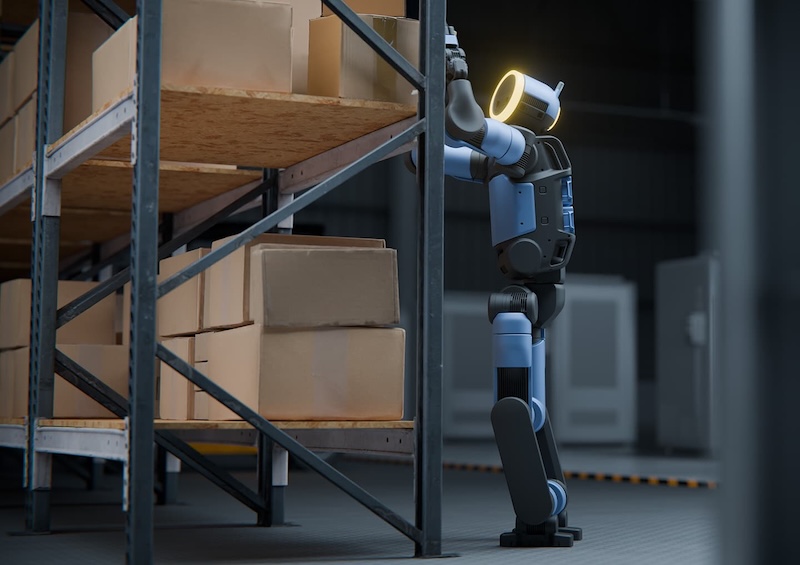
Atlas’ general manager could be forgiven for taking his own victory lap a week after the humanoid strode into the spotlight amid a grand reveal. If CES 2026 was, indeed, the year of the robot, the 6.2-foot, productized version of Boston Dynamics’ humanoid stood out among the rest.
But if a decade of speaking to roboticists facing down the infinite complexities of converting research into scalable production has taught me one thing, it’s that both Atlas and its creators have only just embarked on their thousand-mile journey.
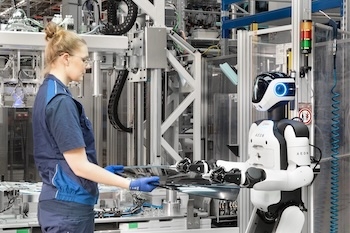
“We're not going to start with the hardest task in the car plant,” Jackowski adds, describing the in-house pilots for the company’s third commercial product. “We have a tremendous amount to learn along the way.”
Those precious first baby steps were, themselves, more than a decade in the making. The concept of productization was seemingly nowhere on Boston Dynamics’ radar when the MIT spinout took an early PETMAN (Protection Ensemble Test Mannequin) prototype out for a brisk walk for cameras on an industrial treadmill in 2014.
Even by the non-existent standards of the day, that bipedal robot wasn’t much to look at. Indeed, the mind contorts to reconcile a beefy rectangular torso mounted atop a skinny pair of hydraulic legs with any shared notion of what constitutes a “humanoid.” The armless, headless system was supported by a series of cables snaked down from a gantry system.
The seeds of Atlas are clearly present nonetheless, with a natural heel-toe walk that effectively mimicked a human gait. In true Boston Dynamics fashion, an employee in protective eye gear and cargo shorts gives the robot a modest shove across the treadmill. PETMAN rights itself and returns to its original spot, while ambling forward the whole time.
Like other early Boston Dynamics projects, the humanoid was brought to life by defense department (DARPA) grants. In PETMAN’s case, north of $26 million was reportedly invested into a system designed to test equipment in extreme settings, without risking human life in the process.
PETMAN was foundational when the original Atlas took its first public steps in 2013. Now sporting arms and a head, the more complex robot was built for more complicated tasks. The robot was stress-tested by a half-dozen the following year during DARPA’s Robotics Challenge.
A considerably slimmed down Atlas debuted a decade later by way of a short video that showcased otherworldly movements. A lot had happened at Boston Dynamics HQ in the 10 years since the first Atlas broke cover. Notably, the Waltham, Massachusetts company ad switched a couple of times. In 2017, Google parent, Alphabet, sold the company to Softbank. The Japanese investment giant held onto the firm for three years before selling it to current owner, Hyundai.
Boston Dynamics executives tend to credit time spent in the Softbank portfolio with its current focus on productization. Longtime CEO, Marc Raibert, stepped aside to continue his research focus by founding the Hyundai-backed RAI Institute, while longtime employee Robert Playter stepped into BD’s top role, first shepherding the quadruped Spot robot to market, followed by truck unloader, Stretch.
The larger, louder hydraulic Atlas was officially retired in April 2024, just as the electric version made its video debut. Like its predecessors, this system — known internally as “R1” — wasn’t destined to be productized. Even in this redesigned form, the robot wasn’t ready to be scaled for manufacturing. For one thing, it was too expensive. For another, it was too hard to repair. Jackowski says R1’s primary function was to establish the company’s “understanding of how to build an electric humanoid.”
In that sense, the R1 harkens back to Boston Dynamics’ roots, as a pure research robot built to demonstrate what is possible with the current state of the art. The follow-up product version, meanwhile, is a bid to balance the somewhat conflicting demands of performance, reliability, and value.
“The big difference between something you're doing for research and something you're doing for product is, when we do research, we try to load up a robot with as many things that it can teach us,” Jackowski explains. “So you want to put all the technologies in there, even though it might be a hard platform to stay on top of in terms of complexity. A product is kind of the opposite, and we know how to do both here. You want to start with the absolute minimum, and you want to add pieces. That's also like a really core part of our heritage here at Boston Dynamics: under-design something — put in less than you really think you need and let it break.”
Despite the brevity of its debut video, R1’s wow factor was immediately clear. The humanoid sported impressively robust and versatile actuators enabling the system to stand, contort, and shift directions on a dime. If anything, the hardware gave the system more of an uncanny, superhumanoid functionality. As the team looked to build a “blank sheet” redesign for market, the number and nature of on-board actuators had to be scaled down dramatically. Jackowski tells me that the productized version of Atlas makes use of a mere two different sizes of actuators — three if you factor in the manipulators.
At press time, Boston Dynamics won’t reveal the internal machinations of the actuators themselves for proprietary reasons, but Jackowski promises that the product version of Atlas was designed with fewer compromises than one might immediately expect, comparing the system directly to the research version introduced just under two years back.
“We'll be doing some fun stuff with the new robot,” he says, “and in fact it's a situation where we can have our cake and eat it too. Because we have some of these special things going on in the actuators, we can do performance, cost, and reliability at the same time.”
The systems’ shared DNA is clear at first glance. The more you compare the two electric Atlases, however, the more pronounced the distinctions become. If anything, Jackowski tells me, the team was surprised more of last week’s coverage wasn’t focused on just how much had changed in the past two years — particularly from the waist down. He anticipated more column space would be devoted to the system’s fully rotational, joint offset legs. No doubt the sheer spectacle of launching an industrial humanoid robot in an ostensibly consumer-focused event meant press coverage failed to extrapolate upon some of the finer details.
Both despite and because of the changes made between the two Atlas models, Boston Dynamics’ third commercial product is its most ambitious. Jackowski, who previously led the Spot team, discusses the humanoid with what might be classified as pragmatic optimism, describing an eventual roadmap to a general-purpose robotic system with numerous pitstops spread out over a somewhat indefinite timeline.
“One thing that we should be really, really clear about is while we're starting with simple tasks, we are very excited about a road map that extends all the way through very complex, dexterous assembly tasks,” Jackowski explains.
The roadmap’s specifics are largely a product of its parent company’s requirements. Being owned by Hyundai means Atlas had a pilot customer baked in from day zero. It’s not difficult to imagine a meeting where Boston Dynamics first showcased R1 for impressed corporate executives. It’s equally easy to picture a few sleepless nights after the most senior member of the bunch says, “That’s great. We want that. Now do it affordably, at scale.”
Dexterous manipulation is, arguably, the form factor’s greatest challenge Jackowski notes, however, that when it comes to humanoids in the workplace, the conversation has largely shifted from “if” to “when.”
“One of the coolest things about being so closely connected with Hyundai Motor Group is they have this crazy deep understanding of everything that happens in their manufacturing facilities, so we have a really well-detailed taxonomy of manipulation skills through Hyundai,” he says. “So we have a road map in terms of we want to do this skill, then this skill, then this skill, and these are our unlocks in terms of addressable manipulation throughout manufacturing.”
Jackowski confesses that how long it will take to address each is another question entirely.
“That's a tough one, and actually like we have the best ML manipulation engineers in the world in the room when we're talking about this stuff,” he says. “There’s a pretty wide variety of answers, and it's usually more about how risk averse folks are about when they really think that the technology is going to be ready, because we're really talking about is something, two years away or four years away?”
It will also take time before Atlas can confidently work in close proximity to human colleagues. Boston Dynamics is among the companies working to produce safety standards for the form factor. Like other industrial humanoids, the productized Atlas is dynamically stabilized, meaning the robot will essentially collapse when it loses power. This issue is addressed to some extent by its ability to hot swap its own batteries, but it remains one of the reasons caution is still required.
Atlas won’t require a physical fence like other, larger industrial systems, but the robot will have a proximity sensor that pauses work when a person gets within 1.5 to two meters of the robot. This is one of a number of steps the company is taking to improve worker safety around the ‘bot.
“We have a very robust road map including all of the technology platform items and AI items necessary to get Atlas working in close proximity to people, because when you get into assembly tasks, you have to be working near people. People need to be able to hand you parts and hand you tools or just work closely with you. That's definitely a required thing. This is going to take time for us to build both the technology and build the regulatory context, because it just fundamentally doesn't exist right now.”