
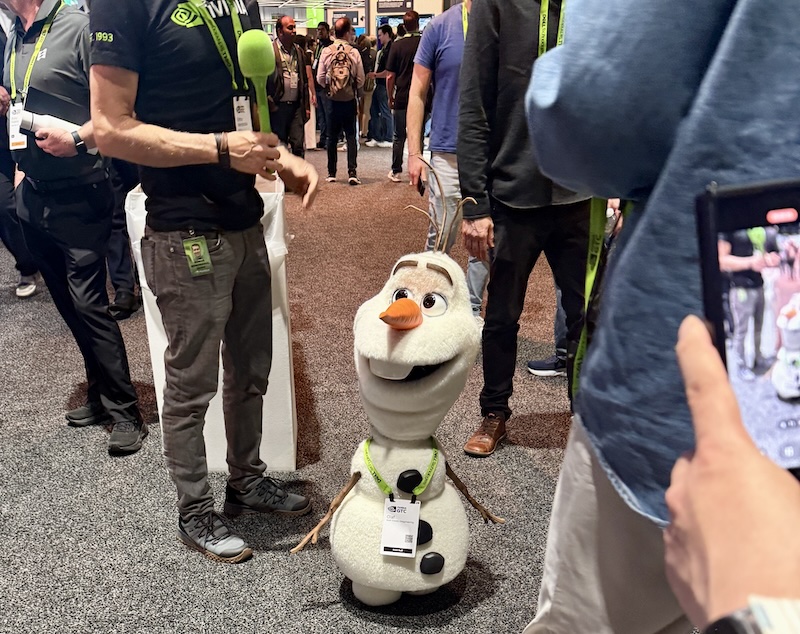
As a real-world, free-roaming robot snowman testing ground, one could do far worse than the San Jose Convention Center on GTC day two. It’s no Magic Kingdom, sure, but you’ve got plenty of awe-struck, extremely distracted throngs of humanity to bob and move around. Fresh off his second stage appearance in as many days, Olaf —– and his Disney research designer, Moritz Baecher — decided it was as good a time as any to walk the show floor. Both wore badges.
The robot’s read,
Olaf
Walt Disney Imagineering
Event Staff
It wasn’t much of a cover, however. A crowd soon gathered around the movie star, eager for a better look a day after he helped close out the day one keynote. Even at a show populated by a dozen or so functioning humanoid robots, a waist-high, anthropomorphic snowman is going to draw a crowd. But hey, it’s a good dry run a few weeks ahead of the system’s official Disneyland Paris debut.
Olaf represents the latest addition to Walt Disney Imagineering’s growing army of advanced robotic characters. Animatronics have come a long way since The Hall of Presidents’ early 70s debut. The goal here is to blur the line between audience and attraction by building characters that can walk amongst showgoers.
This year’s GTC was a return appearance for Baecher, who was joined on stage last year by a BDX Droid. Those Star Wars-inspired systems have since taken up residence at Disney resorts and aboard the company’s cruises.
The Frozen robot currently makes his way through crowds with the aid of a human operator. “Right now , Olaf is remote controlled,” Baecher tells me. “We use a joystick controller, where you use one joystick to control the direction of walking, and with the other, the head motion. So you, as an operator, you avoid obstacles.”
Baecher adds that the plan is to keep a human in the loop for Olaf’s operations. His droid predecessors, on the other hand, are built to autonomously avoid obstacles.
“We have full navigation solutions, where we train a navigation policy,” he says. “You take perception into account, and then it finds its path around you. It does what it’s supposed to do and avoids obstacles. Obviously, if someone were to stand somewhere in the way, then it would navigate around them.”
All the while, the little droid is mapping — and consistently updating — its environment.
“It can truly be an explorer droid, because explorer droids do map the environment,” Baecher adds. “We can run all of that on a Jetson — it’s a pretty robust navigation policy now.
Keeping Olaf upright and planning for eventual edge cases, meanwhile, is a combination of reinforcement learning and training via synthetic data.
“We use reinforcement learning for balancing,” he explains. “It’s not a guarantee. How you do that in reinforcement learning is you sample an entire space for what you want to do on the control side. You have operator commands and you sample them randomly. You sample all combinations of what you can do with two joysticks and with the buttons. We push those in simulation. We apply forces and torques to the pelvis and feet. You also vary the terrain, so it’s not flat ground that it learns to walk on. And then you randomize the simulation prompts. All of this randomization helps it to be robust. The better you sample the real world in simulation, the better performance is going to be.”
Planning for edge cases that arrive in the form of human instigators, however, requires both building robots that maintain a safe distance and relying a bit of good, old fashioned human reinforcement.
“Almost all of the guests are well-behaved,” says Baecher. “But there are also people who help with guest control. But the BDX droids are a safe distance from people and there’s someone in between. Safety is the highest priority.”
.jpg)