Shipping a single product is a milestone plenty of robotics startups will never reach. Not that there’s any time to stop and celebrate, of course. Once your systems are out in the world, you’re suddenly beholden to an entirely new group of people, faced with new challenges and edge cases you’d never dreamt up in the comforting confines of a laboratory setting.
When I Iast spoke with Kaan Dogrusoz over the summer, Weave Robotics’ CEO told me the company was shooting to deliver its home robot, Isaac, before the end of 2025. It was a bit of an overly optimistic goal, but 1.5 months into this year, the startup has made good on delivering a version of its system.
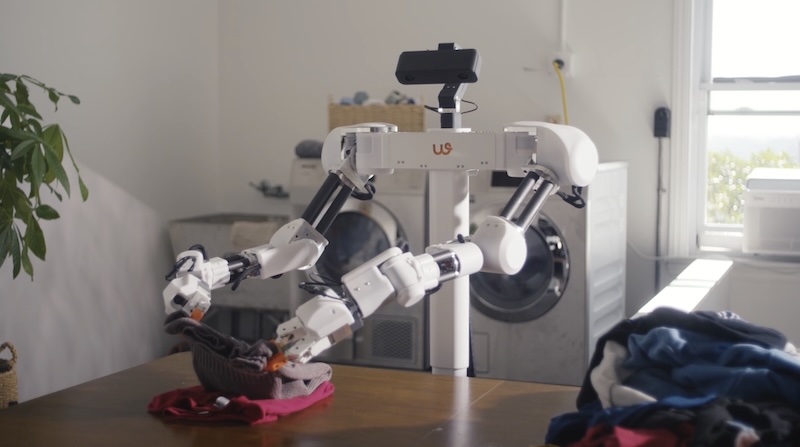
As the name suggests, Isaac 0 isn’t the fully realized mobile robotic platform cruising around the living room in the looping video on Weave’s home page. The company describes it as “the simplest possible form for a laundry folding robot” — a fitting description for a product that began life as a prototype for the more complex version of the platform.
“It was that ruthless paring down that allowed us to deploy our fleet to our first commercial customers' locations as a young team,” the Weave team writes in a recent blog post. “Our fleet has now been operating for months, folding thousands of pounds of laundry every month. And we're now bringing that experience to a new environment, the home. Homes are less forgiving than labs and less predictable than commercial laundries. They demand robots that work without supervision and are quiet, reliable, and safe. The very focus that made Isaac 0 stationary is exactly what makes it ready to be useful in homes.”
So that’s the product Weave began shipping to Bay Area-based customers willing to pay $8,000 up front or $450 a month for an at-home laundry folding robot. Dogrusoz tells me the decision was motivated by the simple desire to get more robots out into the real world.
There was no external or internal pressure to get something out,” he says. “It really is something that is part of our DNA. I would say we really believe that robots should be out of the labs at this point in like a safe and responsible way.”
We’re in a liminal space for widespread robot adoption. Many of the foundational pieces are in place, but we don’t have nearly enough data for proper scaling. The most straightforward method for collecting that data would be a kind of brute force approach, by deploying robots at scale. Chicken, meet egg.
We’re nowhere near a point where we can deploy robots that can reliably perform generalized tasks. We have, however, gotten quite good at building robots that do one thing — like folding clothes — pretty well.
“This is actually very similar in my mind to how the personal computing timeline has rolled out,” says Dogrusoz. “We didn't go from having zero personal computers to an iPhone in hand the next year, right? It is a very iterative process. It is a process where industry learns. It’s a process where the customers learn. And we think that process is very important to enable.”
The system is designed to fold garments (shirts, pants, towels, etc.) autonomously. Sometimes, however, it can get stuck on tricky articles of clothing and unfamiliar settings.
“Once our stack detects that the robot is stuck and not making any progress after some amount of time, or it's made a mistake that basically subtracted from the progress by some threshold, we dial up a Weave specialist,” says Dogrusoz. “The specialist essentially only sees what is crucial to complete the task at hand, which is a camera, no audio feed, and is able to take over the arms of the robot for something on average of a 5-10 second correction and hands it back off to the model so that the robot can continue with completing its task.”
Dogrusoz won’t disclose how many systems Weave has delivered, only that the number is higher than the startup’s headcount, which stands at 15. Having robots outnumber employees will be a true test of the system’s autonomy.
“One of the big factors that goes into being able to operate more robots than you have people is how autonomous the robots are,” says Dogrusoz. “The more autonomous the robots are, the larger of a fleet you can run. The larger your fleet you can run, the more data you can collect and the more experience your models can learn from. The more robots you have, the better your models get.”