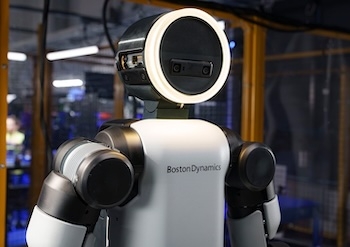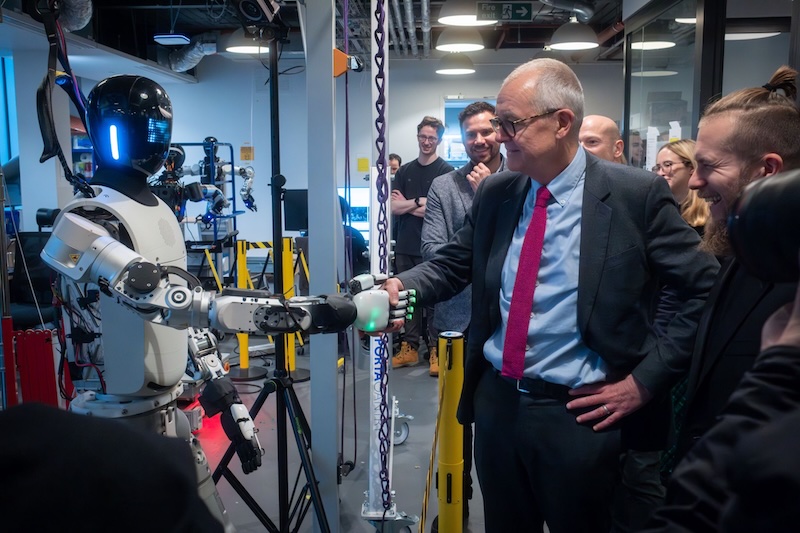
UK-based Humanoid has been coming in hot with the partnership news of late. Just last week saw both the announcement of a Siemens pilot and Schaeffler’s order of “hundreds” of units over the next half-decade. On Monday, the company announced another pilot, this time with the Ford Innovation Centre in Cologne, Germany, where the system went to work moving around totes and car parts. It’s a solid opening for 2026 for a company that really hit the ground running around the midway point last year.
There’s one thing you won’t see listed among this recent dispatch of press releases: robot legs. The above deployments — and, for that matter, all Humanoid industrial partnerships for the foreseeable future — will have none to stand on. While having the option of both legs and wheels has been a key selling point for the firm since day one, you’re likely to see the latter in the vast majority of industry deployments — Humanoid’s primary focus, at least for the next few years.
The breakdown offers fairly unique insight into the form factors, as Humanoid has a stake in both. AMR proponents have long insisted that wheels are a perfectly acceptable — and sometimes superior — choice for the industrial setting. I hear various numbers cited regarding the efficacy of wheels in these environments, with many people landing around 80%. When industrial humanoids began to populate VC balance sheets, however, it was like the third encore at a ZZ Top concert: all anyone cared about was legs.
If you had asked me, say, six years ago, what was next for industrial robotics, I no doubt would have pointed to mobile manipulation. Though my prediction would have been decidedly more conservative, resembling an AMR fitted with vertically elevated robot arms for bin picking. If I was feeling adventurous in a given moment, it might have more closely resembled Array, the automated order picking machine Locus told us about, a month or two back.
For a while there, however, it looked as if the robotics industry was collectively skipping past that missing link, and heading straight toward robots that look — and walk — like us. Glancingly few companies (Apptronik is the one that immediately springs to mind) were hedging their bets from the outset, with a modular upper torso that could mount to a wheeled or legged base.
To some extent, industry sentiment began to evolve around midway through last year. Several hybrid humanoids (the form factor) gained prominence. Around the same time, Humanoid (the company) announced its intentions to launch both wheeled and legged versions of its robots. Unsurprisingly, the former is the London startup’s primary focus right now. We — by which I mean humans, writ large — have gotten very good at making wheels. We’ve been doing it for a long time. My understanding is the whole enterprise started not long after Prometheus gifted us with stolen fire (poor fella).
AMRs haven’t been around quite as long as wheels, but they’ve been deployed successfully at a massive scale. Amazon alone has more than one million of things in U.S. fulfillment centers. Companies have successfully addressed issues around perception, navigation, autonomy, and safety. There is, no doubt, still work to be done on each front, but the systems are out there, doing the work, delivering the ROI. Mobile manipulation remains a massively difficult problem, particularly at scale, but why introduce more friction with legs if wheels 1. Address most areas in a warehouse/factory and 2. Are more affordable, reliable, and easier to deploy at scale?
And that’s not even factoring in all the new safety issues that suddenly crop up when dealing with dynamically stabilized bipedal systems that collapse to the ground when power is cut.
In a conversation last week, Humanoid’s chief strategy officer, Alina Kolpakova, told me that the company is focused on industrial applications for the next five years — applications that will almost exclusively be addressed by an omnidirectional wheeled base.
“We're not rushing into bipedal and we are not seeing bipedal applications in industrial setting,” she noted. “We have very unique, exceptional cases — for example the shipping industry. You have to have a bipedal robot operating on the ships. But compared to the material moving industry and manufacturing logistics, it’s very small. So, we’re not focusing on these rare cases.”
Instead, Kolpakova says, the company is focused on the quickest path to market, delivering ROI for customers, and establishing its own revenue stream.
“We are concentrating on the wheel platform because it can provide the first revenue as soon as possible,” she says. “This is the fastest go-to-market, the fastest revenue-generating engine, because you have to fund your own business to actually be able pursue your dream of a bipedal humanoid robot for everyone.”
In other words, the home robot is very much on Humanoid’s roadmap. The company believes bipedalism will be required to deliver that promise — in part — because its wheeled base is simply too large to navigate around your home, assuming you don’t live in a barn (no judgement either way).
You can add that to the long list of reasons home humanoids are a long way away, including the price, the unstructured setting, the diversity of tasks, and the extraordinarily high bar for safety (particularly in those cases when children and older adults are in play).
Kolpakova notes that nothing about Humanoid’s roadmap was a given from the outset. In fact, the startup explored grocery stores as its initial target audience. As CSO, it was up to Kolpakova to identify a customer base with needs that its technology could successfully address, relatively quickly. In much the same way the company touted the speed with which it built its first prototypes, Humanoid is working to monetize its product as fast as possible.
“[W]e're deploying and we're moving,” she says. “I think we'll be the first company to actually generate revenue, and I think [being headquarted in Europe] helps us get to market faster, because we have huge demand with the ageing population. We are working closely with the government, and we're also working with certification bodies here to actually move very fast.”
The A3 Humanoid Robot Forum is Happening at Automate 2026!
As humanoid robots transition from experimental labs to the factory floor, the Humanoid Robot Forum provides the blueprint for what comes next. This intensive two-day event, taking place from June 23-24 at Automate in Chicago, explores the cutting-edge insights into the performance constraints and measurable outcomes of today's most advanced bionic systems. Learn more and join us there!