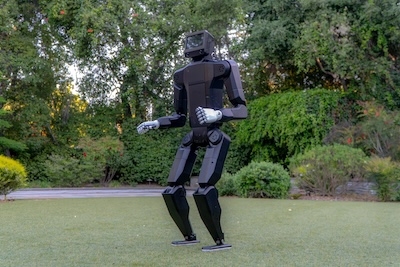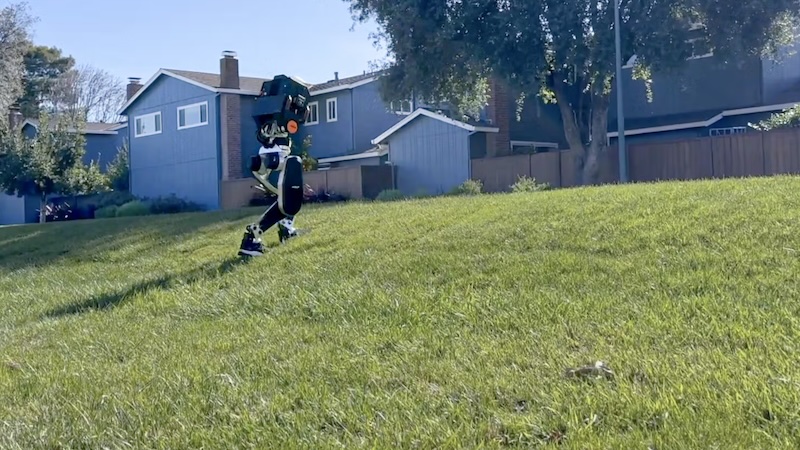
“People ask, what's your biggest difference?” Wei Ding says with a smile, “I think it’s the shoes.” The earliest iteration were purchased at discount chain, Ross Dress for Less for around $20. They lasted all of a month, forcing Noble Machines to upgrade Moby’s footwear to something more befitting a hulking metal humanoid: Caterpillar work boots. Tough robots deserve tough shoes, even at 5x the price.
The Bay Area robotics startup’s CEO sees something deeper in the decision to lace up the robot. Ding notes that the company could have charted a wholly different route, building the rubberized robot feet, but even in this world surrounded by billion-dollar Silicon Valley startups, sometimes the simplest solution is the best.
“We want to use a validated system,” he says. “For technology that's already proven and our partners or suppliers are better at it, we try to not reinvent the wheel. A unique part of us is we use off-the-shelf actuators.”
It’s a philosophy you’ll find throughout much of the industry’s robotics market, wherein companies regularly opt for third-party arms, rather than building their own, in-house. In the world of humanoids, however, most companies seem determined to build as much of a proprietary hardware stack as humanly possible.
Chief among the advantages to this approach are a significant reduction in R&D costs and a substantially shorter time to market. Speed has been foundational to Noble Machine’s approach. The startup is determined to prove out go-to-market as quickly as possible. That, in part, requires building robotics as quickly as possible.
Founded in May of 2024, the startup publicly showcased its first robot at the Bay Area Humanoid Summit that December. “We built our third-generation humanoid from scratch with four co-founders in four months,” says Ding. “That was pretty fast for us.”
He says the company was able to successfully demo the system save for “one, tiny issue.” Next week, Noble Machines faces a larger audience at NVIDIA’s GTC developer conference in San Jose, where it will have four Moby units in tow. “[W]e have a lot of engineers, and we really love to show the world what we are building,” Ding adds. “So, a live demo is always the preference for us.”
He notes that most of the team has spent their respective careers working in robotics, a fact that has compelled the team to move quickly, validate, and continually improve systems. “I spent seven years at Apple building autonomous driving technology,” says Ding. “Two of my co-founders, they have been building humanoids for a decade, before humanoids were a thing.”
After Apple, Ding spent time in the manufacturing hub of Shenzhen, building robot manipulation for the textile industry. “Clothes manufacturing is a really low margin business,” he says. “We were essentially using the most difficult technology to solve the cheapest problem in the world. So naturally there's a gap in business model and go-to-market.” Ding and colleague Wen-Loong Ma moved back to the States to form Under Control Robotics (UCR), the startup that would eventually become Noble Machines.
He notes that the United States is vastly differently for humanoids, versus China, where much of the manufacturing is already highly automated and trending toward lights out operations.
“The average age of American factories is very old,” says Ding. “We see a lot of opportunity to use general purpose robots in those brownfield facilities. In China, a lot of the factories and warehouses are really new. They're building within the last decade. They are already highly automated. They don't need a lot of general-purpose general-purposewhy you see a lot of the humanoid robots in China going after the entertainment and research.”
Much like Florida-based Persona, Noble Machines is going after what the company describes as, “hazardous and physically-demanding industrial tasks.” The startup’s homepage offers up a broad spectrum of industries, including construction, manufacturing, and energy.
For now, Moby pilots are focused on material handling for manufacturing. “[W]e operate under the philosophy of prove value first and then scale,” says Ding. “We'll go through a series of stages of validation phase. First stage, we typically call it proof of technology. That's about one month. We work with customers to define the use case, and define the success criteria, and get all the stakeholders involved. Then we demonstrate our robot can solve their problem. Then we get sign off, then move on to the next phase.”
With each subsequent stage, Noble Machines will ensure that it always has the right shoes for the job.