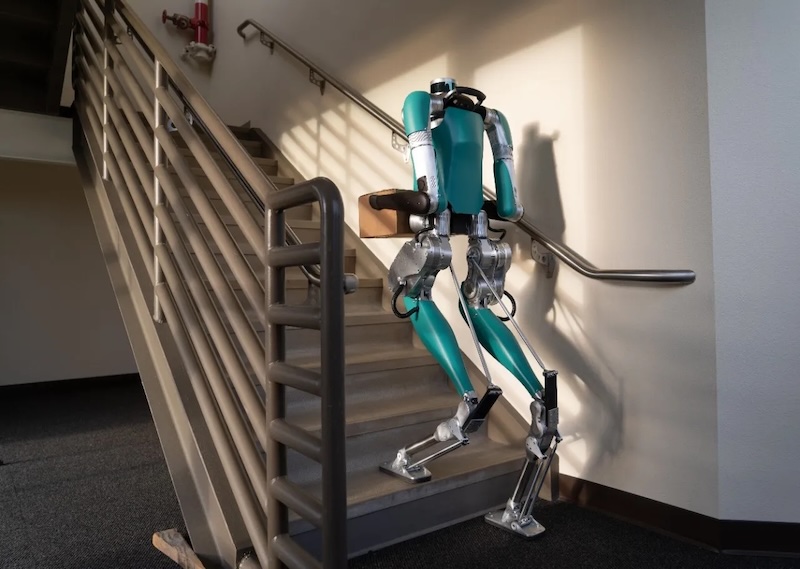
In January 2020, a bipedal anomaly stretched its metal limbs out the back of a Ford van. Digit’s CES debut was regarded by many in the press as a novelty. Humanoid robots stepping out the back of cars to deliver packages to our front doors – it was like the car marker had built a mini-Tomorrowland in its booth, when it should be focused on Android Auto.
What happened next is kind of a blur, if I’m being totally honest, but I think there was a global pandemic and a bunch of other stuff in there. A half-dozen years later, humanoids have mounted a small takeover of the event. It was a bloodless coup. CES seems to go through a mini-identity crisis every few years or so, and a while back, its organizers insisted the name no longer stood for “Consumer Electronics Show.”
While no suitable backronym was offered in its stead, the spirit of the change was clear. CES had evolved into something more than the PC and phone show. A big piece of that transformation arrived by way of automotive’s slow creep into the event. It began with a handful of tech-forward car companies, culminating with the opening of the Las Vegas Convention Center’s West Hall ahead of the 2022 event. The $1 billion expansion immediately became the CES automotive show within a show.
Robotics has been chipping away for decades, as well. True industrial systems never fit the spirit of the show, and have instead found themselves the centerpiece of shows like Automate and Modex. Various consumer robots have shown up at CES over the years, but their journey has reflected the larger landscape, which is to say that nothing has really stuck beyond drones and a bunch of robot vacuums.
Agility’s Digit took one robot step back at the 2020 event, though that particular partnership (Ford) couldn’t deliver on that last mile. Agility would quickly land on industrial settings as the more viable long-term business strategy, a category since embraced by the majority of humanoid forms. Of course, everything old is new again, and Agility-backer, Amazon, is reportedly taking its own long look at package deliveries via humanoid robots.
This year’s CES is a high-water mark for robotics in terms of saturation. Interestingly, while a handful of companies have been trying to hard sell us on home humanoids, it’s largely industrial systems that are making their mark at the event. This does, however, speak to a fundamental disconnect at the heart of humanoid robotics right now. They’re sharing stages with gadgets and cars, but they’re still early-stage industrial machines.
At first glance, it’s a bit paradoxical that industrial systems broke through the CES veil this year. Really, it’s the result of a perfect storm, including the generative AI boom and NVIDIA’s big Jetson push. If we’re really being honest, however, it’s the way humanoids look and move that has really captured the public’s imagination. The same novelty that makes technology an outlier in its early days (see: Digit at CES 2020) can ultimately center it when the right forces are at play.