Amazon has officially surpassed one million industrial robots, the retail behemoth confirmed Tuesday. It’s a sizable increase over the 750,000 figure the company has been tossing around in recent post-pandemic years. A system recently deployed in a Japanese facility tipped that number into the low seven digits.
The company has positioned itself as the largest “operator of mobile robotics,” a claim that’s difficult to dispute, given the 300 facilities that now employ these systems across the globe. The point is driven home in a Wall Street Journal piece from last night stating that Amazon now employs nearly as many robots as humans.
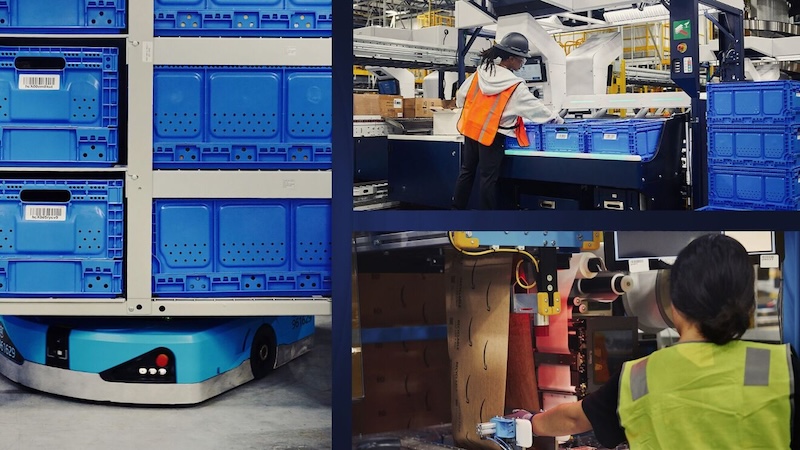
In light of that eye-popping figure, Amazon has gone on the offensive with regards to the jobs conversation, stating that it has “upskill[ed] more than 700,000 employees through various training initiatives” beginning in 2019. Those programs entail training human employees to work collaboratively with robots, be it on the floor or coding.
“In fact, at our next-generation fulfillment center, launched late last year in Shreveport, Louisiana, advanced robotics require 30% more employees in reliability, maintenance, and engineering roles,” writes Amazon Robotics VP, Scott Dresser.
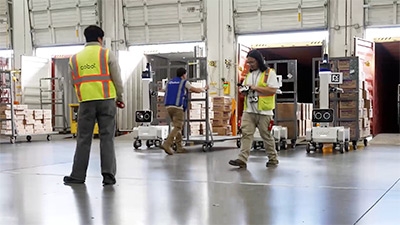
Amazon’s robotic ambitions began in earnest a dozen years ago, with its 2012 acquisition of autonomous mobile robot manufacture, Kiva Systems. Since them, AMRs of various flavors, including the autonomous Proteus, have come to dominate its fleet, largely tasked with the transportation of inventory throughout its fulfillment centers.
The company has produced several industrial arms, as well, including 2022’s Sparrow. Late last year, it introduced Sequoia, a containerized inventory system that functions as the heart of its Shreveport warehouse.
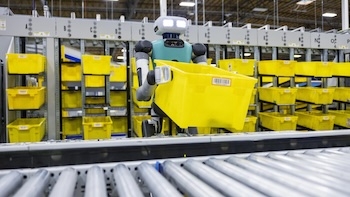
Amazon has also discussed its humanoid ambitions, including early pilots with Agility’s Digit system, which has thus far been charged with tasks like transporting recycling bins.