The procedure is a cholecystectomy — a standard gallbladder removal. The patient, a zonked-out pig. UCSD Healthcare Network members Drs. Ryan Broderick and Shanglei Liu are present to perform the operation. That last bit, however, is where things get a bit tricky. Both surgeons are present in the room with the porcine patient, but their operations are happening in a technological parallel.
Even this isn’t a remarkable element in and of itself. We tend to forget how far ahead of the adoption curve robotic surgery has been. Intuitive’s da Vinci system cleared FDA approval a little over a quarter century ago. By 2012, it was performing somewhere in the neighborhood of 200,000 procedures annually, with hysterectomies and prostate removals topping the list.
In essence, this surgery doesn’t stray far from that work. Our medical professional are performing the gallbladder removal remotely (albeit only a few feet away in this instance), using a joystick similar to the one they’ve trained on for past procedures. What makes this particular instance remarkable, however, is change in form factor.
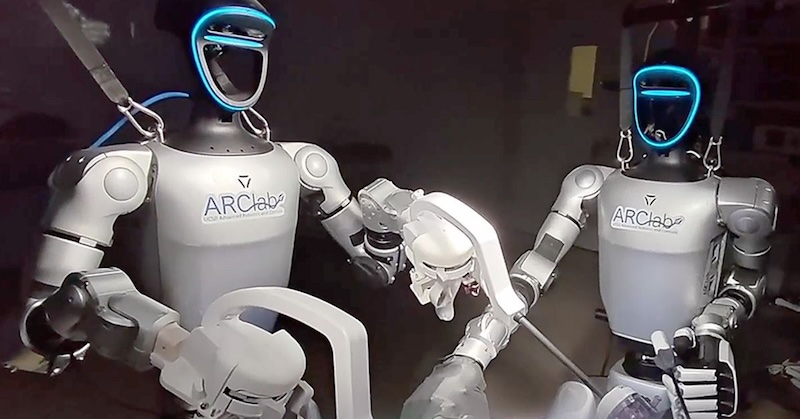
UCSD Electrical and Computer Engineering professor Michael Yip has successfully completed another key step in his ongoing work to bring humanoids into the operating room. The Unitree G1 systems have returned with modifications, most notably to their end effectors, for better grasping the necessary medical equipment. The software stack has also received a major update since we last spoke at A3’s 2025 Humanoid Robot Forum, allowing for sub-millimeter-scale accuracy.
An efficient sterilization process wasn’t the focus this time around in a controlled environment, leaving the involved parties to wipe the robots down with rubbing alcohol. “With a humanoid robot, unlike a human, you can actually pass it through complete decontamination processes, whether it's gas or aerosol liquid,” Yip explains. “That's what the future will look like in my opinion.”
The in vivo porcine procedures took two forms. The first involved a tele-operated G1 aided by a human assistant. In the second, a pair of remotely operated robots performed the procedure with one serving as assistant to the other. According to Yip, the breakthrough for both came when the humanoid robots essentially faded into the background for their human controllers.
“The first one we did was 55 minutes and the second was 30 minutes,” he tells me. “They got a lot better in the second surgery. But there was a moment in even the first surgery where they were working through a humanoid robot. It just felt natural to them. That's what we really were excited about. That basically proves a point that humanoid robots could be a surrogate for these expensive and very highly engineered, but kind of focused systems.”
Discussing humanoids’ operating room potential highlights some key parallels to on-going discussions around the form factor’s efficacy in other workplaces. Much like the factory or warehouse, Yip foresees continued value in purpose-built surgical robots, augmented by the use of more general-purpose systems.
“Those systems may be better at very specific tasks, but in a general surgery case where, you're trying to maximize the number of cases you do and every like sub-millimeter precision may not actually result in a patient outcome difference, the human platform makes a lot of sense,” says Yip.
The next stage in the roadmap involves a deeper dive into human-robot interaction, according to the professor.
“I think that problem as a research topic has to be like better explored, because we want to see a world where the operating room is completely re-envisioned as a place where humanoid robots and [human] surgeons can work together,” Yip explains. “To do that, we need to understand how humans and humanoid robots interface. What is the language? Maybe the eyesight and visual cues that each other can provide, and then how do they team [up] almost in a dance for surgery. I think that's going to be really what we're looking for in the future.”