U.S. manufacturers are facing a pressing challenge: how to maintain productivity and operational excellence amid a growing workforce shortage. As experienced baby boomers retire from shop-floor roles, factories are losing critical expertise. The manufacturing skills gap is widening, and institutional knowledge – much of it undocumented – fades away with every employee moving on to their next stage of life. At the same time, the next waves of talent aren’t arriving quickly enough to replace them.
“Factories are still running on the domain knowledge of individuals who’ve been there for 30 years or more,” says Juan Aparicio, founder and CEO of Reshape Automation. “If Bob and Melody retire, and they’re the only ones who know what to do when the injection molding machine acts up, the factory can face serious consequences.”
The clock is ticking, as the loss of institutional memory accelerates while manufacturers are urged to reshore operations and modernize production. Robots and automation can fill specific gaps, but a bigger opportunity lies in applying generative AI to capture, organize, and deploy human knowledge at scale.
A Generational Cliff in Manufacturing Talent
The looming retirement wave and decades of offshoring talent expose how vulnerable manufacturing operations have become. Many critical processes call upon the workarounds and gut instincts of workers with decades of experience as much as established automation tools and documentation.
“We deindustrialized the U.S. and outsourced a lot of manufacturing knowledge over the years,” Aparicio explains. “In turn, the demand for teaching and learning those skills dropped. Now we’re trying to bring them back, but they’re not written in books, and we’re running out of time. It will take years to build that expertise again, assuming you can find people willing to teach and learn it.”
Today, the average age of a welder in the United States is 55 years old, and the craft isn’t marketed to young workers as a future-forward career. “We need to make manufacturing attractive again,” Aparicio says. “These are high-tech environments, full of robots, automated processes, and emerging AI technologies in facilities cleaner than people’s homes. Demonstrating that these aren’t your grandfather’s factories anymore will help bring a new generation of workers in.”
The transformation will take time. In the short term, manufacturers need solutions that preserve their knowledge and make it accessible to a shrinking workforce.
What Generative AI Brings to the Factory
Generative AI is often misunderstood as just a chatbot or content generator, but it has broader uses in manufacturing settings. Aparicio defines it simply: “Generative AI is a way to compress vast knowledge into a system that can retrieve specific pieces and enhance them in new ways.”
Unlike traditional machine learning or rule-based systems, which follow rigid programming or statistical models, generative AI allows users to ask questions in natural language and get context-aware answers.
“In the past, if you wanted to codify domain knowledge, you had to hire people to write documents and store them in inflexible formats,” Aparicio says. “But in most cases, the person who created the documentation isn’t the one who needs it. The insights were hard to find, outdated, or missing entirely.”
These bottlenecks disappear with generative AI, which can retrieve facts and adapt them to fit the specific situation it is supporting. Every system action and result can serve as training data for workers to derive answers. Whenever a question or issue arises, the AI system can surface relevant insights along with their context and supporting documentation.
“The next time that injection molding machine breaks, the generative AI bot can find what Bob and Melody did last time and instruct a new user. The data model doesn’t need to be perfect; it just needs relevant examples to provide useful answers.”
Automation Leads to Knowledge Transfer
One of the most counterintuitive outcomes of the generative AI boom is the type of work it’s automating. “Everyone thought AI would replace manual labor,” Aparicio says. “But what we’re seeing is the opposite. It’s taking over the administrative tasks, such as emails, reports, and CRM updates, to free up employees to perform more value-added work.”
He cites examples in manufacturing sales and engineering, where account executives and engineers spend most of their time quoting systems and writing proposals. “If we can shift their tasks to give them more time on the shop floor rather than in the office, they’re gaining front-line experience, and we all win,” explains Aparicio.
This ability to “free up the humans” to accelerate knowledge transfer is one of generative AI’s most compelling value propositions. And it doesn’t stop at sales or engineering. Manufacturers find similar benefits in maintenance, quality assurance, and designing factory layouts.
Meeting Workers Where They Are
A key concern about AI adoption is whether it will widen the digital divide, especially for older workers who are less familiar with new tools. Aparicio says generative AI is different.
“Unlike previous technologies where you had to learn to code or use complex software, generative AI meets you where you are,” he explains. “You don’t have to learn new interfaces. You talk or type in natural language, and it responds in kind.”
Accessibility is critical during the transition between retiring experts and incoming digital natives. Generative AI supports both – it bridges knowledge transfer between their worlds and helps find different ways of accomplishing traditional tasks.
“You’re not going to be replaced by generative AI,” Aparicio adds. “But you might be replaced by someone who embraces and knows how to use it.”
Why Real-World Context Matters
Generative AI offers promising new ways to bridge the manufacturing skills gap, but its effectiveness depends on more than language models. Mike Nielsen, CMO at RealSense , emphasizes that connecting AI to production environments requires accurate, real-time perception of what’s happening on the floor. “To bring the real world into generative AI, you need a robust perception system that understands spatial relationships and physical behaviors in 3D,” he says. “This type of physical AI allows robots and automation tools to operate effectively and safely alongside humans by maintaining awareness of the physical rules of the real world that can change between scenarios.”
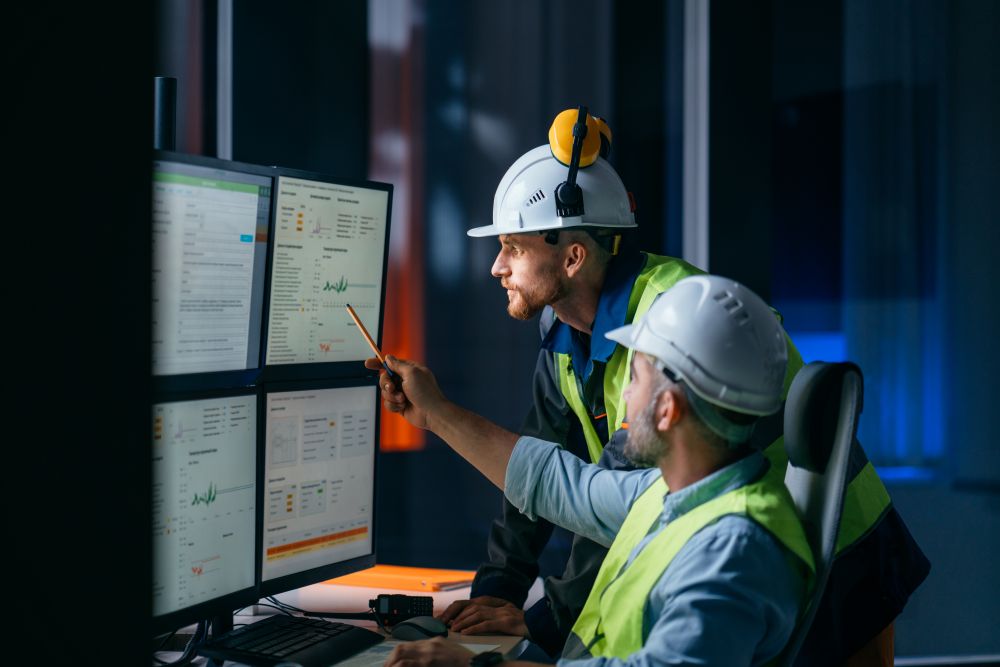
Vision-based AI systems are an example of the technology that can work well with GenAI. They can detect subtle deviations in parts alignment or material behavior that a tired worker might overlook at the end of their shift. Systems capable of monitoring at the millimeter level prevent small discrepancies from building up into major deviations that could cause inspections to fail or issues in the field.
Nielsen notes that many inspections still rely on manual checks or 2D image matching. Integrating 3D vision into broader generative AI workflows reduces the likelihood of costly rework or safety incidents in environments with changing lighting, moving parts, or more complex placements.
Once in place, these systems also ease the burden on aging workers by simplifying complex tasks and freeing up time for mentoring. As generative AI and vision tools take over repetitive or ergonomically demanding jobs, experienced employees can shift their focus to coaching newer team members and passing along insights. This supports smoother knowledge transfer and gives veteran workers more meaningful roles during the final years of their careers, helping to close the manufacturing skills gap from both ends.
Integration Challenges
Successfully deploying generative AI doesn’t happen overnight. Nielsen noted that one of the biggest obstacles organizations face is underestimating the complexity of implementation and overestimating their ability to build it all themselves.
“We see people take the path of complete do-it-yourself, which ends up being a problem down the line,” Nielsen says. “Sometimes the intimacy with known quantities prevents companies from adopting new technologies. The more experienced folks know to go into these projects with an open mind and use more sophisticated tools to shorten development cycles and reduce risks.”
Nielsen recommends a practical path forward: “Get the right people in the room up front and develop a good overview of the AI tools landscape first. The investment, research, and training may be hard, but the resulting system will be worth it.”
Even with the right platforms in place, getting the talent to deploy generative AI-based systems can be challenging. “It’s an inverse skills gap, where there aren’t many AI experts or developers out there who have manufacturing expertise,” Nielsen explains. “Manufacturers want to bring in new talent and technology, but can’t get enough skilled workers to train, deploy, or maintain AI systems. There are a lot more people getting into the AI space than ever before, so it’s just a matter of time until we have the resources to meet the demand.”
Generative AI is a Human-Centered Solution to Workforce Shortages
As manufacturers navigate workforce shortages and legacy knowledge loss, generative AI is proving to be a viable bridge between workforce cohorts. Unlike past technologies, which required steep learning curves, generative AI adapts to how people communicate by text or voice. And most importantly, it shifts the narrative away from human replacement and toward human augmentation and knowledge transfer.
“We’re not going back,” Aparicio said. “The only way to compete, domestically and globally, is to automate with advanced tools while not forgetting the human equation. We need AI that understands how we work and works with us, not around us.”
Generative AI helps manufacturers maintain the line between now and when a new generation of skilled workers is ready. It captures and transfers hard-won knowledge, cuts down on repetitive tasks, and ensures that, even as experienced workers retire, manufacturing skills stay on the floor.