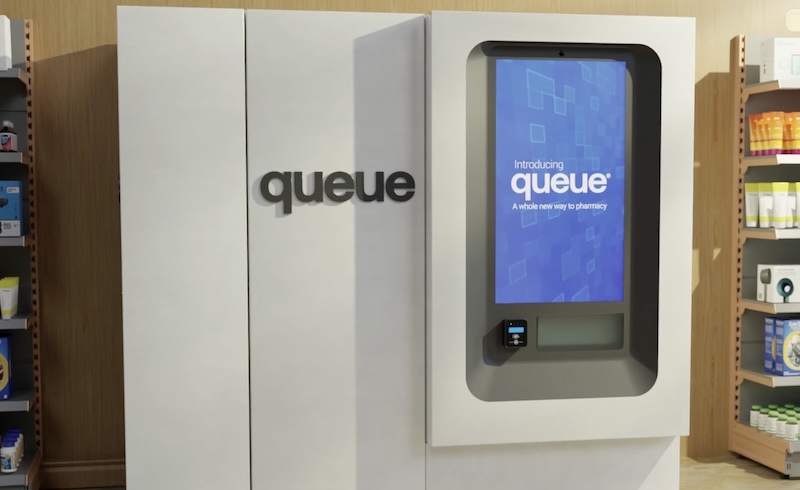
Queue co-founder and CEO, Nick Desa, was suprised by the level of interest from potential customers, following the autonomous robotic pharmacy startup's $12.6 million seed round.
“I literally can’t keep up with the calls,” Desai told A3. “That typically doesn’t happen with software, they can just go online and check it out.”
Maybe we are all just a little tired of waiting in line at the pharmacy.
Silicon Valley-based Queue builds a full pharmacy in a compact machine. The robots 250 common prescription drugs that users can access by scanning a prescription QR code. Once the code is scanned, the machine will dispense the proper amount of the drug into a labeled pill bottle. The machines use computer vision to verify that pills are correct when the wholesale bottles get loaded into the machine and again to ensure that the machine distributed the right amount of the right medication.
Desai said that the machines operate with a 3.9% discrepancy rate. While that seems high for prescription drugs, he added that the current discrepancy rate for human pharmacists is around 3% -- I wasn't able to back up that figure.
The idea behind Queue came after Desai, a five-time software startup founder, started looking for his next company idea. He knew he wanted to go into hardware, an area he hadn’t yet built a startup in but has past experience in as an engineer. He also knew he wanted to do something involving AI that wasn't just another AI-powered software that could be easily replicated by someone else.
He paired up with Joshua Liu, now co-founder and CTO at Queue, to start hashing out ideas. Then came a very frustrating wait in line at a large pharmacy chain.
“The first thing we did was spend some time why no one has done this before, and is what the regulatory environment is,” he said. “Is this regulatorily problematic? The [initial] concept is what we are building now.”
The startup launched in 2025 and is now working with a major pharmaceutical chain on deployment as it looks to finish producing its first set of units. The company recently announced two previously undisclosed rounds of funding including a $6 million pre-seed round led by Riot Ventures and a $12.6 million seed round led by AlleyCorp.
The two major hurdles for the company at this stage will be government regulations and getting consumers on board.
On the regulation side, pharmacies are overseen by each individual state which prevents the company from having just one go-to-market strategy. Desai said overall regulation is moving in the right direction for a company like theirs as opposed to getting more restrictive. He imagines the company will play a bigger role in pharmacy policy in the future too.
As far as getting consumers on board, he thinks it won’t be as big of a leap as it may seem. Many people are already ordering prescription drugs online without interacting with a pharmacist, he said. Although online pharmacists do still use humans and have humans available to call if someone has a question — a service Queue plans to offer as well.
For now, the company hopes to expand its deployment among existing pharmacies and grow its engineering team. Desai hopes to expand to more types of locations, including college campuses, airports and more.
“I think there will be a lot of early adopters who wait in that [pharmacy] line and think anything is better than this,” Desai said.