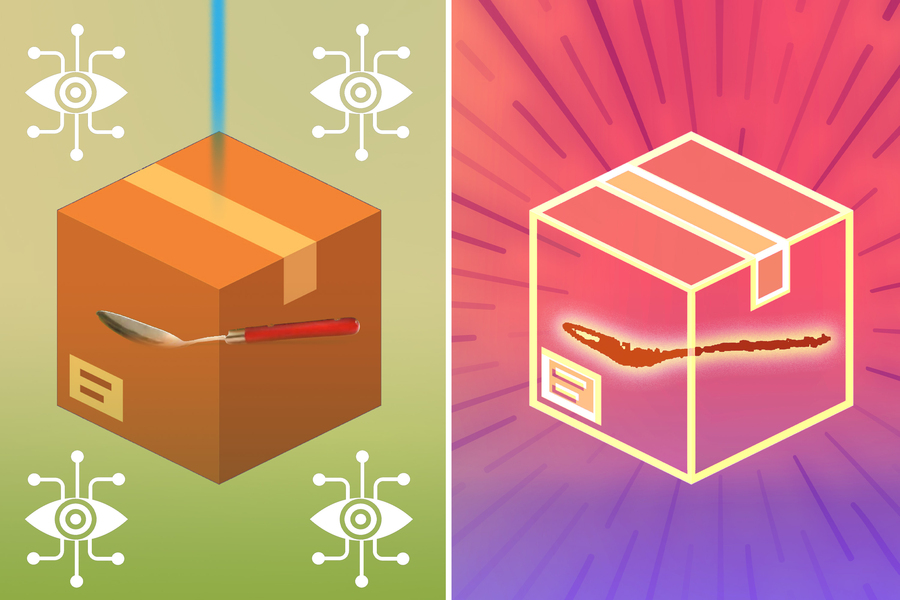
Robots are – generally speaking – more interested in the outside of boxes than the secrets contained within. They have a job to do, after, all, moving inventory from point A to point B. As long as that big parcels gets where it needs to go, they’re satisfied enough to move onto the next thing.
Humans – largely speaking – have more stake in what’s in the boxes than the boxes themselves. Most of the time, when most of us order products online, the container is a means to an end, to sliced up, broken, and (hopefully) recycled.
These two perspectives are necessarily diametrically opposed. After all, if a robot wants to keep its job, it needs to avoid damaging product during transport. Part of the disconnect here is the fact that if a robot can clearly see the contents of the corrugated box it’s tasked with moving, something has probably gone terribly wrong.
One of the more interesting solutions I’ve seen to this issue was presented by MIT researchers, back in May, in a paper titled, “Learning Object Properties Using Robot Proprioception via Differentiable Robot-Object Interaction.” In the study, the robot shakes a box to determine its contents, not unlike a kid at Christmas. Though the shaking may be gentle, the process can still increase the potential of harming said contents.
Leave it to more MIT researchers to take a wholly different approach this gordian knot. Through the use of millimeter wave signals (mmWaves) – the kind that power WiFi – sensors can create a 3D reconstruction of what’s inside. That not only removes a potential avenue for damage, it allow the robot to “see” whether that product is damaged before it hits the conveyor belt.
“We’ve been interested in this problem for quite a while, but we’ve been hitting a wall because past methods, while they were mathematically elegant, weren’t getting us where we needed to go,” says associate professor, Fadel Adib. “We needed to come up with a very different way of using these signals than what has been used for more than half a century to unlock new types of applications.”