At the risk of getting all 80s standup comedian on you, people can’t help but tidy up before having a professional over to clean their house. Maybe it’s vanity. Perhaps it’s a social contract. It could just be that people are okay with a stranger knowing their house is messy, but just not that messy.
Turns out the same is true for robotic vacuums, though this one doesn’t take a degree in human behavior to crack. It’s simply that the little puckish appliances have historically had trouble with big messes. Socks, paper, and computer cables can all wreak havoc on a robot vacuum. And then there’s the pet poop problem that infamously vexed the industry for so long. It’s one thing to get a cord stuck in your rollers. It’s another to paint the carpet with dog droppings (sorry, but it’s a thing).
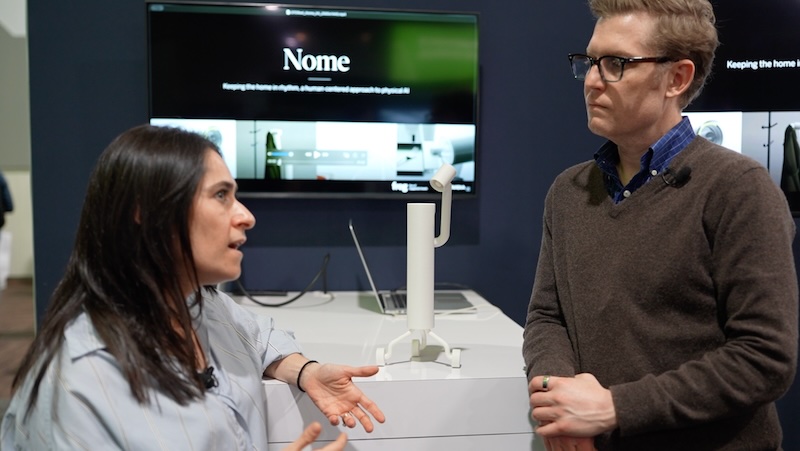
“One thing that's interesting about the robot vacuum space is like for so long that space has been one where you actually have to clean your house before you can have it work,” Frog’s head of industrial design, Inna Lobel, told me this week at GTC. “It was really interesting to see Roborock start to experiment with arms and things like that. I think this is a place where people are going, but they're going at it in a very different way.”
Roborock did what it does best — it built added stuff to a robot vacuum. In this instance, it’s a mobile manipulator that reaches down to pick up socks and other human detritus. Frog, best known for its design work for companies like Apple, Sony, and Disney, took the unstructured path.
Lobel uses the word “unobtrusive” when discussing Nome. Frog’s site describes it as “an internal R&D platform to consider how physical AI should show up in human spaces, shaped by context, culture, and everyday behavior.” I’m pretty sure I called it something like a “robot coatrack.” We contain multitudes.
Point being, Nome is designed to hang out, blend in, occasionally pick stuff up, and then go back to pretending to be a piece of furniture. The design is boiled down to bare essentials, displaying a form of minimalism that betrays Lobel’s years at Apple, designing iPads and Macs. Such simplicity also helps reduce pinch points, so kids’ curious fingers aren’t injured by actuation.
Safety needs to be a priority when designing a product that could one day wind up in homes, alongside children, older adults, and other vulnerable members of society.
“We're thinking about things like weight distribution and making sure that it's not tippy, and even thinking about the dynamics as they roll over carpets, for example,” says Lobel. “We’re just doing our homework on the different analyses that need to be done for weight, for tip. We're thinking about things like how fast does it move, and being able to turn off in the right moments.”
For now, Nome is a kind of proof of concept. Think of it as a bit of industrial outsider art from a non-robotics company, aimed at an industry that can paint itself into corners once it’s settled on a specific design.
“As an R &D platform, this is something that we're trying to inspire the industry with,” says Lobel. “To anybody that's thinking about robotics, there's other ways that you can look at it and what's important is to really understand the use case very deeply, challenge assumptions, deconstruct, and reconstruct back up. I think one thing that we're trying to show is you can achieve something which feels more right and more natural for a space. And I think it's going be much less expensive.”