
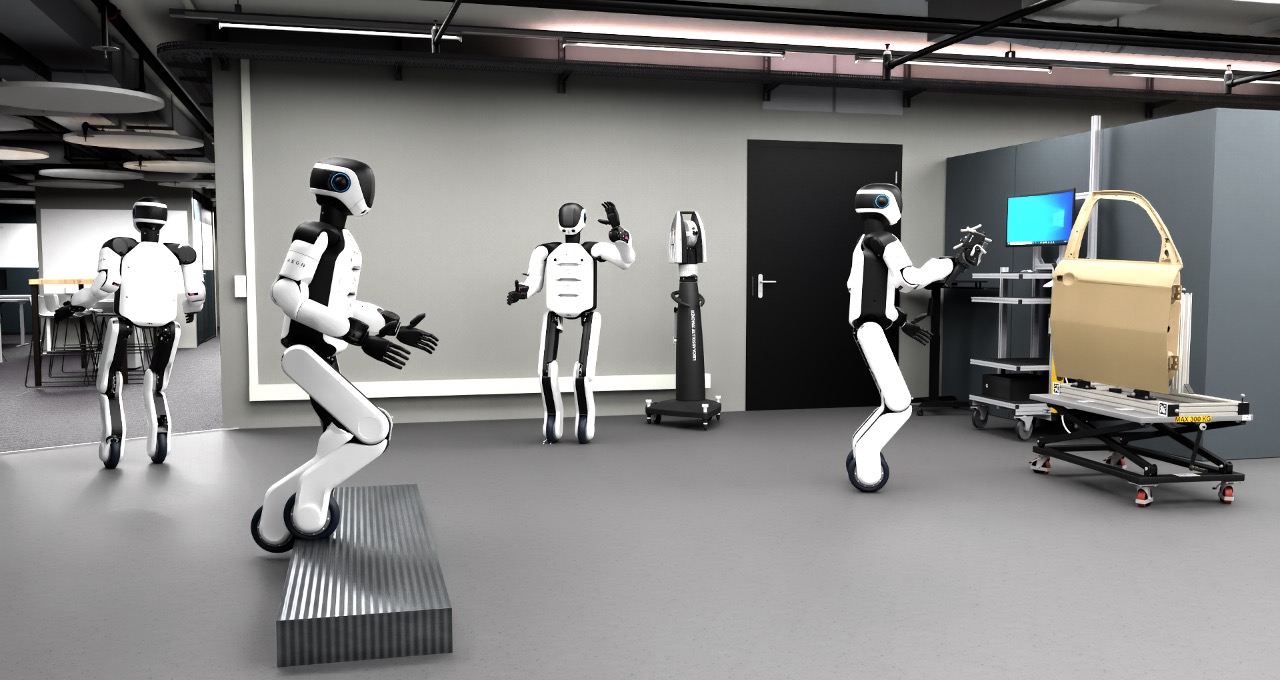
At first glance, Aeon’s most compelling feature is unquestionably a pair of foot-wheels fastened to two legs. The design splits the difference between two much debated locomotion vectors. But hey, us humans have been roller skating as far back as the 18th century, so why not give robots a turn.
Stockholm-based industrial tech conglomerate Hexagon debuted the system amid several product launches at today’s livestream event. Of course, it’s difficult to get a crowd to focus on the finer points of industrial components once you’ve taken the wraps off your humanoid robot.
In a post tied to the event, NVIDIA showcased how the company has has utilized its Isaac and Omniverse platforms to build the latest addition to a growing army of industrial humanoids. Simulation is a big piece of that work, allowing the system to truncate skill learning from half a year to a couple of weeks, per NVIDIA.
A clip of that simulated world showcases how the legs and wheels operate in tandem. Instead of walking in any meaningful sense, the wheels are doing most of the work here. When the system encounters a small flight of stairs, however, the legs raise slightly, while keeping the wheels in contact with the ground.
The whole process is executed smoothly – at least in simulation. Aeon gets the same caveat as every new industrial robot – we can’t definitively say how it works in practice until we see it out in the field. For its part, Hexagon is already engaging with industrial clients here. Swiss Aircraft designer Pilatus and German ball bearing manufacturer Schaeffler have signed up to pilot Aeon.

Hexagon brings its own spatial awareness/3D navigation knowhow to the product. "Hexagon is one of the best-placed companies in the world to lead and shape the field of humanoid robotics,” its chairman, Ola Rollén, says in a release. "Aeon represents a state-of-the-art, industrially bespoke humanoid. It's a leap forward in our goal to help customers drive sustainable growth in the face of structural demographic changes.”
The “demographic changes” alluded to here almost certainly refer to Switzerland’s aging population. The trend will only make it more challenging for manufacturers to find an able-bodied human workforce. Switzerland is not alone in facing this issue, of course. A number of countries, including the U.S., China, and Japan are seeing larger percentages of citizens exiting the workforce.
The phenomenon is one of a number of factors currently fueling humanoids' big moment.
.JPG)