With the right framework, dogs of any age can learn new tricks. In the case of RAMBO (RL-Augmented Model-Based Optimal Control), the dog is a Unitree Robotics Go2, and the trick is doing things with its front legs without losing balance.
Coauthor and ETH Zurich doctoral student, Jin Cheng, shared the work this week, following the paper's recent acceptance to IEEE Robotics and Automation Letters.
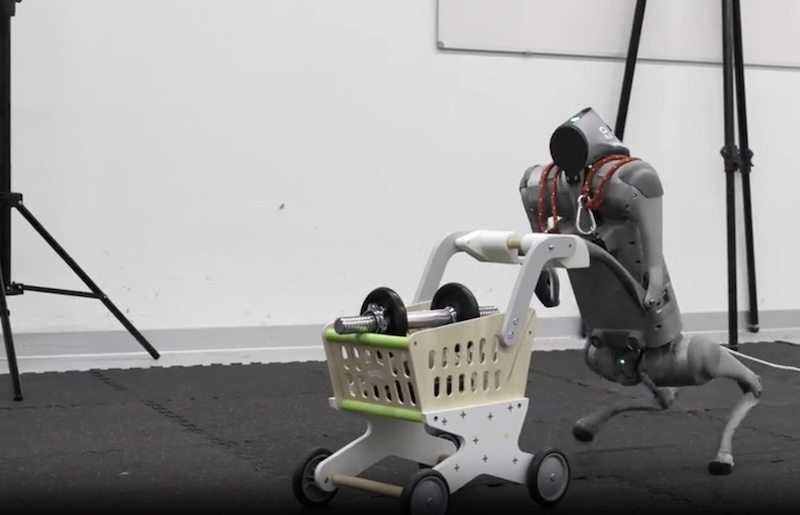
The team behind the project picked a handful of eye-catching examples, as the little quadruped shuffles while holding a large die, crouches to push a miniature shopping cart, hops on three legs while carrying a plate, and hangs onto a sponge, while it moves around an object.
RAMBO combines model-based control with reinforcement learning, to produce a system that can perform the robot equivalent of walking and chewing gum. This allows the system to perform a specific task with its front legs, as its hind legs manage to maintain balance, even when traversing uneven terrain.
“The ultimate goal of this work is to equip the legged controllers with the capability to perform robust, precise, and efficient whole-body loco-manipulation,” the paper’s authors note. “We aim to combine the strengths of model-based and learning-based approaches to achieve effective torque-level control while remaining robust against unmodeled effects and disturbances.”
The authors add that RAMBO’s primary limitation comes down to its reliance on proprioception – the robot’s ability to recognize the position of its components relative to one another. The team hopes to increase robustness by incorporating additional sensors into the system.