Aya Durbin drops two pieces of personal information before the podcast cameras start recording. The first is that a half-decade at 6 River Systems (acquired by Shopify in 2021) wasn’t enough to convince family members that she worked in robotics. Immediately after joining Boston Dynamics in 2023, and working on something more akin to the conceptual ideal, no further convincing was required.
Ask a layperson to close their eyes and picture a robot, the answer is likely to look less AMR, more Atlas.
The other bit Durbin shares is a self-described journey, as a “pragmatism turned dreamer.” The former is how she found herself in a product manager role at 6 River. The latter is apparently a thing that can happen to a person when they work at a place like Boston Dynamics long enough.
“I would say I'm a dreamer that still is a pragmatist at heart, but working at Boston Dynamics has definitely proven to me that the dreams can become valuable customer solutions,” Durbin explains. “Ultimately, that's why I'm a pragmatist, because I'm a product person. I care about delivering real value to customers that provides positive ROI. I don't believe that humanoids will ever become ubiquitous in society if we can't prove that.”
The conversation with Durbin was the last of a marathon of podcast episodes recorded in Boston last week. That may be part of the reason I’ve been reflecting on it as I walk the halls of the Georgia World Congress convention center during Modex. It’s more than that, however. It’s seeing Boston Dynamics’ presence at this material handling trade show and reflecting on the circumstances that put it there, sandwiched between AMR booths.
One could say the company took a fairly circuitous route to the factory/warehouse floor. After 30 or so years building research robots, initially fueled by DARPA funding, the company finally determined it was time to sell product. That course correction occurred after BD switched hands from Google to Softbank, and has only accelerated since it’s become a part of Hyundai.
Cutting edge technologies and a showmanship first put Boston Dynamics on the map in viral video after viral video, from grainy Big Dog parking lot testing to a Sam Adams Super Bowl spot. A flair for the dramatic is a permanent part of the company’s DNA. It can, however, be a difficult thing to reconcile as a serious product person focused on market git.
“When I used to see the robots doing backflips, when I used to see the robots doing roundoff back handsprings or doing parkour, I'd be horrified as a product person,” Durbin says. “Some engineers going out there and working on something that isn't core to the customer need. So, I'd run downstairs and say, ‘why the heck are we doing this?’ ”
Durbin says Atlas’s director of robot behavior, Alberto Rodriguez, quickly disabused her of the notion that product fit and parkour are inherently at odds.
“[Rodriguez] said, ‘hey, this is how it’s working.’ And that really starts to transform the way you think about just work in general,” she says. “You can learn and do science and improve your product in more ways in this new world of AI than just doing the same thing over and over and over again. When it comes to AI, the more we train the robot to do all sorts of different tasks, the more capable the robot gets over time.
This certainly comports with things I’ve been hearing from physical AI firms, of late. A number of top researchers have noted — often with some surprise — that robot performance has improved when a system is trained on data other than that specific task. This gives the system a broader understanding of the world, physics, and various factors at play during deployment.
It’s clear, too, why Boston Dynamics gave me a tour of their facilities before the interview with Durbin. It’s about more than any one specific element, from showing first-hand how much its control system has improved to pointing out a Spot system with three bullet holes from a police standoff to the cafeteria — a remaining office cultural relic from the Google days. And then there’s the pair of black doors with “FUTURE” stenciled in all caps. I’m told stuff happens there that may never see the light of day, but a significant part of me believes it mostly exists to drive journalists bonkers.
What one really gets from the tour, however, is a sense of scope. We’re far removed from the scrappy days of the Boston Dynamics parking lot videos. And while the company’s new HQ is significantly larger than the one I visited pre-pandemic, the company tells me it’s already begun to run out of space. The familiar demo area that served as the setting for hydraulic Atlas videos, the Superbowl spot, and several other bits, has been reduced considerably. A significant portion has been converted into desk space, as the humanoid team has continued to grow.
Hyundai’s sizable resources allow Atlas’s stewards to walk and chew gum at the same time (the robot, on the other hand, is not yet capable of this). Don’t get it twisted, though, the immediate roadmap is clear. Boston Dynamics wants to put the robot to work.
“[My job is] making sure that we're focused first on the core research problems that impact those early customer deployments,” says Durbin. “There are an unlimited number of research problems you could solve with humanoids. Customers want this robot to do everything. And my job is to focus us first on the core research problems that actually block us from providing value to customers and ignore the ones for now that we could do. We could make our robot climb up a pole. We could make it climb up a ladder. But is that the most important research problem to be focused on right now?”
Another key piece is the “unsexy” work of integration. Being a “brownfield” solution is one of humanoids’ chief selling points. Advocates of the form factor will tell you their human-like design removes much of the usual deployment friction. But even the biggest bulls won’t suggest we’re at or near a point where these systems can effectively be plopped down in the middle of a warehouse or factory and just get to work. Humans require training, robots need integration, and the new/less proven the technology, the more handholding is likely to be required.
“In the first few years, we have target industries we want to work in,” says Durbin. “We want to work with industrial customers doing things like automotive manufacturing, food and beverage, semiconductor manufacturing. We want to work in warehouses. In those markets, with those customers, the deployment process will be similar to what it looks like for Spot. You go through a sales process, you work with the solutions designer that makes sure that the solution you're going to get in your facility is what you expect, that it performs the way you want it to, and that you're really going to get ROI from that system before we even show up on site.”
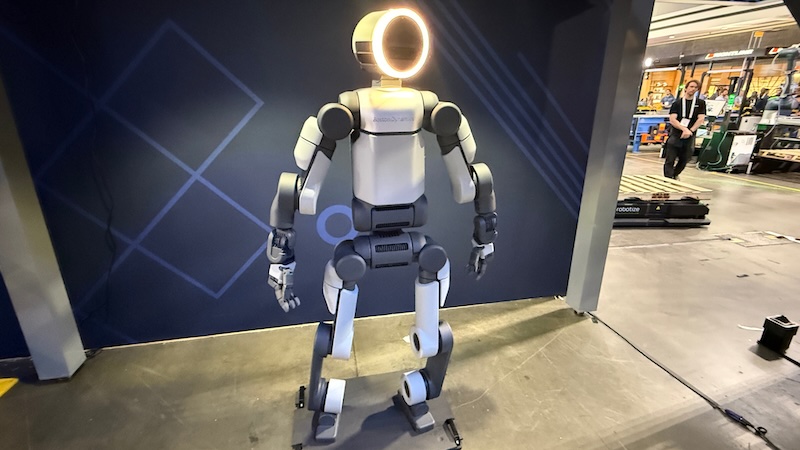
Atlas even made a surprise appearance at Modex this week — albeit with little fanfare. A non-operational version of the humanoid was quite literally waiting in the wings at Boston Dynamics’ booth, propped up in the shadows beneath a set of stairs. Far more people were, understandably, gathered around to watch the Spot and Stretch demos out in the open. At the very least, however, the message was clear: Atlas is getting ready to get its graspers dirty.