"There is no force on earth more powerful than an idea whose time has come."
- Victor Hugo
Bots in the News: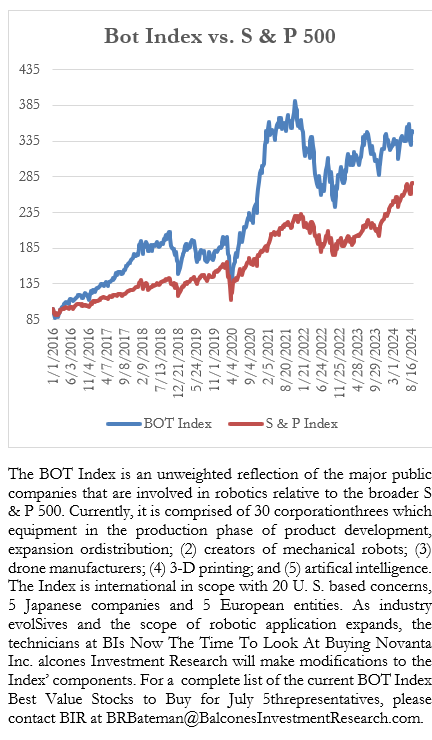
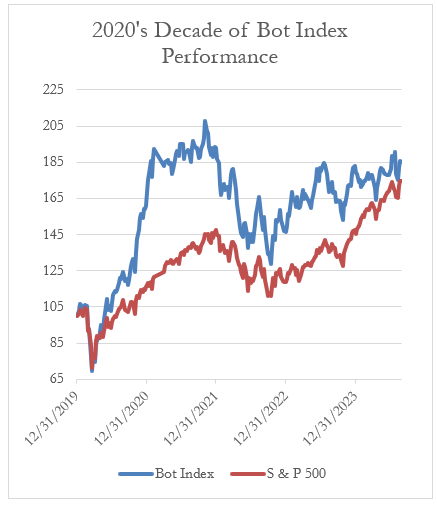
Neither the broad market nor the Bot Index made much headway in last week’s trading. The S & P 500 gained 24 basis points while the NASDAQ and NIKKEI dominated Bot Index fell 34 basis points. While in later commentary we will discuss an Indian 3D printing company’s recent success, the week’s returns by the Bot Index’s 3D Systems accounted for much of the under performance recorded by the bots.
According to the Motley Fool, following the recent report of earnings, investors examined the company’s Q2 numbers. “On Thursday, 3D Systems unveiled those Q2 figures. These revealed that the company's revenue slipped by 12% year over year to just over $113 million. Not surprisingly, this decline was due mainly to lower sales of printers, which in turn was because of an unnamed customer in the dental field that reduced its purchases of 3D Systems machines. This drop was offset to some degree by an increase in services revenue. However, this wasn't enough to halt the decline of the total.” For the week the stock sank 18.63%
Shares of iRobot Corp., likewise, declined significantly during the period as investors failed to find anything but negatives from the company. The failure of the Amazon merger (probably creating a sigh of relief by the M & T team representing Amazon) has been followed by a series of earnings disappointments that are leading investors to question the viability of the company’s future. The stock declined 8%.
The only notable gain for the week was reported by AeroVironment. The drone maker continues to ride the crest of the success of
unmanned aircraft in various battlefields across Europe and the Middle East. The stock rose 9.77% after winning a $990 million U.S. Army contract for its Switchblade "suicide" drones. Two analysts upgraded the drone maker.
Print Me Into Outer space:
Despite the recent misfortunes of 3D Systems, an Indian startup has made a major breakthrough in metallurgical printing. Using a 3D printer from the German firm EOS, Agnikul Corp. fabricated a rocket engine in only three days. The single stage engine was successfully tested in late May, reaching 6.5 km. before splashdown in the Indian Ocean. The test was a precursor to the firm’s ultimate intent of linking similar engines to form a two-stage commercial satellite delivery mechanism. The new rocket, Agnibaan, will include eight engines to carry a payload of 300 kg. to an orbital altitude of 400 kilometers. The new rocket is expected to be commercially utilized in the first half of 2025. The low cost and quick production should become a boon to smaller satellite companies.