This story first appeared in A3's new Automated newsletter. Subscribe here.
To quote a very sweaty, clapping Steve Ballmer, last week’s Qualcomm/Arduino acquisition news was about five things, “Developers, developers, developers, developers, developers.” Hardware developers are a key piece of the tech ecosystem, which thus far haven’t been a core competency for a processor giant, whose primary business dealings are engaged with the world’s largest mobile companies.
Earlier this week, I spoke with Manvinder (Manny) Singh, a longtime Qualcomm VP, about the pending deal. He noted that, while the semiconductor firm’s ubiquitous mobile presence has allowed for diversification into categories like automotive and XR (extended reality), the nature of the IoT market requires a wholly different approach.
“IoT happens to be a very different type of business. It involves many, many customers who buy things off the shelves and build prototypes and products based off that,” Singh tells me. “We were not very good at connecting with the mass market, to be really open about it, and we realized that. A lot of our business relied on direct communication and business relationships where we handheld companies, including drone and robotics companies that built products based on our platform.”
Arduino is among a glancingly few companies a tech giant like Qualcomm could acquire to have a foot in that door over nightovernight. In its earliest days, the Italian firm could be included among the off the shelf prototypes to which Singh is referring. Before it was a full-fledged company, it was an open-source student project, taking its name from a local coffee bar that hosted many early founder meetups.
The nature of its primary product — an open-source microcontroller — has allowed Arduino to maintain a close connection with the sorts of communities that birthed the company. After appealing to hobbyists and the DIY community, Arduino has expanded into prototyping and production, hoping to remain an essential partner for hardware startups, every step along the way.
Singh acknowledged Arduino’s loyal userbase, and notes that Qualcomm will maintain a light touch when it comes to product and relations with the open-source community.
“We're not changing anything as far as how Arduino has been doing its business or how they've been doing interacting with developer community” says Singh. “If we acquire a company and completely change its DNA, that doesn't serve the purpose. There's a reason why we acquired Arduino.”
The acquisition news has already seen the reveal of a Qualcomm-powered Arduino board, the Uno Q, which sports the Dragonwing QRB2210. The move finds the brand nudging into a more powerful class of boards that has largely been the realm of Raspberry Pi.
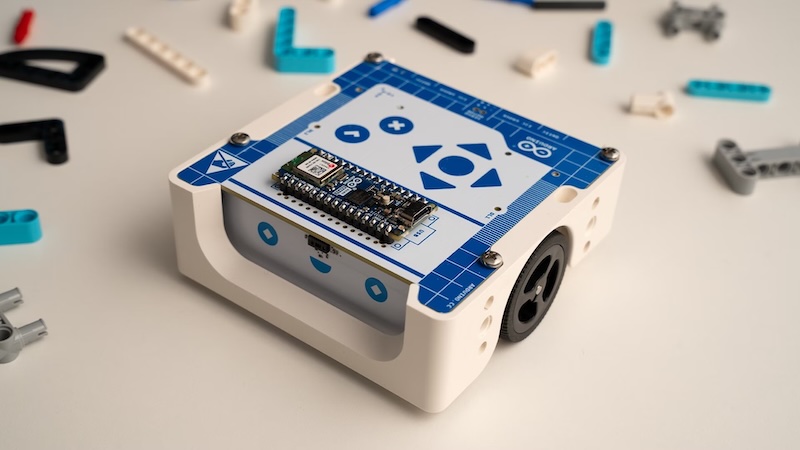
Arduino has already been in the robotics business to a certain extent, through kits largely targeted at STEM educators. Qualcomm has made AI a major piece of its Snapdragon mobile platform for the better part of a decade, though its most notable robotics play may be its work in drones, which resulted in the 2018 spinoff of autonomous flight developer, ModalAI.
The Arduino news comes months after Qualcomm announced it was acquiring Edge Impulse, a platform designed to run AI and ML processes on-device. Singh says the two purchases will combine to form the silicon giant’s new developer strategy.
“The combination of Edge Impulse and Arduino will help us, because they understand how to make things accessible for developers,” says Singh. “That is the superpower they bring. We will leverage that superpower and bring to market ways of delivering these technologies that are easily adoptable.”
NVIDIA’s Jetson platform is the 800-pound gorilla here. As robotics VP Deepu Talla told me in a recent interview, it was essentially the company’s decision to abandon its mobile processor ambitions in 2014 that gave rise to its present success in the category.
“We have a saying inside NVIDIA –— ‘if you’re not at least 10 years before a market or a technology takes shape, you’re probably late,’” “he told me at the time. “I think it was perfect timing for us to jump into physical AI and autonomous robotics applications.”
Qualcomm doesn’t appear to be under the illusion that it’s going to catch up with that decade-long head start overnight. The company isn’t laying claim to next year’s industrial humanoids and AMRs. Arduino affords a more targeted approach toward hobbyists, protoypes, and production systems that require lower lift. Over time, high powered chips, powered by technologies developed for its flagship mobile chips will lead to more powerful boards and, perhaps, robots in return.