This feature originally appeared in the Automated newsletter. Subscribe here.
The early days of every startup are defined by close calls. There’s the funding that nearly didn’t come through, the talent that was nearly poached, the customers who were days from backing out. Enough time — and subsequent success — transforms them into anecdotes you don’t mind retelling in front of a couple thousand people.
Speaking to a crowd at ICRA in May, Dusty Robotics founder and CEO Tessa Lau recounts one particularly ill-fated real-world product test, months after the construction startup pieced together its first system. In mid-2019, the engineer-turned-executive notes, the young startup was granted the opportunity to demo its robot on a “forward-thinking” federal contractor’s jobsite.
The omen, Lau says, popped up immediately on the day of. The construction site was only accessible via a "makeshift" ladder, leaving the team scrambling for ways to transfer a 100-pound robot down a flight. The answer, of course, is “very, very carefully.” Rope was secured to the robot’s box, which was then lowered to the ground below.
Reflecting on what an improper dismount could mean for Dusty’s fortunes, Lau casually noted, “That might be the end of our company.” It wasn’t, of course, as the relatively fragile pre-production system made it to ground without issue. Nor, however, was it the end of the young startup’s fate altering fortunes, standing on the site of what would soon become San Francisco’s latest Whole Foods location.
Addressing the ICRA audience, Lau points to a well-traveled quote from LinkedIn cofounder Reid Hoffman, “If you're not embarrassed by the first version of your product, you've launched too late.”
She doubles down on the sentiment when speaking with me on the Automated Podcast shortly after the ICRA interview. Robotics, after all, has its own set of rules. For one thing, she explains, the urge to operate in secret up to launch day that defines much of the consumer hardware world simply doesn’t work.
“Don't build in stealth,” Lau says. “Stealth is a terrible idea for robotics companies. You have to build in public because you only have a couple shots. Being in public, talking about your ideas is part of that. You have to be constantly testing those ideas with people, getting that feedback, and iterating on what you're learning in real-time. You can't build it in the lab and then do a big reveal and then hope that people buy it. It just doesn't work in robotics.”
Dusty’s journey began with a desire to address construction industry shortcomings using robot engineering know-how. Frequent site tours led to a number of potential avenues, including robots designed for roofing, crawlspace inspection, concrete finishing, material moving, and jobsite cleanup. Despite being labeled a “low-value task,” the team deemed the last concept its least bad idea.
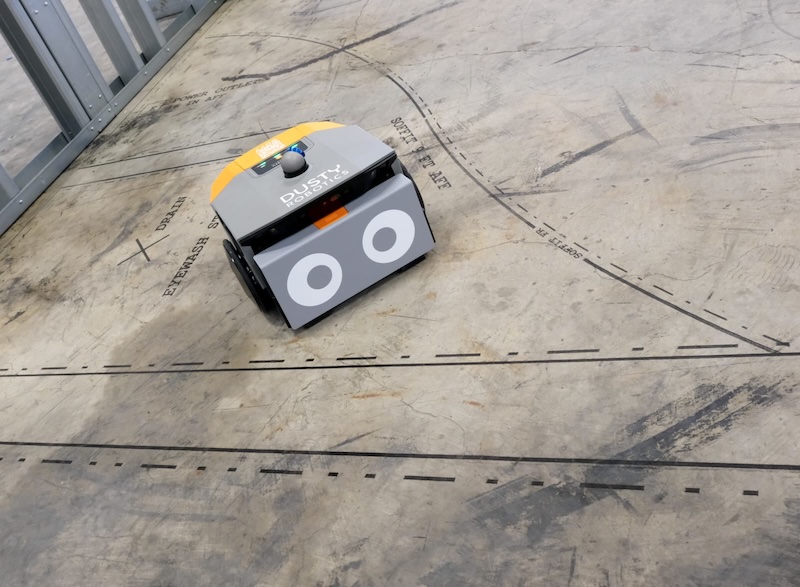
The startup began work on Dusty D1000, a jobsite sweeping robot that was its true namesake. In a very real way, however, the D1000 led to its own demise. A research trip to a jobsite for the proposed robot revealed a construction floor covered in blue and green spray paint lines and squiggles and the word “Door” hastily written where a door would eventually go.
Lau and company weren’t the first to hit on the notion of automating the process. Mentioning the project at subsequent site visits would almost inevitably result in a worker whipping out a phone to show their extremely DIY version of the project, in which they taped a marker to a Roomba.
Dusty’s first swipe at what would become the FieldPrinter was more advanced — though perhaps not as much as the team might have cared to admit at the time. It was the product of attaching sensors and a print system onto the top of a Ubiquity Robotics base recently purchased at the RoboBusiness conference. The version that appeared at the ill-fated Whole Foods job wasn’t far removed from this first prototype.
Lau not only held onto the video evidence of the fateful visit, she showcased it on-stage. Things start well enough. The prototype does its job well, moving forward in a perfectly straight line. And then the wobbling begins. You can hear the panicked “oh noes” in the video, as the path arcs off to the side. “We had just marked up their perfect floor in the wrong place,” Lau noted in the presentation.
The Dusty team discovered the hard way that operating a system that relies on WiFi transmissions in the middle of a dense, tech savvy city can lead to the sort of latency that causes the robot mind to wander.
It was not an insignificant screw up for a high-profile contract working with a massive client. Shouting ensued. The Superintendent banned Dusty from stepping foot on his sites. Lau notes that he still doesn’t believe in the company’s technology, in spite of widespread industry acceptance and the flattery of imitations from high profile tech firms. Turns out leaving your mark isn’t always a good thing. But if you haven’t veered on and made an accidental mark or two, perhaps you’ve launched too late.
“What we found is that the superintendents who see this, they're skeptical at first before they've seen it because they know how important layout is,” Lau says during our chat. “They've seen so many cases where layout goes wrong and the job goes sideways and it becomes a big mess. But as soon as they see the robot in operation, typically what they'll do is take a measuring tape and verify that it's exactly accurate and it always is, then they're sold.”