In the race toward digital transformation and Industry 4.0, the spotlight often falls on smart machines, Internet of Things (IoT) sensors, and fully automated production lines. But for many manufacturers, the real story includes a lot of older, battle-tested equipment still running strong on the shop floor.
“Rip and replace” is a phrase no manufacturer wants to hear, but that’s the phrase that many managers dread when they think about taking the first step in the digital transformation journey. Many of the legacy machines or control systems, after all, were built before digital networking, real-time data integration, and cloud connectivity became standard. These systems might lack built-in sensors, Ethernet ports, or programmable logic controllers (PLCs) with open communication standards.
Nonetheless, these systems continue to perform core manufacturing tasks with precision and reliability. In many cases, they represent decades of capital investment and operational experience.
Fear not. Far from being a barrier, these legacy systems can become essential building blocks of a smart, connected manufacturing environment. Though newer equipment is designed with digital integration in mind, legacy machines can still play a critical role — especially when cost, continuity, and ROI are factored in. With the right approach, manufacturers don’t need to choose between progress and practicality.
Reap the Benefits of Smart Upgrades
Rather than ripping out and replacing functional legacy systems, manufacturers can retrofit them with smart technologies, such as edge computing devices, aftermarket sensors, and industrial communication gateways. The result? Real-time data capture, improved productivity, and visibility into operations — all without starting from scratch.
There are lessons to be learned along the way, but one of the most significant is that you might be kicking yourself for not doing it sooner. “We’ve got customers that wait and wait and wait,” notes T.J. Tatum, senior design engineer for Bosch Rexroth. “But when they finally invest and finally do it, I usually get: ‘Wow. We should have done that a long time ago.’”
Not only can you extend the useful life of your assets, but the benefits of digital transformation are also considerable.
By integrating sensors, edge devices, and connectivity modules, manufacturers can access real-time operational data from machines that previously operated in isolation. This visibility allows for predictive maintenance, reduced downtime, and optimized performance — boosting both productivity and overall equipment effectiveness (OEE).
These upgrades also create a bridge between the old and the new, enabling legacy machines to communicate with modern manufacturing execution system (MES), enterprise resource planning (ERP), or cloud platforms. This integration supports smarter decision-making and centralized control, accelerating the shift toward Industry 4.0.
In addition, retrofitting helps manufacturers meet sustainability goals by reducing waste, lowering energy consumption, and avoiding the environmental cost of premature equipment replacement. For many, it’s the fastest and most efficient path to a smarter, more connected, and more resilient manufacturing operation.
Add-ons That Help
There’s no need to start from scratch. “You’ve got machines that work that do your process. We just want to monitor some points on that machine — whether it’s motor current, vibration, maybe pressure, some different levels,” Tatum says. “I can usually do that by buying a smaller controller and tying into your existing controls on the machine.”
If the machine has at least some type of Modbus serial communications, this is usually straightforward. If the equipment’s older than that, discrete I/O can be used to connect to a next-generation controller to support Industry 4.0 standards.
“So don’t rip out the whole controls; let’s just tie into the key points that we want to watch,” Tatum adds.
What exactly you need for your system will vary widely depending on what you’ve already got on it. As an example, Tatum points to Bosch Rexroth’s Assembly Technology division, where the company makes conveyors.
“All those conveyors — whether you bought it today or you bought it 30 years ago — it’s got an induction gear motor on there. I can use some CTs [current transformers] to measure motor current coming back in and do some predictive maintenance off that,” Tatum explains. “I can also use some vibration sensors placed in the right locations on there and do some bearing analysis, and I can predict wear and tear on the bearings.”
Adding two different types of sensors to the equipment, in this case, adds a certain level of complexity. “The older machine may or may not accept that complex of a sensor, so I bring in a smaller IoT-ready controller,” Tatum says.
This kind of addition to your equipment could cost as little as a couple thousand dollars, Tatum notes, or it could cost as much as $10,000 to $20,000. “It depends on the amount of sensors and how much data you want to keep,” he says.
Some of the factors affecting price and complexity include whether you’re storing the data locally or in the cloud — and everything that decision entails. “If you’re storing it up in the cloud, then there’s typically some recurring costs on that,” Tatum says. “And now you need a controller that not only can connect to the Internet but also has firewalls and VPN in place to make it a secure connection.”
An App-Based Approach to Industry 4.0
At the heart of the CtrlX platform is a versatile, app-based controller that can be adapted to meet different industrial needs. “We’ve got a controller on there similar to a PLC, but it’s an app-based controller,” Tatum explains. “So if I want it to be a PLC, I put a PLC app on it and I can write ladder logic, structured text, whichever. In this case, I want it to be an IoT device, so I’m going to put an IoT app on it.”
The app being used in this example is called Device Bridge, which enables the controller to communicate across a wide range of common industrial protocols. Once the connection is established, data can be pulled into the CtrlX controller.
The example in Figure 1 uses Modbus TCP/IP to pull data from one controller, and a Siemens S7 connection to retrieve data from another. That information is then fed into a MongoDB database. For visualization, a Node-RED front end is used to display the results in real time.
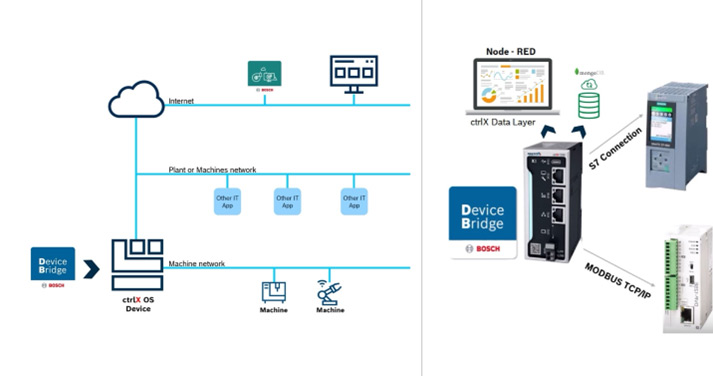
Ultimately, the CtrlX platform acts as a bridge between legacy and modern industrial systems. “I’m using this Device Bridge app to pull that data from that legacy equipment onto our controller,” Tatum says. “From there, I can send it up into the cloud or I can keep it all locally.”
PIA Automation takes a similar approach with its PIA Industrial App Suite (piaIAS), a digital portfolio of products, solutions, and services used to commission and optimize the machines that it designs. “But these apps can also be applied retroactively,” explains Thomas Schwoerer, managing director at PIA Automation, which builds machines for assembly and testing.
The smart apps combine active and passive elements, Schwoerer notes, to perform a range of functions. “For example, we have an element called piaOEEtracker, which increases availability,” he says. “We have an app called piaAnalyze that is for quality improvements. We have one called piaOptimum that is to improve efficiency.”
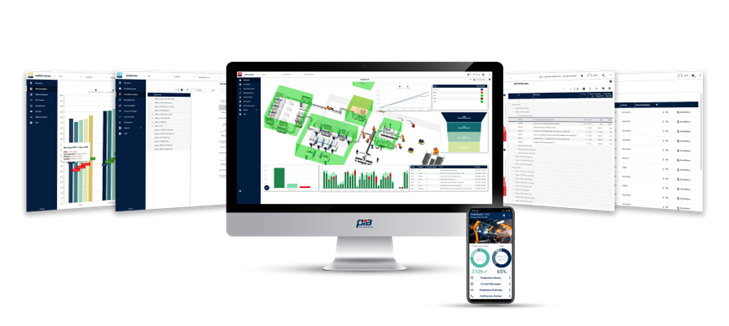
Other modules include piaVisibility and piaMaintenance. The tools address different user groups with features providing information for line workers, evaluations for shift managers and the maintenance team, or reports for management.
“We use these if we build a brand-new machine,” Schwoerer says. “And we could also use the same tools if we retrofit an existing old machine.”
Digital Twins Help to Optimize Production
When PIA Automation designs a new custom system from scratch, it also builds a digital twin around that system — modeling and simulating the motion mechanics, throughput, etc., of the machine. “We program the code even before the first screw is on the shop floor,” Schwoerer says.
That same digital twin technique can be applied to legacy systems — to reverse engineer the physical system back into the virtual world, Schwoerer explains. “One of our entities currently has such a request on the table to reverse engineer a machine that was not even built by PIA,” he notes. PIA is working to digitalize the third-party equipment to help optimize its performance.
Creating a digital twin of a legacy system can be particularly beneficial if the goal is to optimize throughput. A customer might say, for example, that they’re looking to improve cycle time by 20% or even 50%, and wonder if their old system can be retrofitted to do that. “That’s where the digital twin world comes in and has more potential,” Schwoerer says.
This is essentially the request that came recently from a tier one automotive supplier. They had an old machine built by a company that has since gone out of business. They want to keep using the system while also improving cycle time and throughput.
In this case, the customer had a CAD model on hand to help PIA Automation bring the legacy system into the digital world. This certainly helps, providing a base from which to start. But PIA can also use a handheld tool, walking around a machine to produce a point cloud and reverse engineer the system from there.
How Old Is Too Old?
Not every legacy system will be a candidate for the benefits of a digital twin, Schwoerer concedes. “It would depend on the complexity and the task that the machine is targeted for,” he says.
From Bosch Rexroth’s perspective, no equipment is too old to bring into the digital realm.
“My background was in field service, so we worked on a lot of the old equipment, and some of the stuff was before the PLCs were even put in,” Tatum says. “I opened a cabinet once and there’s just a bunch of relays in there, so the whole thing was done in relay logic. But even those types of systems — I can bring those into a controller, and I can analyze that data.”
Granted, it won’t be particularly sophisticated data in this case, but depending on the application, that level of analysis might be enough.
Lessons Learned: Don’t Get Buried in Data
One note of caution Tatum mentions to manufacturers considering bringing their old systems into the modern world: Beware how many data points you go after.
Manufacturers often underestimate the amount of data they are likely to gather when they connect legacy systems, Tatum says. “They connect to an old machine and they want to bring in every point of data possible, and they get overwhelmed with the amount of data they bring in.”
Bringing in 15,000 variables just because you can isn’t always the best route. Instead, Tatum advises, make sure you understand the critical functions of the machine and then bring in just a handful of variables that you want to keep an eye on.
“You don’t need every aspect of the machine because you’re going to get overwhelmed by the data,” he says. “So break it down and understand the machine itself. What is critical to that machine running? What do you want to monitor? Are you trying to monitor OEE? Are you looking for predictive maintenance? Have a scope of what you’re looking for. Otherwise, you’ll bring in way too much data.”
Other advice that Tatum offers is to start small. “You don’t have to make it super difficult. Start with a few key points on that machine — maybe you want to monitor amperage and pressure,” he says. “You can take a slow approach into it. You don’t have to do it all at once.”
Legacy equipment doesn’t have to be a roadblock to digital transformation — in fact, it can be a key enabler. With the right mix of smart sensors, edge controllers, and secure connectivity, manufacturers can bridge the gap between analog reliability and digital intelligence.
Retrofitting older machines allows for meaningful data collection, real-time visibility, and operational improvements without the disruption or cost of full system replacement.