 Cobots are redefining what’s possible in modern manufacturing, enabling flexible automation at a scale never seen before. A report from IDTechEx shows collaborative robots on a steep growth trajectory, with revenues expected to jump from $1.2 billion to nearly $30 billion in just over a decade. This rapid growth raises a critical question for manufacturers: what new possibilities do cobots unlock on the factory floor today and in the years ahead?
What is a Collaborative Robot?
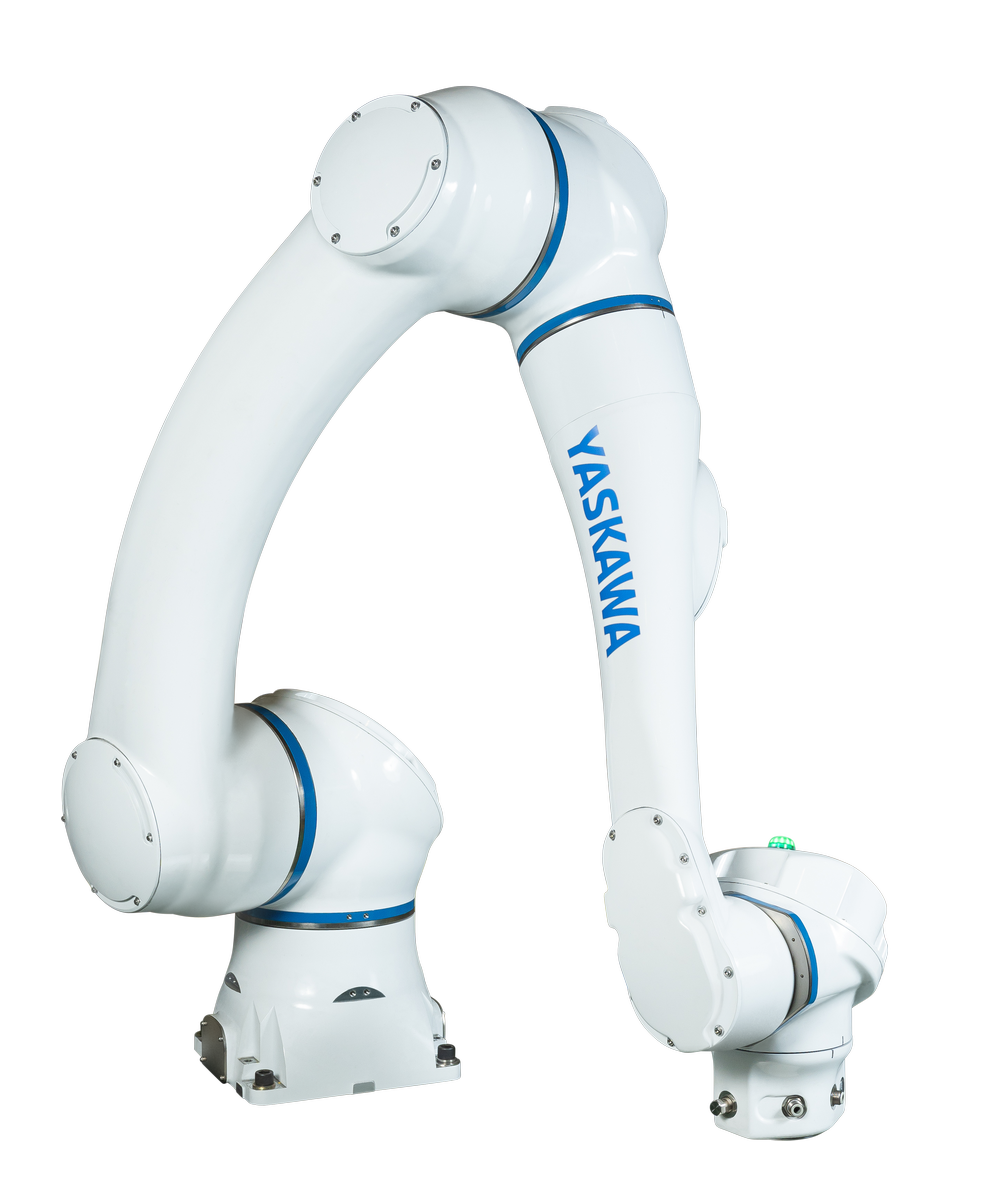
What exactly is a collaborative robot? In simple terms, a cobot is a robot designed to work with humans in a shared work environment without any extensive safety gates, guards, or fences. Cobots are lighter weight and smaller than traditional industrial robots, and are equipped with sensors and programming that stop a cobot if it detects an obstacle (or a person) in its path. It is often designed with rounded edges and extensive controls that monitor speed, direction and environment in real-time. In addition, cobots are smaller, more flexible and more adaptable, and can often work in areas too small for traditional industrial robots. Cobots can be mounted on trolleys or platforms that can be moved from station to station, and typically run on 110V current.
In practice, many cobots, especially ones that are employed in palletizing/depalletizing or pick-and-place operations, end up with some kind of guard or fencing. “I would estimate that up to 50% of cobots end up with some kind of fencing or additional sensors, either at the time of installation or after. It’s not a design flaw; it’s a matter of safety. For example, in tasks like palletizing/depalletizing, the arm operates at the level of an employee’s head, or the welding function is at eye level of an employee. Added safety doesn’t make it less collaborative; it’s the ease of use rather than strictly proximity that makes the robot collaborative these days,” said Jerry Perez, business development, FANUC.
While industrial robots generally require a robotic applications engineer to program, troubleshoot, and operate them safely, cobots are designed for straightforward operation. They are easier to program and operate, which provides higher-value opportunities for employees who operate the cobot. If the cobot includes smart technology, machine learning or artificial intelligence (AI), the cobot can self-troubleshoot and send reports in real-time. In addition, programming and operation can be handled via a teach pendant or tablet, which can be connected with an application on a smartphone or tablet.
Industry 4.0 vs. Industry 5.0
Industry 4.0 emphasized technological advances that transformed manufacturing. These advances included edge and cloud computing, smart technologies, and advanced analytics powered by real-time data.
Industry 5.0 builds on that foundation by shifting the focus to collaboration between humans and technology. AI, machine learning, and natural language processing enable automation to take on routine, repetitive tasks that require speed and precision, as well as dangerous work. This allows human employees to focus on higher-value, more creative, and strategic tasks.
Edge and cloud computing technologies allow troubleshooting and problem-solving via a virtual connection. The service technician can see what the operator is seeing in real-time. Instead of a production line shutting down for days until a service technician can arrive, virtual reality and AI allow many issues to be solved quickly.
In addition, edge and cloud computing have built-in cybersecurity measures that protect any data from hackers or cyberattacks. Some of the biggest cyberattacks targeted third-party suppliers whose cyber protection were more vulnerable to attack.
Just as industrial automation transformed the automotive industry, cobots are now leading the transformation in several industries including bio-medical, logistics, materials handling, agriculture, and food processing.
Trends in Cobots
One of the advantages of cobots is their smaller footprint vis-à-vis traditional industrial robots. Industrial robots take a large space to operate, and if a company has grown through acquisition, there may be a variety of robots. One of the biggest challenges an integrator faces is designing a system that can “communicate” with existing automation; solutions must be system agnostic and able to work with any other manufacturer’s robots.
Cobots with Higher Payloads
Dieter Pletscher, global sales manager, Kassow Robotics, shares that one of the trends in the industry in the last couple of years is a demand for robots with a higher payload, a higher reach and stronger capability. “While it is less collaborative than traditional cobots, it is still lighter and easier to program than traditional industrial solutions. It combines the ease of programming and use of a cobot with increased capacity and reach, without needing as much floorspace as a traditional industrial robot.”
Pre-engineered Solutions
Pre-engineered solutions are another trend in cobots. It’s a “cobot and go” solution that is simple to use, quick to deploy, and targets standard operations such as palletizing, welding, and machine tending. “We have seen sales of these pre-engineered solutions jump double or triple in the last couple of years. It’s a robots-for-all approach for people who don’t ‘speak robot’ or have 10 years of robotic automation experience. It needs a really good interface; no XYZ coordinates, no frame, no joint linear moves — it’s in the language of the solution. Robots are the engine, but people want to buy the whole car. Pre-engineered solutions are the ‘car’,” said Perez.
Cobots for Inspection Use
One area where cobots excel is the inspection of precision parts, especially in the bio-medical or aerospace industries. There may be parts with multiple facets that must be correct, or bad things can happen, and standards and tolerances must be exact. Perez gave an example of an aerospace client who had one inspection operation that took 12 hours to perform manually. After retrofitting cobots with pre-engineered solutions, including advanced scanning tools and mounting the cobot on a cart, the same inspection could be performed in 10 minutes. The customer could have multiple machines feeding one central inspection system that resulted in greater accuracy and precision.
Mobile Robots with Manipulators
Another cobot trend is putting manipulators on a mobile robot, such as Kassow Robotics’ Edge Edition line. The controller is built into the base of the robotic arm, and is designed for mounting on a mobile platform or attached to an automated guided robot (AGR). “It’s ideal for logistics solutions. The integration is easier, it operates on a direct connection to a battery, and it can move from station to station to complete a number of tasks with various end-of-arm-tools [EOAT]. It’s another trend towards keep-it-simple robotics,” said Pletscher.
New Industries
With the combination of Industry 5.0 and AGR applications, new sectors are exploring cobots. For example, general purpose cobots are increasing in use. They are lower cost and less precise than special-purpose cobots, while still delivering ease of use and programming. Perez described a cobot that is being used for machine tending in a 3D printing company. Depending on the type of product the 3D printer is creating, the operation can take hours. “ With a cobot in charge of machine tending, the employees can turn out the lights and go home, and the printers will keep operating overnight since the cobots keep monitoring and loading raw materials, and picking and placing finished parts, ensuring the parts are ready for the additional manufacturing the next day.”
A partnership between Inbolt and Fanuc has paired a robot with AI-powered 3D vision that allows “adaptive dynamic path creation in real-time.” Artificial intelligence paired with machine learning allows the robot to auto-generate a path that allows for “screw insertion, bolt rundown, glue application and other high-precision tasks on parts moving down the line.” The AI-vision provides real-time analysis of the part orientation, allowing the robot to adapt the path from part to part without changing the end-of-arm-tool or stopping the production line. “We debuted it at Automate 2025 in Detroit. Innovation is changing how people think about automation, while delivering lower cost, more efficient solutions,” said Perez.
“The customer user experience is always pushing innovation, and AI is driving a whole new eco-system. For example, pairing a cobot equipped with a 3D vision camera powered by AI is being used in the agriculture sector to harvest produce.” It’s an industry that has been plagued with labor shortages. AI and machine learning allow the robot to “learn” what produce is ready for harvest, and to pick only that produce. Adding a robot arm equipped with an EOAT with sensors that adjust the grip to the type of produce, mounted on an autonomous mobile robot (AMR) allows harvesting to be completed more efficiently, with less waste. “This was a sector that has traditionally been unable to automate many of the tasks. Even three years ago this kind of solution would not have been possible. Artificial intelligence and real-time data analysis to send the right signals to machines are opening up new avenues,” said Pletscher.
Continued Labor Shortages
The American Welding Society estimates that by 2029, there will be a need for approximately 320,500 employees in welding positions. Skilled trades are attracting less young people, while more than 157,000 current welding professionals are approaching retirement. Other skilled trades are experiencing similar shortages.
Cobots are ideal for repetitive tasks such as welding, especially in hazardous environments. “If you have 10,000 parts that need simple welds, adding a collaborative automation solution can complete the task efficiently, which releases the employees for higher-value tasks. The ease of use allows for human-robot collaboration without the need for an applications engineer. For example, a 7-axis cobot can complete a 380° weld in one pass, eliminating issues with singularity and consistency. The integrator can place the elbow in the safest operating location, and cobots can operate in hazardous environments that are dangerous for human employees,” said Pletscher.
What is the Future of Cobots?
As advances in AI and ML continue to drive innovation, new sectors will benefit from cobot automation solutions. For sectors such as agriculture, the ecosystem driven by improved AI-powered vision, cameras and sensors, paired with advances in EAOT and continued labor shortages will continue to provide opportunities that were not possible a few years ago. The pharmaceutical industry is another that is still not highly automated; there are many operations that are still completed manually,” said Petscher.
“There are a number of non-manufacturing sectors such as food service that have never had cobots. Startups are using AI to power a whole ecosystem of applications, sensors and cameras designed for cobots that can fit in small spaces, such as the back of a pizza restaurant. Small and medium businesses are looking for automation solutions that work, are cost effective, fit into existing spaces and provide efficient, consistent results,” said Perez. “Many sectors are looking for plug-and-play turnkey solutions.”
Global geopolitical tensions, including trade wars, ongoing geographical conflicts, and economic uncertainty are having an impact on capital expenditure decisions. While cobots are less expensive than their larger industrial cousins, they still represent a significant financial investment. “OEMs and integrators have been challenged to find new ways of doing business in periods of economic uncertainty. Instead of payment in full at the time of installation, integrators may offer a “lease or rental” option, allowing the end-user to pay in installments per month, or per hour. We need to find new ways to do business, maybe taking a page from B2C (business-to-consumer) where the cost of the automation is amortized over time. We need to make it simple to do business with us,” said Perez.
Collaborative robots, paired with AI and ML technology, will continue opening new sectors to automation solutions that were not previously available. Technology will continue to drive innovation, feeding both the cobot industry and related ecosystem to further explore the possibilities of automation solutions.