This feature originally appeared in the Automated newsletter. Subscribe here.
It was supposed to be a sabbatical — six months to get a taste of real-world challenges, away from the university life. Half a year spent trading one institutional grind for another, out of the metaphorical frying pan, into the proverbial fire. The wherewithal to carry on arrived on the floor of Amazon’s now-defunct Re:MARS, a self-proclaimed “global AI event for machine learning, automation, robotics, and Space.”
“When I was at this conference, it was just like being in Disneyland,” Grace Brown explains on the latest episode of Automated. “I was like, ‘my God, all these robots that I've always read about and watched videos on.’ But then when I was interacting with some of the companion robots, I realized that these are companies that had raised hundreds of millions of dollars, all of the technical challenges that they were facing with like reliability, with like latency, engagement, like they weren't that much further along than what I was.”
Having already devoted much of her downtime to building the robot that would become Abi, the then-University of Melbourne engineering undergrad was determined to spend a full six months on the project.
“I just wanted to dedicate more time to making [Abi] more sophisticated, but then to also understand like how could I build a product and bring it to market?” Brown says. “What's actually required to start a business? It was always meant to be like a six-month stint of self-learning and self-discovery of how to do all of this.”
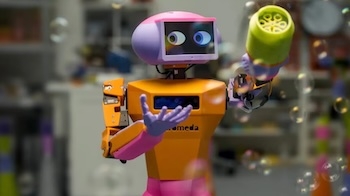
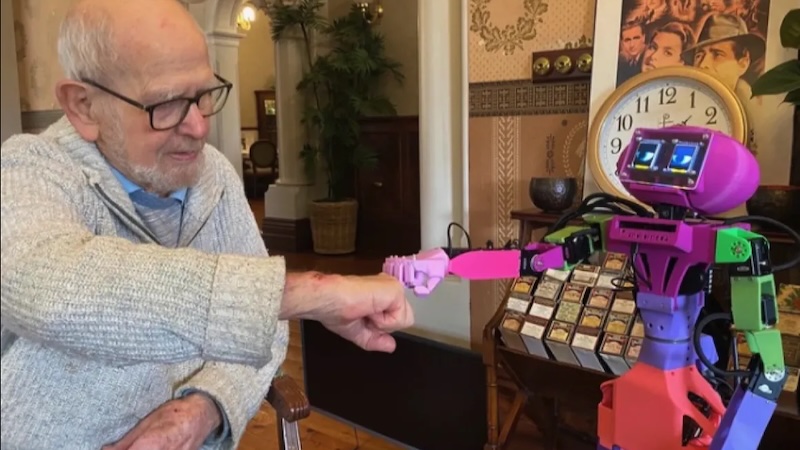
Sometimes the best business plans are no particular plans at all. There is, after all, little pressure when there are no specific expectations. The earliest version of Abi was a 3D printed exoskeleton housing a minimalist chat feature, just enough for Brown and the seeds of Andromeda Robotics to lay out the foundation of a thesis at a local assisted living facility.
“Even that brought so much joy to people that I was bringing her to for free at the time, just by myself, just putting her in front of people, trying to understand how to create a really high-quality interaction,” Brown adds. “I could just see that people just adored her and loved her really, really quickly. And I thought, if I had more resources and more time to make her even better, that impact could be so much higher.”
The half-year of zero expectations found Brown and Abi raising $120,000 AUD, and sparking enough interest to indefinitely extend her higher learning sabbatical. “I didn't even tell my parents for like a whole year,” she confesses. Brown adds that she worked up the confidence when she “had the realization that [Andromeda] could be a billion-dollar company,” during a MassRobotics residency.
“Doing a startup is so risky,” she confesses. “I was doing well in uni. I was getting good internships from reputable companies in our country. I remembered there was an article that came out about our pre-seed raise. Up to then we'd raised a million dollars, and I sent that to my parents along with the news that I hadn't actually been studying.”
For Brown, the transition also meant trading in her engineering hat for an executive blazer.
“It was always very clear that I would end up being CEO,” says Brown. “I had a huge identity shift from being an engineer to being a CEO. I think engineers sometimes also undervalue business skills and other skills outside of engineering. Now I think what motivates me and drives me is realizing it's not about learning these specific skills. For me, it's not about becoming the best engineer. For me now, it's about building the best team and enabling them to be able to do their best work so that Abi can reach people at scale.”
Abi and Brown took a major step toward that goal this past September, as Andromeda announced a $15 million Series A. The new funding is helping the startup develop Abi’s successor, Genesis Abi, while expanding operations into the United States.