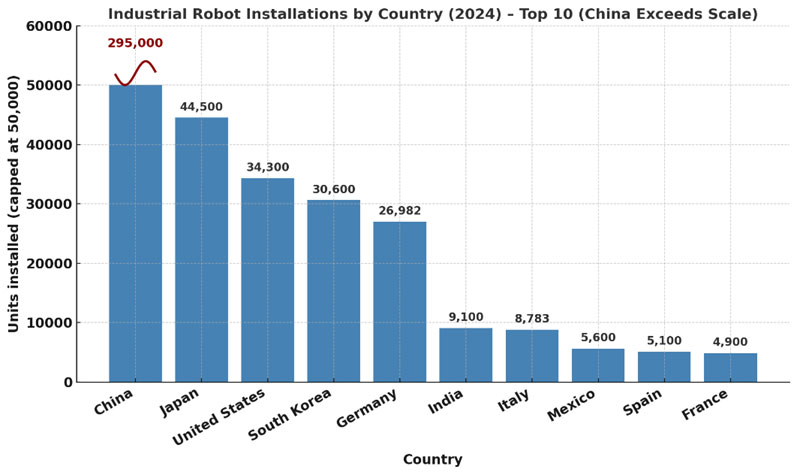
India is among the fastest-growing robotics markets in the world. According to statistics from the International Federation of Robotics, robot installations in India grew by about 84% from 2021 to 2024. India is now the sixth-largest country worldwide in terms of annual industrial-robot installations.
However, after a huge 2023, which saw a 59% increase in installations, the Indian market cooled in 2024 with just 7% growth. In 2025, tariffs and other economic uncertainty have created a market that is waiting for stability in the global supply chain to take hold.
For the second time in two years, the Association for Advancing Automation visited India to discuss the trends and opportunities for the robotics and automation industries in what is now the world’s largest country. The trip was supported by U.S. Commercial Services and the U.S. Department of Commerce through a grant supporting the development of trade relations between the United States and India.
 During our visit, Robert Little, Novanta’s chief robotic strategist, and I met with more than 100 companies — ranging from system integrators to technology suppliers to global and local manufacturers with operations in India.
Most of them saw a bright future for automation in India — while also offering insights into the challenges facing widespread adoption.
Here are some of the key takeaways from our weeklong visit to Bangalore and Chennai:
- When it comes to robotics and automation, there are two Indias
When it comes to automation adoption in India, there are really two distinct customers with very different demands.
As the global supply chain has arrived in India, large multinational manufacturers are demanding the precision, speed, quality, and traceability that demands sophisticated robotics and automation. These companies come equipped with their own playbook. A robust ecosystem of Indian-based system integrators has risen up to meet these challenges, delivering extensive large-scale automation.
Manufacturers cited quality as the top reason for adding automation. For example, one large automotive tier supplier stated they had an expensive recall due to a quality issue. They said the problem could have been avoided if the process had been automated. They complained that the lack of skilled labor and the high attrition of trained employees contribute to the quality issues. (More on that in a moment.)
Right now, these global players are the beachhead and the biggest area of opportunity for automation.
However, these integrators have found local manufacturers to be a much tougher sell. That’s not to say there won’t be opportunity. One large automation player told us that it expected more than 40,000 manufacturing facilities to be built in India in the next 5 years.
And, even from some local manufacturers, there is curiosity.
We met with a local trade association in Chennai. AIEMA, the Ambattur Industrial Estate Manufacturers' Association, is one of the premier industrial associations for small and medium-sized enterprises and sponsors of a metal forming show in 2026. They invited many of their local members to meet with us. These included companies in industries such as sheet metal and steel production, door and window manufacturing, and glass painting. Some were already using automation. Others were interested.
However, in India, it’s …
- Still all about the ROI
In nearly every conversation with automation providers, both system integrators and technology suppliers expressed exasperation at how the local Indian market fails to see the true value of modernizing their operations.
Conversely, local manufacturers told us how they couldn’t justify an ROI of robotics — especially when you factor in the risks of new technology and their inability to service new technology. “There are robots in storage all over the country,” one integrator says.
It doesn’t help that tariffs and other factors have driven up the expense. One auto supplier complained the costs to automate “are doubling.”
To stay in consideration, automation companies have had to be patient, starting with small projects or proof-of-concepts. One technology supplier helped improve a manual metal-polishing process before moving the customer toward robotic solutions.
Some integrators also believe that this frugalness has led customers to sometimes select cheaper solutions — often from China — that haven’t been reliable or delivered all the potential value.
.jpg "The first A3 member meeting in India. From left: Purushothaman C. (Fanuc India), Prakash Ramanathan (Siemens), Siddharth Bhagra (Ati Motors), Robert Huschka (A3), Sarang Panse (A3), Robert Little (Novanta), Anuj Bihani (Impaqt Robotics), Rahul Sahastrabudhe (A3), Kumar Dasari (SFacto Global).") Also, during an A3-hosted reception in Bangalore, a panel of experts spoke to a large audience of manufacturers and robotics and automation experts. In that talk, it was clear that integrators in India have the same problems as in the United States. Manufacturers want to take on their most complicated and toughest problems and automate those first. This is a recipe for failure, only making manufacturers less likely to automate in the future.
Also, during an A3-hosted reception in Bangalore, a panel of experts spoke to a large audience of manufacturers and robotics and automation experts. In that talk, it was clear that integrators in India have the same problems as in the United States. Manufacturers want to take on their most complicated and toughest problems and automate those first. This is a recipe for failure, only making manufacturers less likely to automate in the future.
And, if they’ve failed at it once, companies are less likely to try automation again.
One system integrator expressed frustration that Indian manufacturers were looking for an ROI in the 18–24-month time frame, which he stated was too short for many applications. The good news is that we heard from another integrator that a few manufacturers understand this and have expanded that window to 36 months.
And, despite the hurdles, there is a growing belief that the move to more automation is inevitable as India develops a more robust middle class that demands more quality from their products.
And, there’s the issue of workforce …
- With more than a billion people, can India have a workforce problem?
India has more than 1.4 billion people and is the most populous country in the world, with a median age of about 28.8 years. On its face, this should indicate a large pool of manual labor for domestic manufacturing.
However, over and over, the Indian manufacturers we spoke with talked about the struggles of finding and retaining workers — especially skilled workers. One aerospace supplier told us that they hire 50 new workers every six months, then spend three months training these new hires before they’re allowed to do any work on the floor. The company explained that they always need “a surplus” of workers to cover for illness or attrition. Another company said 70% of their workers were just “faces that kept changing.”
So, why is this a problem in such a populous country? The reasons don’t sound that dissimilar to what we hear in North America.
India’s younger generation doesn’t want to work in manufacturing jobs. One company told the story of a top worker who left his factory job to work as mall security — even though the pay was less. “They have air conditioning,” the worker said.
And as the educated middle class has grown, educated Indian workers are turning more to the tech industry and other office jobs, choosing to stay away from the dull, dirty, and dangerous careers associated with manufacturing.
The small- and medium-sized companies also shared with us their frustrations about the lack of skilled manufacturing labor — and complained that larger corporations frequently snatch up talent from smaller firms.
Still, India has plenty of workers — especially when compared to the United States and Europe. But this frustration about the workforce has led some manufacturers to look to automation to give them the quality and reliability they need in their operations, while making the cost and longer ROI of investments more palatable.
- Eyes on the North American market
With India still an emerging automation market, many Indian system integrators and robotics and technology startups have looked to the North American market for growth. Several integrators — Wipro PARI, Titan Engineering & Automation Limited, and DiFACTO — have established themselves with North American customers. Many others we talked to looked to make the leap, offering turnkey solutions, design, and simulation services.
Most of the integrators (if not all) were looking for U.S. partners to further expand into the U.S. robotics and automation market.
Robotics startups are also looking to cross the Pacific. Some, like mobile robot player Ati Motors, have established a presence. Others — offering solutions from indoor painting to commercial kitchens to fleet management — see North America as a better market for robotics than their home country and are looking to make connections.
Right now, tariffs and other trade barriers may limit the possibilities, but that isn’t stopping Indian companies from betting their fortunes on future moves into the United States.
Are you interested in learning more about A3’s efforts in India or joining us on our next trade mission? Sign up here to stay informed of our India activities.