Microbots are prized for their ability to access places their larger brethren can’t, like the human body. Of course, extreme sizes present extreme limitations, including how the ‘bots are constructed. Researchers at the University of Colorado Boulder this week are highlight a new method for building customizable systems measuring 0.2 microns – or 500x thinner than a strand of hair.
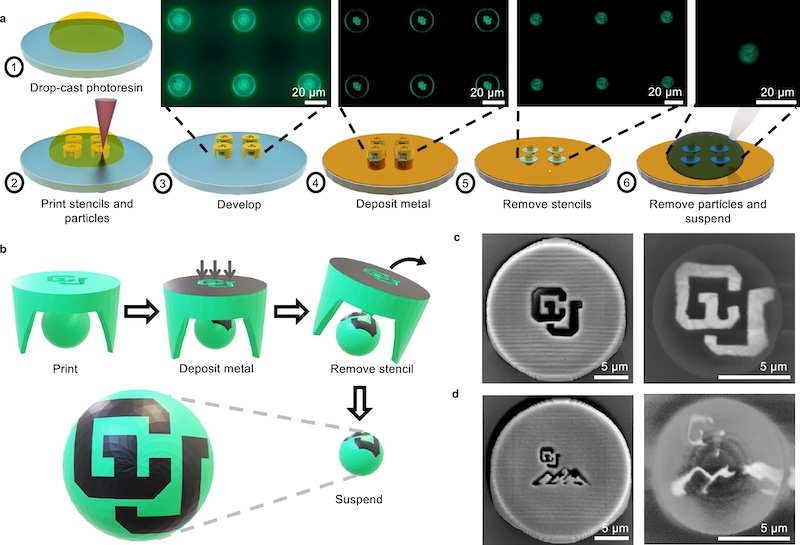
The process utilizes a form of additive manufacturing known as two-photon lithograph. The microbot is 3D printed along with an attached stencil mounted atop “legs,” allowing it to “selectively” wash away when deionized water is applied.
Metal – mostly gold, platinum, and cobalt – is deposited into the stencil’s openings to form patches. The size and location of the deposits control where the precise patchy particle (PPP) goes when magnetic/electric fields are applied. Those patches can be printed in sizes as small as 200 nanometers.
“The shape of surface patches gives particles information about where to go,” says coauthor, Wyatt Shields “We've not had good methods to control the shape of those patches until now.”
Naturally, the first print was University of Colorado’s “CU” logo, while the second featured an outline of the Rocky Mountains. The tiny branding possibilities are practically endless.