In robotics and automated manufacturing, glue inspection has long been treated as a mature problem. For opaque adhesives, this assumption largely holds true. Height, width, and continuity can be measured reliably with conventional laser profilers and structured-light systems.
Semi-transparent glue changes that equation entirely.
As automation advances across automotive electronics, PCB/SMT manufacturing, and consumer electronics, manufacturers are increasingly adopting translucent sealants, gels, and encapsulants. These materials offer mechanical flexibility, thermal stability, and electrical insulation—yet they introduce a fundamental optical conflict that many inspection systems are not designed to resolve.
The result is a persistent gap between nominal measurement capability and actual measurement reliability on the production line.
The Optical Problem Most Engineers Underestimate
Semi-transparent glue does not behave like a conventional surface. When a laser line strikes the material, reflection does not occur at a single, well-defined boundary.
- Instead, the beam partially:
- reflects from the top surface,
- penetrates the adhesive body,
- and reflects again from internal structures or the bottom interface.
For a vision system, this creates competing depth signals within the same pixel region. Standard 3D laser profilers interpret these mixed returns as:
- unstable height values,
- false peaks,
- distorted profiles,
- or high-frequency noise that cannot be filtered without losing valid data.
This phenomenon becomes especially problematic in automated cells where:
- glue translucency is around 60%,
- glue thickness varies dynamically,
- and inspection must occur inline, at production speed.
In applications such as automotive control unit sealing, PCB pin coating, and consumer electronics encapsulation, even small height deviations can compromise reliability. Yet many systems fail not because of mechanical limitations, but because they were never designed to distinguish which surface the laser is actually seeing.
.jpg)
Why Conventional Filtering Fails in Semi-Transparent Glue Inspection
A common response is to apply stronger filtering, averaging, or thresholding. In practice, this approach only masks the symptom.
Below a thickness of approximately 0.15 mm, semi-transparent adhesives allow excessive bottom-surface reflection. This leads to peak saturation and inconsistent sampling. Above that threshold, interference persists, but becomes more predictable—if the system knows how to interpret it. The key limitation is architectural: Most laser profilers treat all reflected photons equally.
Without a mechanism to isolate the true top-surface return, the system cannot reliably reconstruct glue geometry. No amount of post-processing can fully correct an ambiguous signal source. This is where dedicated glue-mode architectures begin to matter.
Reframing the Solution: Algorithm First, Hardware Aligned
Modern semi-transparent glue inspection requires a shift in design philosophy. Instead of asking how to clean the signal after capture, advanced systems ask a different question:
Which part of the signal should be captured at all?
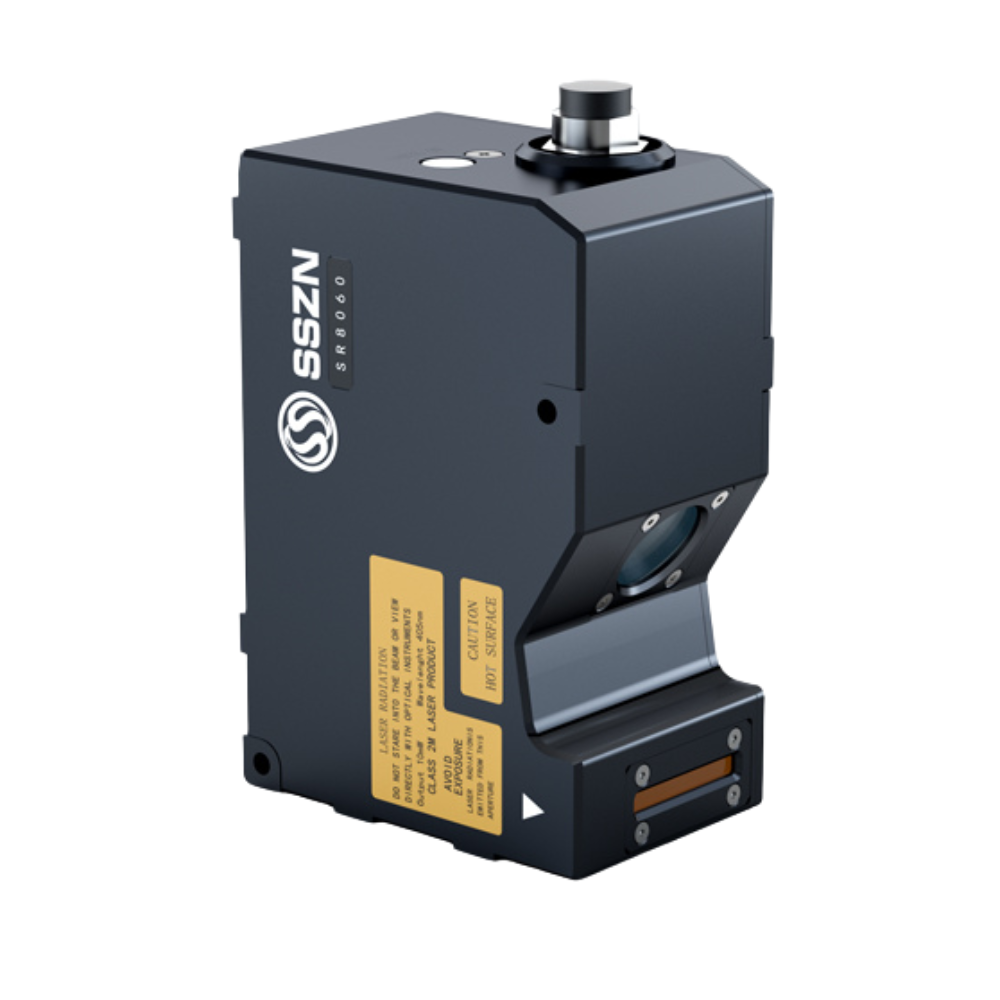
The SRI8060 and SRI8020 3D laser profilers address this challenge through a dedicated glue-mode algorithm designed specifically for translucent materials. Rather than treating glue as a noisy surface, the algorithm models it as an optically layered medium.
Inside Glue-Mode Measurement: Three Technical Mechanisms
1. Surface Pixel Isolation
The algorithm identifies and extracts only the pixel responses associated with the glue’s top surface. Deeper reflections—whether from the substrate or internal scattering—are algorithmically excluded at the acquisition stage. This prevents multi-peak ambiguity before it enters the height reconstruction pipeline.
2. Background Interference Suppression
Semi-transparent materials generate diffuse and delayed reflections. Glue-mode processing actively suppresses these signals, maintaining a stable height reference even when translucency fluctuates across the bead. This is critical in robotic dispensing applications where glue composition, temperature, and flow behavior change over time.
3. True Contour Reconstruction
By analyzing only validated surface-return data, the system reconstructs the actual glue profile—height, width, continuity, and edge geometry—without distortion.
In production environments, this enables consistent measurement of glue features that would otherwise appear unstable or undefined.
What This Means on the Factory Floor
When applied in automotive electronics, PCB/SMT lines, and consumer electronics assembly, the practical implications are significant:
- Stable glue height measurement within 0.01–0.1 mm accuracy
- Reliable inspection of glue thicknesses above 0.15 mm
- Detection of fine defects as small as 0.15 mm × 0.15 mm × 0.05 mm
- Consistent inline performance without slowing robotic cycle times
More importantly, engineers gain confidence that the data represents the actual glue surface, not an optical artifact.
Closing the Measurement Gap in Automated Production
Semi-transparent glue inspection has exposed a broader truth in robotics and automation: not all measurement problems are mechanical or optical. Many are interpretive.
As materials evolve, inspection systems must move beyond generic sensing and toward application-specific intelligence. Glue-mode measurement in 3D laser profilers represents this transition—where algorithms are no longer optional enhancements, but foundational components of metrology.
For manufacturers pushing toward higher automation density and tighter quality margins, the ability to measure translucent materials reliably is no longer a niche requirement. It is becoming a baseline capability. And in that shift, semi-transparent glue is no longer an exception—it is the test case.
For detailed technical specifications, application notes, and integration guidance for semi-transparent glue inspection using the SRI8060 and SRI8020 3D laser profilers, contact the SinceVision engineering team at [email protected] or visit www.sincevision.com to explore related solutions and documentation.