From semiconductors to agriculture, manufacturing sectors are demanding smarter, faster, and more efficient motion control systems. Innovations in modular architectures, energy efficiency, real-time data analytics, and artificial intelligence (AI) are reshaping how machines move. The future of motion control looks to be more open, more integrated, and more autonomous.
Customers are demanding motion control advances in safety, reliability, flexibility, and real-time data collection, and continue to expect smaller, faster, more precise motion systems. And a wide range of industries are benefiting from the advances, including semiconductor manufacturing, automotive manufacturing, medical devices and life sciences, aerospace, defense, and consumer goods.
“All these industries are adding advanced motion control to increase throughput, keep up with demand, and raise profit margins,” says Garrett Wagg, ctrlX Automation product manager — automation and electrification for Bosch Rexroth. “These systems are also reducing energy consumption, downtime, and wasted material.”
Smaller, Faster, Smarter
Miniaturization is at the heart of next-gen motion systems. “With advancement in the semiconductor industry, miniaturization of drives, motors, and PLCs has led to more modular and even cabinet-free motion systems,” Wagg says. This evolution is key for manufacturers trying to squeeze more performance into tighter footprints.
Tim Stellmacher, vice president of sales and development at PBC Linear, echoes this sentiment. “The manufacturing industry is always looking for smaller, faster, more precise motion products.”
High-speed communication protocols have become a standard for motion control systems, Wagg says, pointing to the deterministic communication with cycle times below 100 ms that EtherCAT offers, for example. These high-speed protocols ensure that machines respond in real time, enabling faster throughput and more reliable operation.
With increased speed comes the need for heightened safety. “Safe motion technologies like FSOE (failsafe over EtherCAT) enables safe motion at the machine level and can enable cobots to work alongside humans in a safe and efficient manner while increasing productivity,” Wagg says.
Rethinking Motor Efficiency
BlackBox Energy Systems is pioneering a new direction in motor efficiency. With a background in energy and physics, when founder and CEO Elijah Jensen couldn’t find a motor that met his expectations for broad-spectrum efficiency, he made one instead.
“People need a motor that is more efficient over a wider range of operating parameters, meaning that it’s more efficient when it has a lower load on it,” Jensen says.
Induction motors, for example, are only 20% efficient when there’s only a 10% or 20% load on them, he says. An automation system could be running at these low loads close to 90% of the time, but users still specify large motors because they might have a high torque at some point.
BlackBox is closing that gap with motion systems that are not only energy-efficient but also cost-effective. The company’s TruVolt MultiMotor integrates a variable-frequency drive (VFD), programmable logic controller (PLC), and motor into a single unit — a major step toward decentralized, intelligent control.
Compact, Cabinet-Free, and Modular
Bosch Rexroth has been a leader in pushing motion control technology out of centralized cabinets and into the edge of the system. Its XMS2 and XMD2 cabinet-free drive technologies let customers shrink or eliminate traditional control cabinets.
Jensen had seen the trends toward cabinet-less motion control when he launched BlackBox almost six years ago. “They were trying to bring the control systems out of the massive cabinet and put them in the devices that are actually doing the motion,” he says, prompting him to put the drives directly on the motors.
This simplifies system design and improves field-serviceability. If a motor needs replacing, users no longer need to match it with a separate drive. The electronics live directly on the motor, easing integration and reducing failure points. “People are really interested in simplifying their overall design and taking that computing out to the edge,” Jensen says.
Without the need for separate PLC panels, wiring, or cabinets, installations are faster and cleaner. Motion sequence logic, safety interlocks, or custom control strategies can be programmed directly within the motor’s controller, which works well for variable-speed or servo applications. The motors can also make standalone decisions, like stopping on fault, adjusting speed, or communicating performance data, significantly reducing system complexity.
“The big plan here is to simplify — to take what we have in industry now and say, ‘How can we make this even more integrated, more simplified?’” Jensen says.
Integrated, Open, and Modular
Manufacturers are shifting from closed systems to modular, open-architecture platforms, Wagg notes. “With a closed proprietary system, this limits the flexibility and robustness of a complete motion control system,” he says. “Truly open motion control devices that allow collaboration between third-party devices are gaining popularity.”
This philosophy is embodied in Bosch Rexroth’s ctrlX AUTOMATION control platform and app-based operating system ctrlX OS. The operating system provides advanced motion control and PLC functionality through ctrlX CORE and also implements Internet of Things (IoT) functions such as data collection, remote monitoring, and additional security features.
“Customers are looking to reduce the amount of hardware through integrated motion systems,” Wagg says. “This reduces complexity of wiring, configuration, and commissioning compared to modular systems.”
Examples of how Bosch Rexroth is integrating its motion systems include its KSM integrated motor and drive; and its ctrlX DRIVE, which integrates its ctrlX CORE PLC functionality into its servo drives.
German manufacturer Wolf Verpackungsmaschinen, for example, upgraded its packaging lines using ctrlX MOTION and ctrlX DRIVE, simplifying its architecture while gaining modular flexibility.
“The compact size of the ctrlX DRIVE significantly reduces the required control cabinet space, while the MS2N servo motor’s single-cable connecting technology minimizes the cabling,” says Arno Wördemann, sales representative for Wolf. “In addition, the web-based and wizard-supported engineering with integrated motion control of ctrlX CORE has been designed to be incredibly simple. ctrlX MOTION is easy and intuitive to program.”
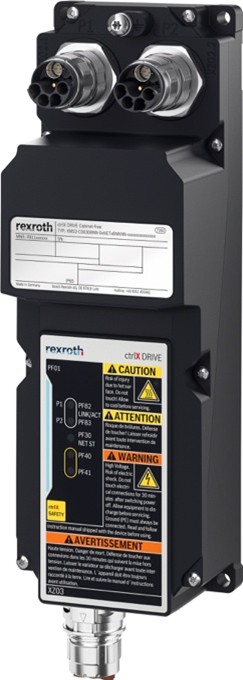 Among the most recent innovations in control technology are cabinet-free drives, like Bosch Rexroth’s ctrlX DRIVE, which help reduce hardware footprint within a manufacturing facility.
French manufacturer BFR Systems has developed an innovative robotic unscrambling unit that picks up tipped bottles or vials — regardless of type or shape — and deposits them upright on a conveyor that feeds a filling machine.
The versatile solution integrates the automation with Bosch Rexroth motion control on delta robotics. “We provided the motors, the servo drives, and the control system for the complete implementation of the application,” says Nathanael Briand, an applications engineer for Bosch Rexroth.
Managing the automation and the robotic functions in one control system simplifies the architecture of the machine, notes Olivier Lecorre, head of automation services at BFR Systems. “The Bosch Rexroth control system is what allowed us to obtain the best trajectories. It’s a key element of this machine,” he says. “We need optimized and fluid movements, and they need to be as smooth as possible. This is what will prevent bottle or vial losses.”
Making Motion Control Easier
As systems grow more complex, ease of use becomes essential.
“Companies are looking to make things easier to hook up,” Stellmacher says. They’re looking for full systems that they can plug and play easily, he adds.
Traditional motion setups involved selecting and assembling parts piecemeal — bearings, shafting, belts, etc. That’s time-consuming and error prone. Although this practice might have looked less expensive, that wasn’t always the case once figuring total cost of ownership — including the labor and know-how needed to put everything together.
Today’s approach is to offer pre-integrated solutions. For instance, PBC Linear’s Simplicity line includes maintenance-free, self-lubricating linear bearings.
“We’re seeing more people come to us over a ball bearing system that requires grease, which requires constant maintenance,” Stellmacher says. “In a large factory, there’s a maintenance guy going around and greasing a bunch of ball bearings — that’s time, that’s money.”
Motion Control in Agriculture
For agriculture companies — focused on uptime and durability in harsh environments — self-lubricating motion systems can lower the total cost of ownership, improve reliability, and require less maintenance.
FarmWise, an innovative agricultural technology company, combined a self-lubricating linear motion system from PBC Linear with computer vision and artificial intelligence to optimize weed control management on vegetable farms in California. FarmWise’s Vulcan Automated Weeding System accurately detects and differentiates crops from weeds, enabling precise weed removal without damaging crops. This not only minimizes the need for expensive manual labor but also provides a more sustainable weed control method than commonly used herbicides.
.jpg "PBC Linear slides on the Vulcan intra-row weeding implement system")
PBC Linear slides on the Vulcan intra-row weeding implement system provide the precision and robustness needed to automate the weeding process while minimizing the risk of crop damage.
A technology eager to do away with harmful chemicals in farming operations certainly doesn’t want the grease that can come with other motion systems, Stellmacher notes. But the maintenance-free system was also vital, he adds.
A key challenge that FarmWise faced as it developed the Vulcan system was the need to adapt to the wide variety of crops, bed spacings, row spacings, and soil morphologies found on vegetable farms. In addition to advancements in deep learning and precision control software, Vulcan features a perception module combined with an actuator to perform consistent intra- and inter-row weeding.
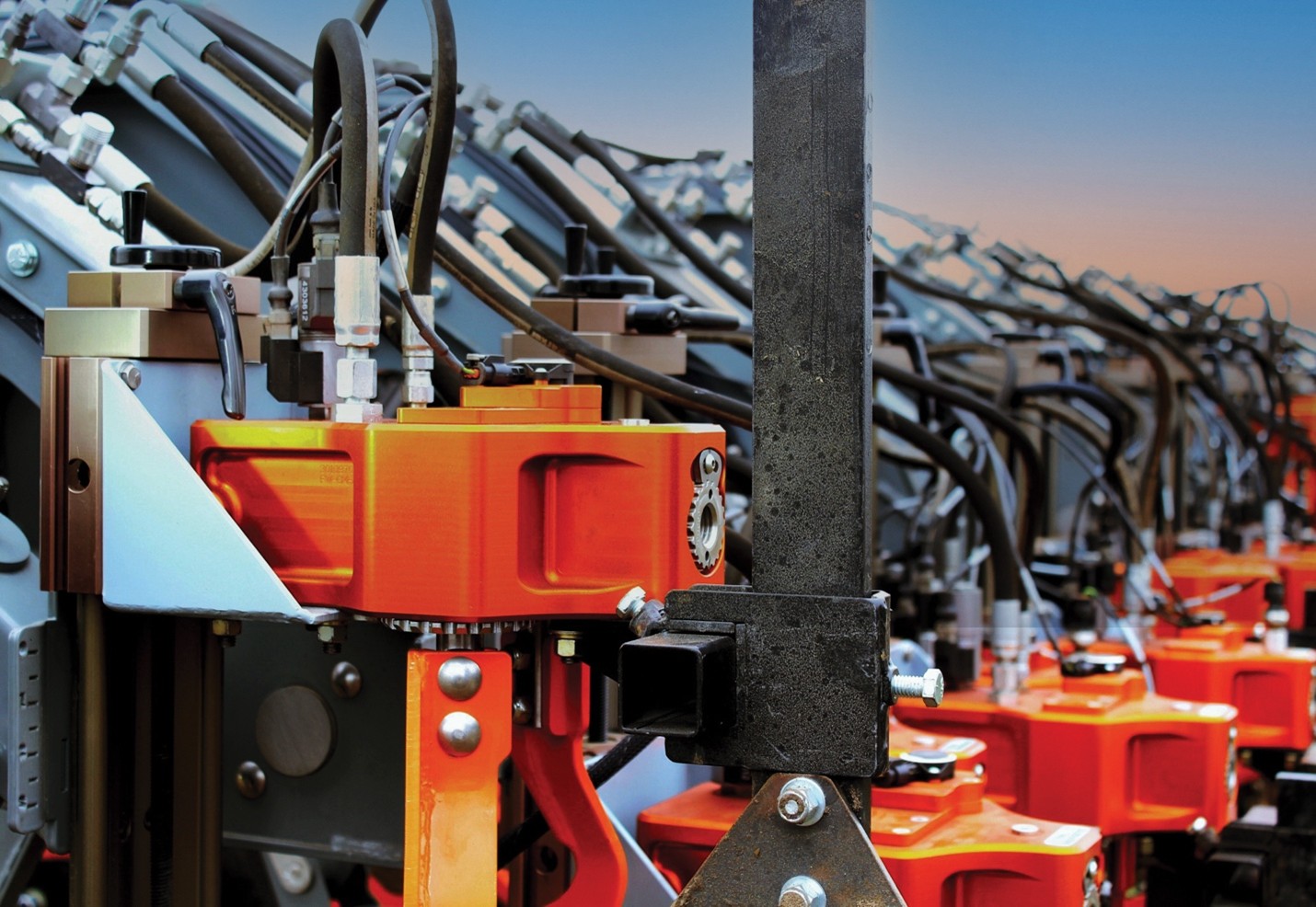
PBC Linear slides are a key component of FarmWise’s Vulcan Automated Weeding System. The slides provide precise height adjustment for the weeding tool, ensuring that the tool is always at the correct level to remove weeds without damaging crops.
The weeder module has two translation axes, including a hydraulic Z-axis actuator, allowing it to move up to a dozen or so inches vertically. To achieve the required flexibility and reach in the Z axis, FarmWise specified a self-lubricating low-profile Uni-Guide linear slide with a custom-positioned hand brake from PBC Linear. The Vulcan system uses up to 18 self-lubricating slides, located at the back of the implement, each offering a few inches of vertical travel to accommodate varying soil types and terrains.
Vision, AI, and Data-Driven Insights
Next-gen motion control is no longer just about motion — it’s about intelligence.
“Some other advancements in motion control systems include vision-guided motion systems that integrate AI and 3D vision that allow robots to adapt to unstructured environments and advance flexibility in a system,” Wagg says. These technologies enable smarter automation that can learn, adapt, and make complex decisions.
“The addition of IoT devices allows motion controllers to collect and analyze data from the system that incorporates predictive maintenance, performance optimization, and remote monitoring,” Wagg says.
In the age of Industry 4.0, data collection and integration with enterprise systems is non-negotiable. Bosch Rexroth’s ctrlX OS and ctrlX CORE enable this by providing real-time analytics and network integration, allowing manufacturers to make smarter decisions faster.
AI is taking motion control systems even further, enabling greater precision, efficiency, and adaptability in automation.
There’s been a lot of buzz over the past few years about large language models like ChatGPT, moving more recently into excitement about agentic AI. The next buzz, notes Rohit Khanna, chairman of the board for 3D Infotech, is about physical AI — robotic systems enhanced by motion control and machine learning.
“We are definitely seeing a greater application of AI into the physical world,” agrees Kristi Martindale, chief commercial officer for Palladyne AI. “It’s something that historically has been a challenge when trying to apply traditional AI to the physical world. Typically, when someone is using large language models, there’s not enough information out in the wild to program the robots.”
Sarcos Robotics, now Palladyne AI, pivoted in 2023 from hardware to AI-powered autonomy software. Martindale says the company is leveraging 40 years of robotic expertise to push physical AI into mainstream manufacturing applications.
Integrating AI into robotic systems is not without its challenges, however. To hear more of Khanna’s and Martindale’s perspectives about the latest innovations, practical applications, and industry insights shaping the intersection of motion control and AI, watch A3’s webinar, AI-Enhanced Motion Control: Innovations Driving Automation Forward, available on demand.