 Advanced AI, vision systems, motion control, and other components are enabling more capable robotics systems that combine manipulation with movement and intelligence. All this technology gives robots the ability to accomplish more tasks than ever as mobile manipulators.
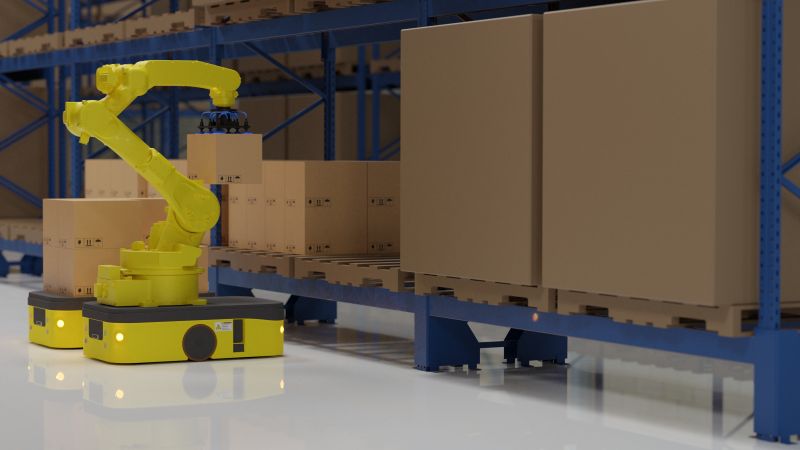
Mobile manipulators combine automated mobile robots with robot manipulators and AI for an intelligent mobile solution that can solve complex tasks in a variety of environments. AI is the element that elevates a mobile manipulator from a remote-controlled arm on wheels to a valued worker that can move and act with purpose.
“It’s an exciting period for AI-powered robotics, as AMRs dominate current deployments, while mobile manipulators are a rapidly expanding category,” says Erik Nieves, CEO, Plus One Robotics.
Moving Market Growth
Within the robotics market, mobile manipulation is among the segments experiencing the most growth, driven largely by the continued labor shortage and increased capabilities of mobile manipulators.
“Mobile manipulators are one of, if not the, fastest growing verticals of the mobile robot market,” says Jeremy Rockman, head of product development, robots, Mobile Industrial Robots (MiR). “Labor shortages as well as the advancements in AI have enabled this type of robot to really expand the amount of applications it can be successful in.”
When discussing mobile manipulation, the impact of humanoid robots cannot be overstated. This emerging segment is producing excitement from the industry and end users alike. Morgan Stanley estimates the market for humanoids alone will reach $5 trillion with 1 billion units in use by 2050.
The firm predicts adoption of humanoid technology will accelerate in the late 2030s, with 90% of the robots used in industrial and commercial applications. It goes so far to say that the market for humanoids could dwarf the auto industry in the coming decades.
“Although many manufacturers have widely adopted traditional automation, much of the assembly process remains manual, which still requires humans to perform,” says Barry Phillips, chief commercial officer, Apptronik. “Our customers face significant labor challenges in the form of shortages and high turnover and are exploring humanoid robots and mobile manipulators to help fill the gap.”
What Is a Mobile Manipulator?
Users are taking to this emerging robotic segment, but what exactly is it? Put simply: Mobile manipulators are robot systems comprised of a robotic arm (the manipulator) mounted on a mobile platform, whether wheels or bipedal. They are often, but not always, enabled with AI for advanced manipulation tasks.
“Traditional robots were either arms fixed in place or AMRs running around the facility but with no hands at all,” Nieves explains. “The combining of the two is a recent development in the industry. Boston Dynamics’ Stretch robot is a good example of a mobile manipulator performing a real task.”
Humanoids are an even newer embodiment of the mobile manipulator. In this case, the upper torso serves as a manipulator with more than one arm and bimanual manipulation. Mobility is enabled by either legs or wheels, depending on the environment and application needs.
“In warehouses and factories where floors are generally flat and longer-haul transport is required, the wheeled Apollo mobile manipulator can make more sense,” Phillips explains. “Facilities where customers need the most versatility, ability to climb steps, and for the robot to fit and work in tight, human-accessible spaces, the legged Apollo system is a great fit.”
Overcoming Challenging Component Integration
It seems simple. Put a robot arm on a mobile base, and you’re ready for mobile manipulation. In practice, mobile robotic manipulation is difficult to perfect because it combines so many technologies to autonomously perform complex tasks.
“By combining sensors, motion control, physical AI, and autonomous navigation, these robots can tackle a much wider variety of tasks and adapt to dynamic environments. This synergy enables mobile manipulators to reduce the need for human involvement in repetitive, hazardous, or labor-intensive jobs, making automation feasible in sectors facing labor shortages or requiring flexibility — such as logistics, manufacturing, and healthcare,” Rockman explains. “Additionally, the adaptability gained through these technologies allows robots to handle delicate or variable items and quickly adjust to new workflows without extensive reprogramming.”
Harmoniously combining these technologies is a challenge for all robotics. However, mobile manipulators add another layer to this complexity by integrating often disparate components, such as a robot arm and the mobile base to which it’s connected.
“Because traditional robot arms and AMRs grew up as separate industries, the technical integration between the two has been a challenge,” he explains. “Most mobile manipulators require that two different companies with two different tech stacks collaborate to create this new capability. Controls and software integration is where most of the hurdles need to be addressed.”
Although difficult to develop in their own right, humanoids benefit from integration by design.
“A humanoid is essentially a fully vertically integrated device. The vendor builds the whole stack from the bottom up: the actuators, the controls, and the software,” Nieves adds.
AI Adds Additional Challenges
Autonomous operation and advanced intelligence are essential features of complex mobile manipulator robotics. Mobile manipulators have the ability to operate without human intervention to complete tasks, which requires some level of AI.
However, this intelligence brings with it its own trials.
“In the era of AI-powered robotics, one challenge is the scarcity of data required for the models to learn to perform manipulation autonomously,” Phillips says.
Apptronik is working to solve this problem with Google DeepMind. Together, the companies hope to accelerate robot learning with an AI model that provides robots with semantic and spatial understanding of objects and the ability to autonomously perform fine-grained manipulations, he adds.
Uniquely Designed for Dexterity
As robots find a place in an increasing number of applications, dexterity becomes even more important, regardless of the type of robot. Mobile manipulators require more precise dexterity to complete complex tasks autonomously, especially for humanoids or two-armed units. This capability complicates design but is essential for tasks like picking up fragile objects such as fruit or electronics, Rockman explains.
The variety of objects that can be picked increases with dexterity levels as well, Phillips says.
“High dexterity enables a wider variety of items and objects the robot can pick — from solid items like bottles and packaged goods to deformable objects like apparel and fabrics,” he says. “Fine dexterity allows the robot to take on even more precise tasks, such as fixture placement in manufacturing, where the manipulated objects need to be slotted very specifically and placed precisely before moving to the next step.”
Another example of where dexterity is essential is in the automotive space. Tasks such as material kitting in the production process, where raw components are picked and prepared for lineside delivery, require dexterous manipulation, Phillips adds.
Dexterity Design Difficulties
Effective dexterity is challenging to design and build. Among the main pain points is the need for tight feedback loops between sensing and force, according to Rockman.
Dexterity between the arms of a two-armed robot is another difficulty, Nieves highlights. The number of axes in each arm, the degree of cooperation between those arms, and the end-effectors or grippers on those arms can all impact how well a robot handles objects, he explains.
“Achieving adequate dexterity presents several challenges,” Nieves says. “While robots excel at mobility, they often struggle with the precision required for manipulation tasks. This limitation is why fixed manipulation stations remain more common, as they’re purpose-built and highly efficient for handling objects. Projects like Amazon’s Vulcan are exploring ways to enhance robotic manipulation, aiming to bridge the gap between mobile flexibility and the fine control needed for complex picking and handling tasks.”
Introducing Mobile Manipulators to the Team
Component challenges for unit development are just the first hurdle to overcome. Next is installation. Afterward, as is the case with all robotics, mobile manipulators face the biggest challenge of all — employee perception.
Many robotic installations have fallen short of their potential because of the lack of employee buy-in. This holds true for mobile manipulators as well. Nieves calls it the “cultural integration” challenge. Engineers and technicians might be able to get all the technologies to work in perfect harmony, but it’s all for naught if those who work with it don’t want to see it succeed.
“A larger hurdle is the perception of the workforce. Some employees see robots as a threat or a hassle, while others view them as helpful tools. Addressing this requires training, education, and clear communication about how automation supports, rather than replaces, human work,” he explains. “These challenges are addressed through closer collaboration between vendors and operators, simplified interfaces, workforce upskilling, and careful validation of initial deployments. As in manufacturing decades ago, the path forward lies in proving that robots of any type — including these new mobile manipulators — reliably add value.”
Where to Put One to Use
Market growth can be partially attributed to the increasing number of applications mobile manipulators can accomplish. From electronics manufacturing to logistics, construction, and healthcare, the use cases for mobile manipulation are rapidly multiplying.
“There is no lack of opportunity for mobile manipulation,” Nieves says. “These new robots can be found in new construction painting drywall or in solar fields mounting panels.”
Supply chain and warehousing environments are among the most successful implementations. E-commerce fulfillment centers, parcel distribution hubs, and direct-to-consumer operations are among the large- and small-scale operations experiencing the benefits of mobile manipulation, Nieves explains.
Replenishment tasks are also excellent opportunities for these robots. Small component replenishment in electronics manufacturing and machine tending with one robot managing more than one machine at a time are popular successful applications, Rockman adds.
When it comes to consumer-facing applications, mobile manipulators are gaining traction in healthcare.
“Healthcare is an emerging market with many needs for this type of solution. Diligent Robotics has deployed dozens of mobile manipulators in hospitals, and Cobot’s new product is steadily increasing its footprint as well,” Nieves says.
Humanoid Applications
When it comes to humanoids, the manufacturing, logistics, and retail distribution industries are leading the demand, according to Phillips.
The logistics industry has been innovative with humanoid applications, Phillips reports. Some facilities are implementing a combination of legged humanoids and mobile manipulators to handle the diverse range of requirements within their operations.
“Humanoids are a good fit for handling a combination of dexterous and gross manipulation, such as pick, pack, and ship operations, where both reaches and cases are part of the material handling,” he explains. “Mobile manipulators excel at pick and transport of items across longer stretches of warehouse, as well as so-called water spider tasks — navigating to a single SKU, picking, then delivering that item to shipping for a hot order, for example.”
Finding the Right Solution
Although the opportunities seem endless, there is no one-size-fits-all solution for mobile manipulation. Like most robotic applications, mobile manipulation robots can be comprised of myriad options to fit their exact environment and application.
“You have to start with what problem you are trying to solve and go from there. What environment is the robot going to operate in, and what type of obstacles or variability is it going to encounter?” Rockman explains. “Your manipulator needs to be designed for the payload it is anticipated to handle, and the method of being mobile is dependent on its environment.”
What Does the Future Hold?
With labor trends showing no signs of changing, experts point to continued growth for this robot segment, as more applications become viable and OEMs continue to improve their technology.
“The future of mobile manipulators suggests steady expansion, although fixed manipulation robots will likely remain dominant due to their lower costs, reliability, and performance. Market growth will be driven less by technology alone and more by aligning robots with the right workflows,” Nieves explains. “Continued efforts to simplify deployment and use, along with improving cultural acceptance, will be key.”
For humanoids, expanded applications with increased variability could be on the horizon, according to Phillips. “As we advance the AI model and safety protocols, we see a future where mobile manipulators and humanoids are adopted in areas such as retail, delivery, as well as assisted care, hospitals, and even elder care.”
Mobile manipulators have been a longtime hope for the robotics market. It’s clear this emerging robot segment is finally carving out its place, with no signs of slowing.