Waste reduction in manufacturing isn’t just good practice — it’s a strategic imperative. For manufacturers navigating today’s competitive, resource-constrained economy, minimizing waste translates directly into higher profit margins and long-term sustainability.
From a profit perspective, waste is a hidden cost lurking in every corner of the production line. Whether it’s excess material scrap, machine downtime, energy inefficiencies, or overproduction, every wasted input drains resources and erodes margins. Streamlining operations to reduce this waste leads to lower operational costs, more predictable production, and improved throughput — all of which drive profitability.
From an environmental standpoint, reducing waste is essential to shrinking a manufacturer’s carbon footprint. The global shift toward greener practices — driven in large part by increasing regulatory and consumer pressures — makes sustainability a business necessity. Efficient use of materials, energy, and water not only reduces environmental impact but also positions manufacturers as responsible partners in a circular economy.
Ultimately, waste reduction supports a dual goal: doing more with less, for the good of both the business and the planet. Whether the motivation is compliance, cost savings, brand reputation, or ethical responsibility, manufacturers who prioritize waste reduction are better equipped to thrive in a changing world.
Automation and digital technologies play a wide range of vital roles in reducing waste in manufacturing. Automated systems can perform tasks with micron-level precision and repeat them continuously without deviation, reducing material waste from errors like overcutting, misalignment, or defective assembly. Real-time monitoring and data analytics can optimize processes on the fly. Robotic systems and smart controllers can be programmed to use just the right amount of raw materials, energy, and water — minimizing overuse and waste. Vision-guided robotics and AI-powered motion control allow systems to adjust to variability in parts and orientations, reducing the need for overproduction and lowering the chance of discarding non-standard parts. The list goes on and on.
Robotics: Sustainable at Its Core
“Everything we do in robotics is about sustainability,” contends Nicolas Durand, vice president and general manager at ABB Robotics Canada. “Sustainability, if it’s the opposite of waste — this is how every robotic project is born. We’re looking at a project where we need to improve efficiency, we need to improve throughput, we need to improve safety — all elements of good sustainability.”
Detailing how robots contribute to this value proposition during an A3 webinar, Leveraging Advanced Manufacturing Technologies to Drive Sustainability, Durand pointed first to sheer longevity. Some of ABB’s robots have been in use for more than 35 years, he notes. “I actually had a customer call me from the Ottawa region, and he had a robot from 1974 that he was pulling out of production, and he asked me if I wanted to buy it back to put it in our museum,” he says. “That gives you a sense of just how dependable these robots are.”
Beyond that, almost all of ABB’s robots used in the automotive industry get remanufactured to extend their lifetime. “That’s a pretty impressive stat, especially if you think about what that means from a sustainability standpoint,” Durand adds. “Building a robot vs. remanufacturing a robot is going to reduce your carbon footprint by about 75%. So, every time that we get to remanufacture a robot and send a new robot out with a new lease on life, we’re actually improving the carbon footprint.”
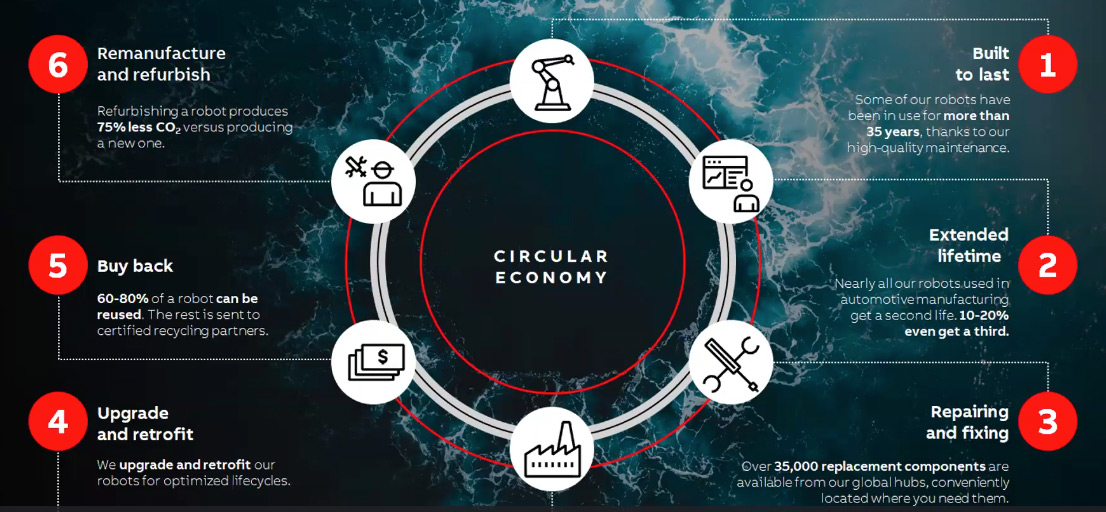
Up to 20% of those robots even get a third life, Durand notes. “After they’ve been retooled and remanufactured, once they come back 10, 15 years later, we actually retool them and send them back out for another 10 years.”
This refurbishment/circularity aspect is a topic we’ll discuss in more detail in our third installment in this Sustainable Manufacturing Series, later this year.
Achieving Robotic Energy
When it comes to reducing the carbon footprint of a typical robot, 70-75% of that comes from the use phase, Durand notes. “How we can drive the efficiency of the robots is a great lever that we can action,” he says.
Far from it costing money to initiate sustainability efforts, the cost reduction in energy creates a virtuous cycle in which it makes economic sense for companies to invest in energy reduction. “At the end of the day, these things are self-funding all the efforts that we are doing,” Durand says. “Most of our customers today have some sort of an energy efficiency strategy.”
With hundreds of thousands of industrial robots operating in North America today, reducing energy efficiency for each of those by 10% could bring significant energy savings for the world of manufacturing. Robots are becoming the next low-hanging fruit for energy reduction, Durand says. “Everybody looked at HVAC, everybody looked at lighting, everybody looked at whatever. Now we’re getting to the point where robots are starting to be in the limelight.”
It’s no surprise, he adds, that ABB is spending a lot of time — through software design and energy efficiency as a whole — to understand how to address that part of the robotic lifecycle.
Optimizing a robot’s path is just one part of that equation. That alone could not only improve the productivity of the robot but also provide a more energy-efficient path. “With the automatic path planning that ABB has developed, we’re able to look at an existing robot that is running out there and look at what kind of improvements we could generate if we were to improve those paths,” Durand says.
To learn more about how manufacturers are effectively managing robot energy consumption, read the first article in our Sustainable Manufacturing Series.
Hygienic Design Alleviates Ruined Product, Consumables
When it comes to reducing waste on the manufacturing floor, Kollmorgen plays a big part with its motors’ washdown capabilities in food applications, particularly in the handling of raw proteins or grains.
“The ability to do washdown and cleanup quickly and effectively in a very small timeframe is a big part of the efficiencies — reducing downtime and improving uptime and ROI and things of that nature,” says Chris Cooper, senior director, product management at Kollmorgen.
Such washdown capabilities can play a significant role in reducing waste in manufacturing by improving hygiene, durability, and operational efficiency — especially in sectors like food and beverage, pharmaceuticals, and packaging.
The ability to withstand high-pressure cleaning and harsh sanitizing agents helps to maintain sterile conditions, preventing cross-contamination or product spoilage that would otherwise lead to entire batches being scrapped.
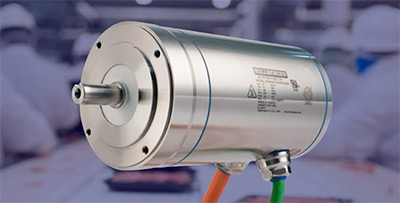 Kollmorgen’s AKMH series is made up of hygienic, stainless-steel motors designed for food contact and washdown zones. “That particular solution is one of the most solid, robust solutions for high-pressure caustic washdown, especially areas where you have to have some kind of sanitizing agent, not just high-pressure water,” Cooper says.
The AKMA series is also made up of washdown-capable motors but in anodized housing, so it can handle minimal caustics and soaps. “Ours is a true anodized aluminum, and it is a rounded housed motor, so you don’t get places for things to rest like you would on a square body motor.”
Using motors that do not have the right kind of hygienic features can cause significant production issues in washdown environments. This was the case for a Kollmorgen customer processing and packaging sausage in Wisconsin.
“They were having lots of issues with water ingress. As you can imagine, when they go in and they spray those motors down, you get water ingress around the shaft or you get water ingress around the feedback housing, and it basically corrodes the motor electronics or bearings,” Cooper says. “Of course, when you have a fault, the machine jams, and you have a lot of issues with product loss. As the motor loses reference, it starts to jam, and you either tear up a knife or tear up manufactured product or consumable product.”
The motors being used were struggling with the high-pressure, high-caustic washdown of the equipment, causing the system to jam repeatedly. Kollmorgen replaced the competitor’s motors with its AKMH servo motors — including working directly with the competitor’s drives to incorporate the right feedback protocol — and eliminated the problem.
Reducing Hardware Waste
Kollmorgen also provides servo drives that support multiple Ethernet fieldbus protocols, including EtherCAT, CANopen, PROFINET, EtherNet/IP, SERCOS, and SynqNet. This plays a role in reducing the need for excess inventory, minimizing the spares required.
By consolidating multiple communication options into one drive platform, manufacturers can reduce hardware variation, integration time, engineering complexity, and downtime during commissioning or reconfiguration.
A Holistic Viewpoint
Siemens uses artificial intelligence (AI) and other digital technologies to get a broader look at the big picture of energy and material savings. “Our approach to waste reduction and automation combines AI-powered operator assistance, real-time monitoring, and predictive analytics to address waste reduction from a holistic standpoint — using Copilot assistants for optimal decision-making, digital twin simulations for process automation, and integrated data analytics to connect the shop floor operations with enterprise systems,” says Phillip Cannon, customer solution architect for Siemens.
Saving energy in manufacturing, for example, isn’t as straightforward as turning machines off for the weekend the same way you’d turn the lights off when you leave a room. If you turn that machine back on Monday morning and restart production without going through an appropriate warm-up period, you could just as well be creating foul product.
“Having sensors in place to be able to detect all of this allows us to effectively minimize waste,” Cannon says. “We’re maximizing overall productivity and minimizing waste.”
A Mind Is a Terrible Thing to Waste
Every production facility tries to be mindful of wasting time, energy, or materials. But Siemens likes to talk about a fourth kind of waste — knowledge waste.
Cannon points to the legions of retiring engineers who hold years of knowledge in their heads. Siemens partnered with a machine shop recently that was about to lose its senior machinist — and his decades of experience — to retirement.
The director of the company was concerned that he’d no longer be able to go to the machinist (Ron) and ask him questions to troubleshoot systems. Ron gave about a year’s notice, so during that time, the director set out to capture as much knowledge as he could from him.
“He didn’t have any idea he was going to partner with us at the time, but for a year, he collected all correspondence with Ron,” Cannon says. “By the time he ended up partnering with us, we put forth the idea of our Industrial Copilot options. He took that data and put it in and now has a Copilot that is trained to be AI-run. Now he feeds it questions to ask it things he would normally ask Ron, and he has said it’s remarkable — the way it answers him, it's as if Ron is still there.”
Cannon emphasizes how important it is to occasionally receive the answer, “I don’t know.” It points to the difference between public AI services and an industrial chatbot that has been trained on a specific pool of data.
“If I just hop on the Internet and ask any resource, it’s going to query the Internet and come back with something, and I have to worry about the validity of that information,” Cannon says. “When you have trained your bot to only pull from a certain data lake, you can get that response of ‘I don’t know.’ And that’s crucial when you’re looking at it from an industry standpoint.”
For many of Siemens’ customers, the Industrial Copilot provides a way to better train young employees who might not have a long-time employee to mentor them. They’ve been able to use the Copilot tool to capture knowledge and give guidance to newer employees, successfully achieving a reduction in training time as well as a reduction in operator errors, Cannon says.
Automation as a Catalyst for Sustainable Transformation
As manufacturers push toward a more sustainable future, automation continues to prove itself as a powerful enabler of waste reduction. A variety of technologies are not only optimizing performance; they’re extending equipment lifecycles, minimizing material loss, and preserving critical knowledge across generations.
By embracing automation with sustainability in mind, manufacturers can reduce costs and environmental impact while also building more resilient and future-ready operations. In our next installment of the Sustainable Manufacturing Series, we’ll explore how robot refurbishment is playing an increasingly vital role in the circular economy — giving automation assets a second, and even third, life on the factory floor.